Artwork
Sfânta Treime; Încoronarea Fecioarei
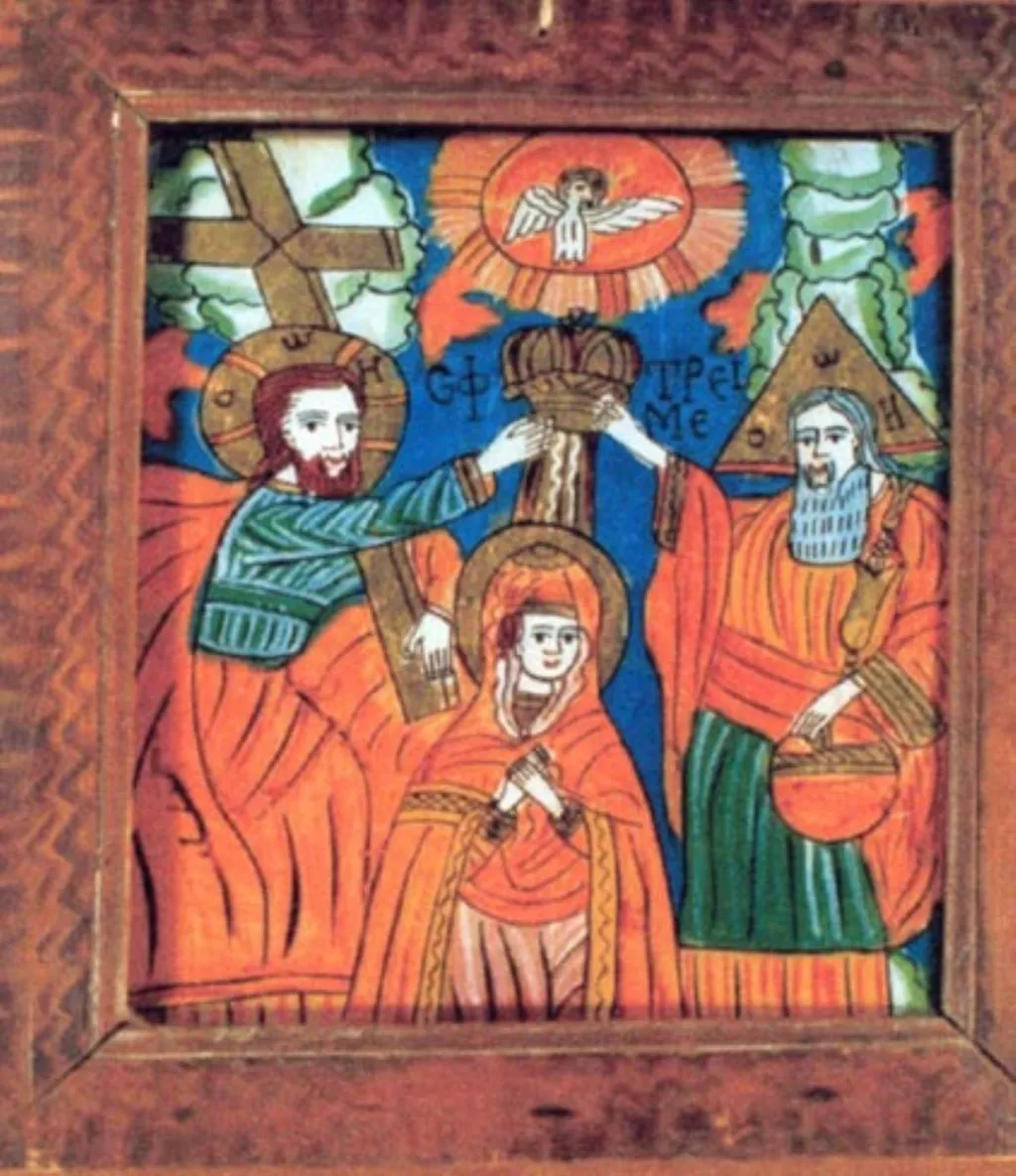
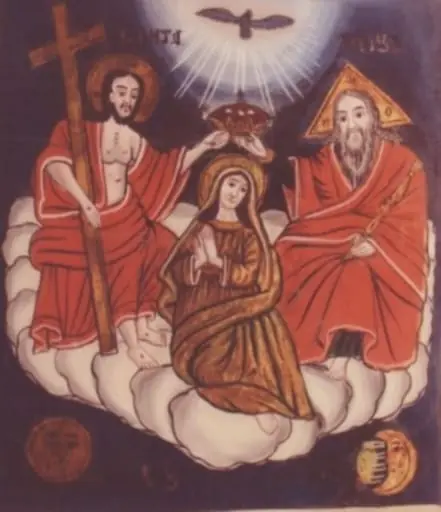
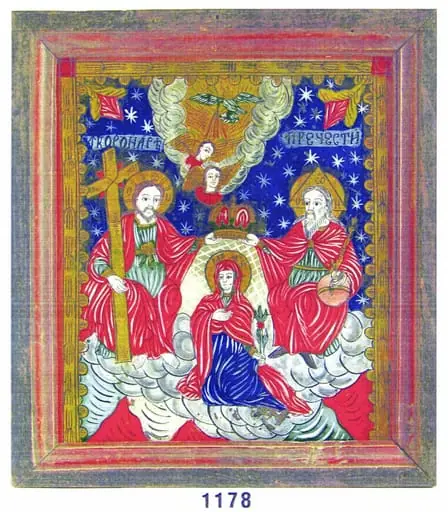
Sfânta Treime; Încoronarea Fecioarei is a drawing by Unknown. It dates from 1850 and is held in the collection of the "Dimitrie Gusti" National Village Museum. This painting depicts a religious scene titled Sfânta Treime, or Holy Trinity, rendered in flat, vivid colors with minimal depth.
About this work
Overview
This painting depicts a religious scene titled Sfânta Treime, or Holy Trinity, rendered in flat, vivid colors with minimal depth.
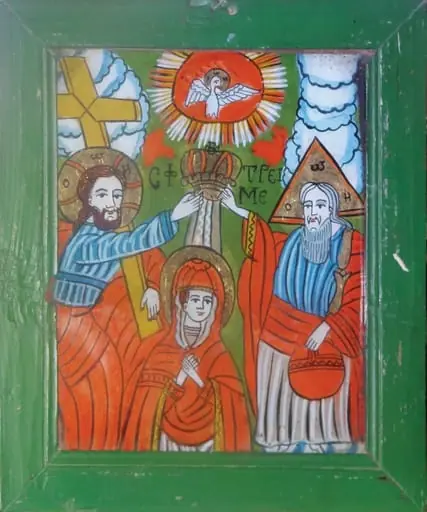
This painting depicts a religious scene titled Sfânta Treime, or Holy Trinity, rendered in flat, vivid colors with minimal depth. Three figures are arranged in a horizontal composition, each marked by halos to signify sanctity. Above them, a radiant circle encloses a bird-like form, commonly interpreted as the Holy Spirit. The presence of a crown being placed over the central figure suggests a moment of divine investiture, though the specific narrative remains implied rather than explicitly detailed.
Subject & Meaning
The three figures represent the Christian Trinity: the Father, the Son, and the Holy Spirit. The bearded figure on the left, crowned and holding a royal diadem, likely symbolizes God the Father bestowing honor upon Christ, the central figure in orange. The figure on the right, holding a spherical object, may represent the Holy Spirit or a symbolic orb of sovereignty. The bird above reinforces the spiritual presence, completing the theological triad in visual form.
Technique & Style
The painting employs a stylized, two-dimensional approach with bold, unmodulated colors and sharp outlines. Shading is absent; volume is suggested through color contrast and symbolic elements rather than naturalistic light. The figures are arranged symmetrically, emphasizing order and divine harmony. The use of halos and radiant circles follows Byzantine conventions, prioritizing spiritual symbolism over physical realism.
History & Provenance
The work originates from a Romanian Orthodox tradition, likely created in the 18th or early 19th century for liturgical use. Such icons were typically commissioned for churches or private chapels and followed established iconographic models. While the exact artist and location remain undocumented, its stylistic features align with regional ecclesiastical art from Moldavia or Wallachia, where traditional iconography persisted into the modern era.
Context
In Orthodox Christian practice, icons serve as windows to the divine, not merely decorative images. The depiction of the Trinity, though theologically complex, was rendered cautiously due to doctrinal sensitivity. This painting reflects a localized interpretation, blending Byzantine templates with folk aesthetics. Its flatness and symbolic clarity reflect a devotional purpose, intended for contemplation rather than narrative storytelling.
Legacy
This work contributes to a broader corpus of Eastern European religious art that preserved medieval iconographic forms well into the modern period. It stands as an example of how theological concepts were visually sustained in communities with limited access to Western artistic developments. Today, it is studied as a cultural artifact that reveals the persistence of spiritual symbolism in rural and ecclesiastical contexts.
Artist & collection
Museum
"Dimitrie Gusti" National Village Museum
Continue through works from the same source collection.
 Domestic Scene
 Giacomo and Cardinal Marco, investing Andrea, Abbot of San Zeno, with his Benefice
 The Nymph of Fontainebleau
 Portrait of a Woman
 Madonna and Child with Saints in the Enclosed Garden
 Venus and Minerva
 Family Group of Four on Sofa
 Wall painting from Room H of the Villa of P. Fannius Synistor at Boscoreale