Museum
"Dimitrie Gusti" National Village Museum
"Dimitrie Gusti" National Village Museum is a museum.
About "Dimitrie Gusti" National Village Museum
Overview
The Dimitrie Gusti National Village Museum is a prominent open-air ethnographic museum located in King Michael I Park (formerly Herăstrău Park) in Bucharest, Romania. Established in 1936, it serves as a living testament to traditional Romanian rural life, showcasing authentic peasant settlements, monuments, and artifacts from across the country. The museum spans over 30 hectares and currently houses 123 authentic settlements comprising 363 monuments and more than 50,000 artifacts. It represents a unique synthesis of sociology and museography, presenting a 'village' within the capital that reflects the diverse architectural and cultural heritage of Romania's various ethnographic regions, including Banat, Transylvania, Moldavia, Maramureș, Oltenia, Dobrogea, and Muntenia.
History & Founding
The museum was founded by the renowned sociologist and folklorist Dimitrie Gusti, who directed the Sociological School in Bucharest. Its creation was the culmination of over a decade of interdisciplinary monographic research campaigns conducted between 1925 and 1935 in villages such as Fundu Moldovei, Nereju, and Dragomirești. These campaigns, involving specialists from various fields, provided the theoretical and practical basis for the museum. The institution was officially inaugurated on May 10, 1936, in the presence of King Carol II, with financial support from the Royal Cultural Foundation 'Prince Charles'. Initially, the museum occupied 4.5 hectares and featured 33 authentic complexes. The project was a pioneering effort in Europe, becoming the fourth open-air museum on the continent after those in Stockholm, Oslo, and Cluj-Napoca.
Building & Architecture
The museum's layout and architectural reconstruction were executed under the supervision of set designer Victor Ion Popa and sociologist Henri H. Stahl, who applied the criteria of authenticity and respect for local building traditions. The structures were dismantled in their original locations and reassembled on the museum grounds by craftsmen brought from the villages of origin. The site is organized to reflect the topography and spatial organization of traditional Romanian villages, with buildings arranged to mimic their original settings. The architectural styles vary significantly by region, ranging from wooden churches with shingle roofs and swallow-tail joints to houses with thatched or tiled roofs, stone foundations, and specific regional decorative elements. The museum's design ensures that the monuments are presented in a context that respects their original functional and aesthetic integrity.
Collection Highlights & Notable Holdings
The museum's collection includes over 70 houses, 99 outbuildings, and churches, along with technical installations such as water and windmills and oil presses. A centerpiece of the collection is the wooden church from Dragomirești, Maramureș County, built in 1722. This church features a rectangular plan with a five-sided apse, spruce beam walls joined in 'swallow tail' fashion, and a roof with shaped shingles. Its interior is divided into the altar, nave, pronaos, and porch, with walls painted by local artists depicting scenes of heaven, hell, and daily life. Other notable holdings include traditional peasant houses from the 17th to the 20th century, representing the diverse architectural traditions of regions like Suceava, Neamț, Maramureș, Timiș, and Alba. The collection also encompasses a wide array of interior objects, including furniture, ceramics, fabrics, and tools, all sourced from the original villages.
Significance & Legacy
The Dimitrie Gusti National Village Museum holds immense significance as a pioneering institution in the field of open-air museography and sociological research. It was the first museum in Romania to adopt a 'sociological museum' approach, aiming to display the reality of village life as it was lived, rather than just static artifacts. Initially, peasant families from the villages of origin lived in the museum houses to demonstrate traditional customs, although this practice led to some deterioration of the monuments. The museum survived a period of severe disruption between 1940 and 1948 when it was used to house refugees from Bessarabia and Bukovina, resulting in the loss of some inventory and the dismantling of certain monuments. Despite these challenges, it reopened in 1948 under the directorship of Gheorghe Focșa and has since grown into one of the main tourist attractions in Bucharest, preserving and promoting Romania's rural heritage for future generations.
What to see at "Dimitrie Gusti" National Village Museum
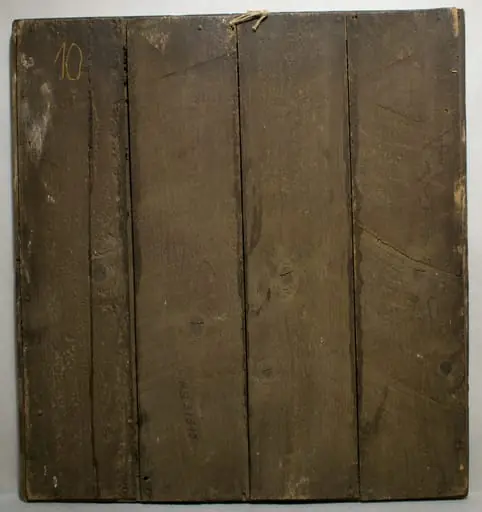
Start with Zugrăvița a combinat cu inocență două teme iconografice (cea a Bunei Vestiri cu cea a Botezului), fenomen frecvent în icoanele Anei Deji.În prim plan, în picioare, un sfânt cu o ramură verde în mâna dreaptă înălțată binecuvintează un înger. Sfântul tânăr, cu părul lung, negru, barbă scută, mustăți. După poziție și trăsături ar putea fi asimilat Sf. Ioan din scena Botezului. Poartă un chiton roșu, asemănător blănii de cămilă și un himation verde.În jurul capului are o aureolă cu limbi de foc asemănător acelora din Pogorârea Sfântului Duh. Îngerul privește către sfânt, ținînd pe brațul stâng un ștergar cu vrâste verzi și roșii, iarăși asemănare cu scena Botezului. Îngerul are trăsături feminine, ochii mari, negri, aripi strânse, tunică roșie cu poale cafenii.Nu poate fi vorba de Botez deoarece lipsește Isus dintre cele două personaje iar decorul arhitectural din planul doi(o construcție cu mai multe caturi, cu intrări largi, cu portal semicircular, 4 ferestre la ultimul cat și acoperiș rotund de olane) nu se regăsește în scena Botezului. De sus coboară sfântul Duh, sub formă de porumbel roșu cu aripi cafenii, pe un fond verde într-un oval de nori alburii marcați cu linii roșii. În partea de jos,relief ușor vălurit, realizat din benzi late cu margini ondulate de culoare verde, roșie și cafenie.Restul câmpului- albastru ultramarin, decorat cu steluțe albe și roșii. Pe trei laturi este pictat un chenar din semicercuri suprapuse, primul cu roșu alternînd cu verde, al doilea ocru. Icoana ar putea fi asimilată Buneivestiri, dar în acest caz în locul sfântului ar trebui să fie un înger iar în locul îngerului Fecioara Maria. Rama este alcătuită din patru șipci drepte, îmbinate oblic la colțuri. Dosul este realizat din scândurele subțiri de brad, dispuse vertical și fixate în cuie. by Ana Deji.
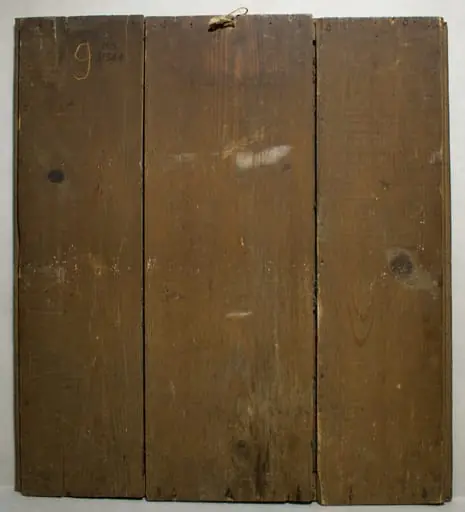 Zugrăvița a combinat cu inocență două teme iconografice (cea a Bunei Vestiri cu cea a Botezului), fenomen frecvent în icoanele Anei Deji.În prim plan, în picioare, un sfânt cu o ramură verde în mâna dreaptă înălțată binecuvintează un înger. Sfântul tânăr, cu părul lung, negru, barbă scută, mustăți. După poziție și trăsături ar putea fi asimilat Sf. Ioan din scena Botezului. Poartă un chiton roșu, asemănător blănii de cămilă și un himation verde.În jurul capului are o aureolă cu limbi de foc asemănător acelora din Pogorârea Sfântului Duh. Îngerul privește către sfânt, ținînd pe brațul stâng un ștergar cu vrâste verzi și roșii, iarăși asemănare cu scena Botezului. Îngerul are trăsături feminine, ochii mari, negri, aripi strânse, tunică roșie cu poale cafenii.Nu poate fi vorba de Botez deoarece lipsește Isus dintre cele două personaje iar decorul arhitectural din planul doi(o construcție cu mai multe caturi, cu intrări largi, cu portal semicircular, 4 ferestre la ultimul cat și acoperiș rotund de olane) nu se regăsește în scena Botezului. De sus coboară sfântul Duh, sub formă de porumbel roșu cu aripi cafenii, pe un fond verde într-un oval de nori alburii marcați cu linii roșii. În partea de jos,relief ușor vălurit, realizat din benzi late cu margini ondulate de culoare verde, roșie și cafenie.Restul câmpului- albastru ultramarin, decorat cu steluțe albe și roșii. Pe trei laturi este pictat un chenar din semicercuri suprapuse, primul cu roșu alternînd cu verde, al doilea ocru. Icoana ar putea fi asimilată Buneivestiri, dar în acest caz în locul sfântului ar trebui să fie un înger iar în locul îngerului Fecioara Maria. Rama este alcătuită din patru șipci drepte, îmbinate oblic la colțuri. Dosul este realizat din scândurele subțiri de brad, dispuse vertical și fixate în cuie.
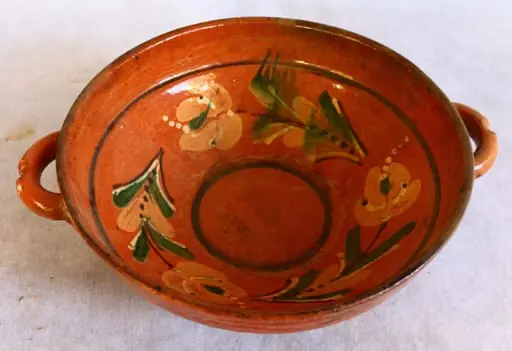 Vas de formă tronconică, cu două toarte laterale („cu urechi”) și una mică la spate. Decor geometric și floral stilizat: între două cercuri concentrice (unul pe fundul vasului, iar cel de-al doilea în partea superioară), trei flori cu frunze stilizate. Cromatică: roșu, negru, verde, alb, galben. Timp de lucru: circa două săptămâni.
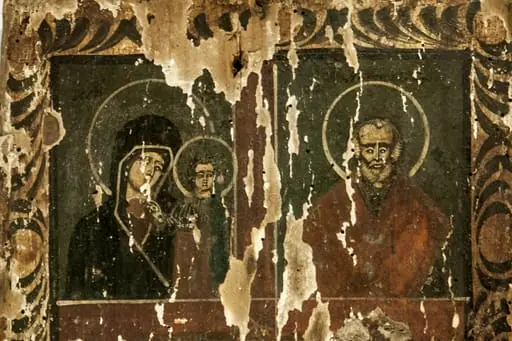 Un câmp central sub formă de cruce, împarte spațiul pictural în patru casete dreptunghiulare care conțin următoarele scene: Stânga sus Maica Domnului cu Pruncul tipul Kazanskaia. Este reprezentată până la piept, nu se văd mâinile, înveșmântată cu maforion negru cu galon alb. Are chipul îndurerat, privirea tristă, capul ușor înclinat spre Prunc. Iisus – Emanuel, binecuvintează cu dreapta, privirea îndreptată lateral, către sfântul Nicolae..Chiton brun deschis, himation verde. Dreapta sus - Sf. Nicolae în veșminte simple, capul descoperit, cărunt, cu barba rotundă și scurtă, privind la rândul său către pruncul Iisus. Înveșmântat cu sacos verde și omofor mare orange, care îi acoperă umerii. În casetele de jos sunt redați doi sfinți în vârstă, în picioare, în veșminte preoțești, întorși unul către altul, cu privirea îndreptată către scenele din registrul superior. Inscripția ce denominează primul dintre ei a fost ștearsă, cel de al doilea posibil sfântul Savatie?. Icoana are un vădit caracter popular, naiv. Spațiul cruciform pictat cu roșu, fondul scenelor verde închis, 2/3 din fondul scenelor de jos galben-orange. Nimburi trasate cu alb, inscripții caligrafice, litere cursive, cu negru. Compoziția este încadrată de un chenar cu decor vegetal, motive ample de factură populară, specifice spațiului slav.
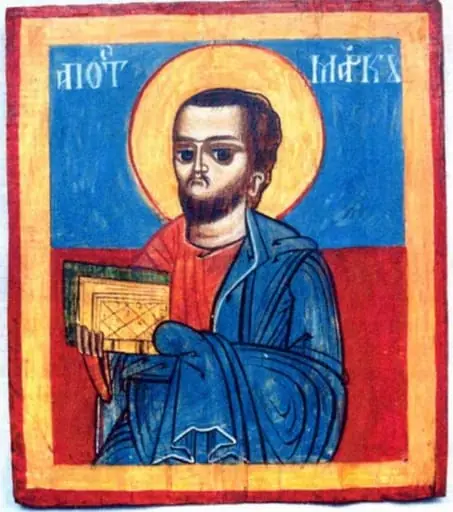 Apostolul Marcu
 Icoale c
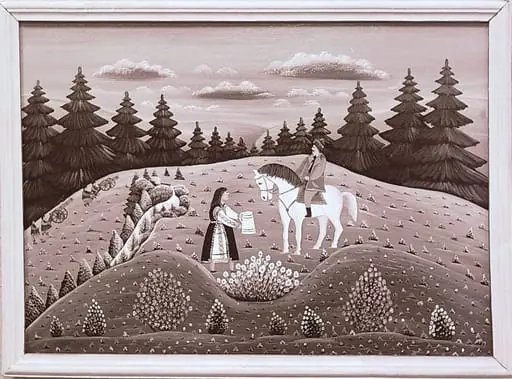 Sequences from the Village Museum, naive painting by Petru Mihuțe - Avram Iancu and Romania (1988)
What's on
- Icoana ortodoxă – lumina credinței6 Jun 2026 – 31 Jul 2026
- Expoziție aniversară ”90”10 May 2026 – 10 Sep 2026