Artwork
Sfinții Apostoli Petru și Pavel sunt reprezentați frontal, în picioare. În stânga compoziției e pictat sfântul Apostol Petru, ținând cheia raiului în mâna dreaptă, în timp ce mâna stângă o ține la piept. Sfântul Apostol Pavel, pictat în dreapta scenei, are în mâna stângă o sabie, simbolizând probabil "sabia duhului", iar mâna dreaptă o ține la piept. Între cei doi sfinți apare pictat un ornament cu rujel. Cromatica se compune din tonuri de roșu vermillon, verde, albastru, ocru galben, gri, maro și foiță aurie. Rama icoanei e profilată, băițuită, și e formată din îmbinarea a patru baghete de lemn.
Sfinții Apostoli Petru și Pavel sunt reprezentați frontal, în picioare. În stânga compoziției e pictat sfântul Apostol Petru, ținând cheia raiului în mâna dreaptă, în timp ce mâna stângă o ține la piept. Sfântul Apostol Pavel, pictat în dreapta scenei, are în mâna stângă o sabie, simbolizând probabil "sabia duhului", iar mâna dreaptă o ține la piept. Între cei doi sfinți apare pictat un ornament cu rujel. Cromatica se compune din tonuri de roșu vermillon, verde, albastru, ocru galben, gri, maro și foiță aurie. Rama icoanei e profilată, băițuită, și e formată din îmbinarea a patru baghete de lemn. is a drawing by Unknown. It dates from 1850 and is held in the collection of the Ethnographical Museum of Transylvania.
About this work
Overview
This image depicts Saints Peter and Paul standing frontally, each holding symbolic objects: Peter grasps the key to heaven in his right hand, while Paul holds a sword in his left, representing the "sword of the Spirit". Both saints display solemn expressions and are adorned with golden halos.
Subject & Meaning
The key and sword are central to the saints' identities: Peter's key signifies his role as the gatekeeper of heaven, while Paul's sword likely symbolizes his association with the spiritual weapon mentioned in Ephesians 6:17, highlighting their distinct yet complementary roles in Christian tradition.
Technique & Style
The artwork features a vibrant color palette including vermilion red, green, blue, yellow ochre, grey, brown, and gold leaf. The composition is set against a backdrop of red flowers before a blue sky, contrasting the seriousness of the saints' expressions with the liveliness of the surroundings.
History & Provenance
Limited information is provided about the artwork's historical context, creation date, or provenance.
Context
The depiction of Saints Peter and Paul together reflects their intertwined importance in early Christianity, often symbolizing the unity of the Church. The use of golden halos and symbolic objects grounds the image in traditional religious iconography.
Legacy
As a representation of two foundational Christian figures, this image contributes to the enduring visual legacy of Saints Peter and Paul in religious art, reinforcing their symbolic roles across various artistic interpretations.
Artist & collection
Museum
Ethnographical Museum of Transylvania
Continue through works from the same source collection.
 Domestic Scene
 Giacomo and Cardinal Marco, investing Andrea, Abbot of San Zeno, with his Benefice
 The Nymph of Fontainebleau
 Portrait of a Woman
 Madonna and Child with Saints in the Enclosed Garden
 Venus and Minerva
 Family Group of Four on Sofa
 Wall painting from Room H of the Villa of P. Fannius Synistor at Boscoreale
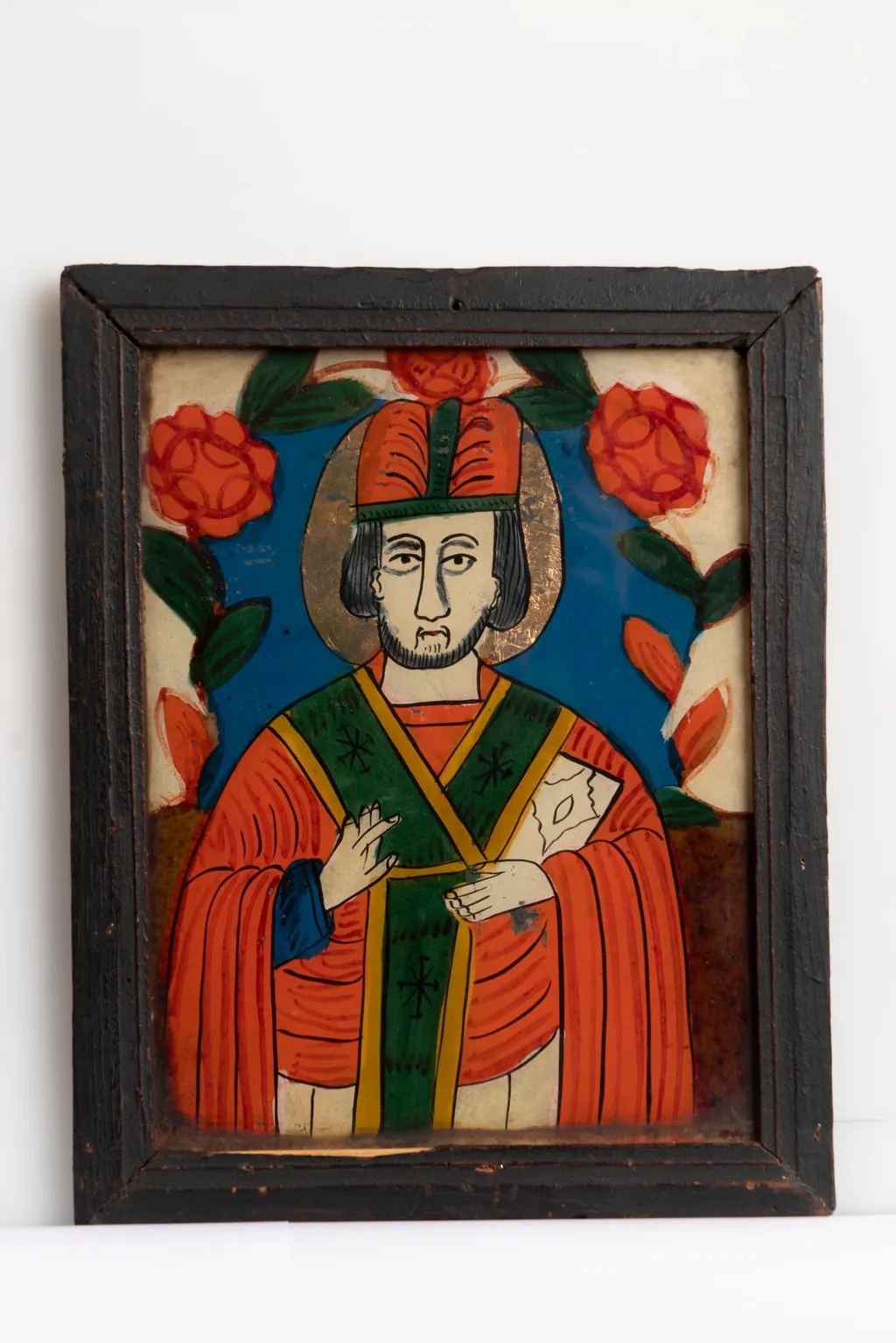
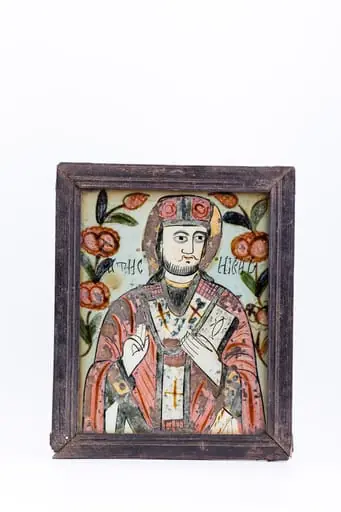 Sfântul Mare Ierarh Nicolae Făcătorul de minuni ține în mâna stângă Sfânta Evanghelie închisă și binecuvântează cu mâna dreaptă. Veșmintele arhierești liturgice ale sfântului ierarh sunt într-o alternanță cromatică de roșu vermillon, verde, ocru și gri-cenușiu antracit, cu broderie galbenă pe margini. Epitrahilul-patrafirul este gri-alburiu cu marginile verzi și trei cruci galben-aurii. Fondul icoanei este albastru bleu-ciel foarte senin. Întreaga compoziție este încadrată în spațiul cerului senin de o ghirlandă de ruje - elemente decorative fitomorfe, 6 trandafiri roșii, cu bobocei și frunze verzi. Icoana este de Nicula, Nordul Transilvaniei. Cromatica este armonioasă, specifică centrului de la Nicula: roșu vermillon, albastru bleu-ciel, galben-ocru-muștar, verde de China, alb, brun, negru, gri. Inscripția din româno-chirilică se traduce Sfântul Nicolae.
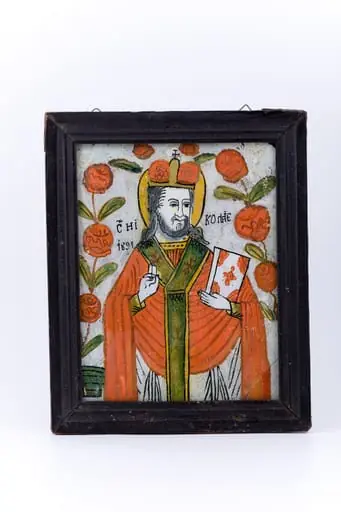 Sfântul Mare Ierarh Nicolae, făcător de minuni, îmbrăcat în veșminte liturgice, de ierarh, sacos alb cu dungi subțiri negre și epitrahil-patrafir verde văratic, cu marginea galbenă și cu trei cruci roșii-acajou. Ține în mâna stângă Sfânta Evanghelie închisă și cu mâna dreaptă Binecuvintează. Este unul dintre cei mai populari și iubiți sfinți, ocrotitor al caselor, familiilor și copiilor. Are barbă sură, părul lung și mithră arhierească bej-brună și aureolă. Fondul icoanei este cerul bleu-ciel senin alburiu, încadrat de un chenar decorativ fitomorf, format dintr-o ghirlandă de 8 ruje roșii-orange. Întreaga tematică iconografică este încadrată de un chenar decorativ geometrizant alb. Inscripția din româno-chirilică se traduce Sf Nicolae. Icoana este datată 1891. Cromatica este armonioasă: roșu-vermillon-orange, albastru bleu-ciel-alburiu, galben-chihlimbar, crem, bej, crem, bronziu, alb zinc, negru. Icoana este din Nordul Transilvaniei, Nicula.
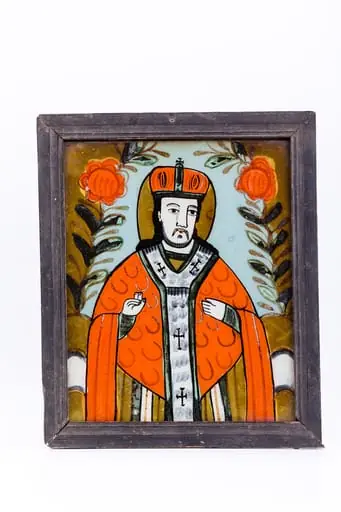 Sfântul Mare Ierarh Nicolae Făcătorul de minuni binecuvântează cu mâna dreaptă. Veșmintele arhierești liturgice ale sfântului ierarh sunt într-o alternanță cromatică de roșu vermillon, verde, ocru și gri-alburiu, cu elemente decorative geometrizante rotunde și ovoidale, fin sugerate și schițate. Epitrahilul-patrafirul este gri-alburiu cu marginile verzi și patru cruci negre. Fondul icoanei este albastru bleu-ciel foarte senin, în registrul superior și un câmp ocru-galben, alternativ dispus, în registrul inferior. Întreaga compoziție este încadrată în spațiul cerului senin de o ghirlandă de ruje - elemente decorative fitomorfe, doi trandafiri roșii, cu frunze verzi. Icoana este de Nicula, Nordul Transilvaniei. Cromatica este armonioasă, tomnatică, specifică centrului de la Nicula: roșu vermillon, albastru bleu-ciel, galben-ocru-muștar, verde de China, alb, brun, negru, gri.
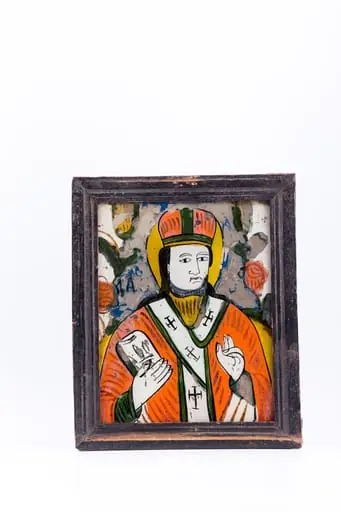 Sfântul Mare Ierarh Nicolae Făcătorul de minuni ține în mâna dreaptă Sfânta Evanghelie închisă și binecuvântează cu mâna stângă. Veșmintele arhierești liturgice ale sfântului ierarh sunt într-o alternanță cromatică de roșu vermillon, galben și verde. Epitrahilul-patrafirul este alb cu marginile verzi și patru cruci brune. Fondul icoanei este alb-albăstrui-gri în registrul superior și un câmp galben-solar în registrul inferior. Întreaga compoziție este încadrată în spațiul cerului senin de o ghirlandă de ruje - elemente decorative fitomorfe, patru trandafiri roșii-galbeni, cu frunze verzi. Inscripția din româno-chirilică se traduce Sf Nicolae. Icoana este de Nicula, Nordul Transilvaniei.
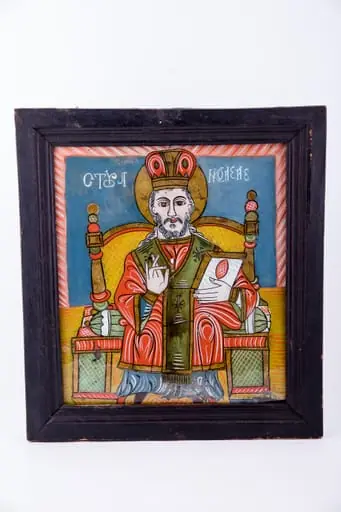 Sfântul Mare Ierarh Nicolae Făcătorul de minuni este redat central, șezând pe tron arhieresc, ținând în mâna stângă Sfânta Evanghelie și binecuvintează cu mâna dreaptă. Veșmintele arhierești liturgice ale sfântului ierarh sunt într-o alternanță cromatică de roșu vermillon-verde-albastru-alb. Epitrahilul, patrafirul este verde, cu patru cruci pe el, sacosul albastru. Poartă mithră și are aureolă. Sfântul ierarh este așezat pe un tron foarte frumos și bogat ornamentat decorativ geometric, în nuanțe de verde olive, gri și galben muștar și ocru. Pe tron este și o pernă rulou. Icoana are cu o combinație cromatică mai deosebită, cizelată: albastru, portocaliu-orange, galben citrone, brun roșcat, verde olive, alb, negru. Fondul este albastru și întreaga tematică iconografică este încadrată de un semi-chenar decorativ-geometrizant, din liniuțe delicate de alb și roșu, alternativ expuse, asemenea unui fir de mărțișor. Inscripția în româno-chirilică de pe albastrul cerului se traduce Sfântul Nicolae. În desenul trăsăturilor chipului și minuțiozitatea detaliilor se observă stilul pictorului zugrav Ioan Pop de Făgăraș, presupus autorul icoanei.
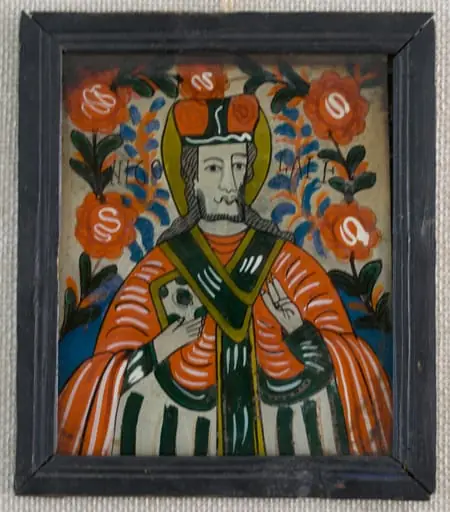 Icoana îl reprezintă pe Sf. Nicolae 3/4, în veșmânt de marea ierarh, cu mitră pe cap, sub o arcadă de flori. Desenul este naiv, stângaci, ușor încărcat cu detalii. Sfântul, cu mitră înaltă pe cap, bipartită, aureolă de culoare galbenă, binecuvintează cu stânga diformă, cu unghii ascuțite, zugravul a desenat tiparul fără să țină seama de faptul că urma să picteze "în oglindă".În dreapta ține Evanghelia. Părul și barba sunt cărunte, părul lung, privirea este îndreptată ușor lateral. Mustățile mici, husărești. Înveșmântat cu un sacos roșu cu falduri din linii albe, epitrahil alb cu cruci negre și blicuri albe, stihar alb cu vrâste verzi.Câmpul icoanei este alb, cu o ghirlandă de trandafiri care se unesc deasupra aureolei, dublate de doup ramuri cu frunze albastre pliate pe conturul umerilor și capului personajului. Treimea inferioară: fond albastru de Prusia Cromatica este dominată de roșu și alb, culorile intense. Rama de culoare neagră, alcătuită din patru stinghii îmbinate oblic la colțuri. Dosul este din lemn subțire de brad.
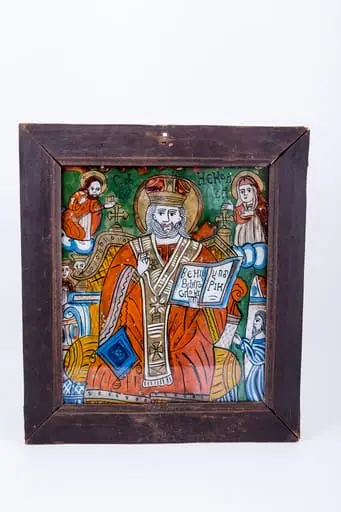 Sfântul Mare Ierarh Nicolae Făcătorul de minuni este redat central, fiind așezat pe un tron arhieresc, ținând în mâna stângă Sfânta Evanghelie deschisă și binecuvântează cu mâna dreaptă. Veșmintele arhierești liturgice ale sfântului ierarh sunt într-o alternanță cromatică de orange-albastru regal-brun-bronziu și alb și negru. Epitrahilul, patrafirul este brun-bronziu, cu patru cruci pe el, sacosul orange-roșu vermillon. Poartă mithră și are aureolă. În registrul superior îndepărtat sunt Dumnezeu-Tatăl și Maica Domnului, care binecuvântează și ocrotesc întreaga narațiune iconografică. Pe fondul verde, Mântuitorul și Maica Domnului au veșminte brune-crem și roșu-vermillon-orange. În registrul inferior sunt cele trei fete salvate de la sărăcie și păcat și tatăl fetelor mulțumind, în genunchi, pentru ajutorul primit. Inscripția din româno-chirilică se traduce Sf Nicolae ICXC MP Iisus Hristos Maica Domnului. Icoana are o cromatică puternic-vie, specifică Țării Oltului: roșu vermillon-orange, verde spanac-avocado, albastru regal, brun, gri,bronziu, alb, negru.