Artwork
Sham Singh Atariwala
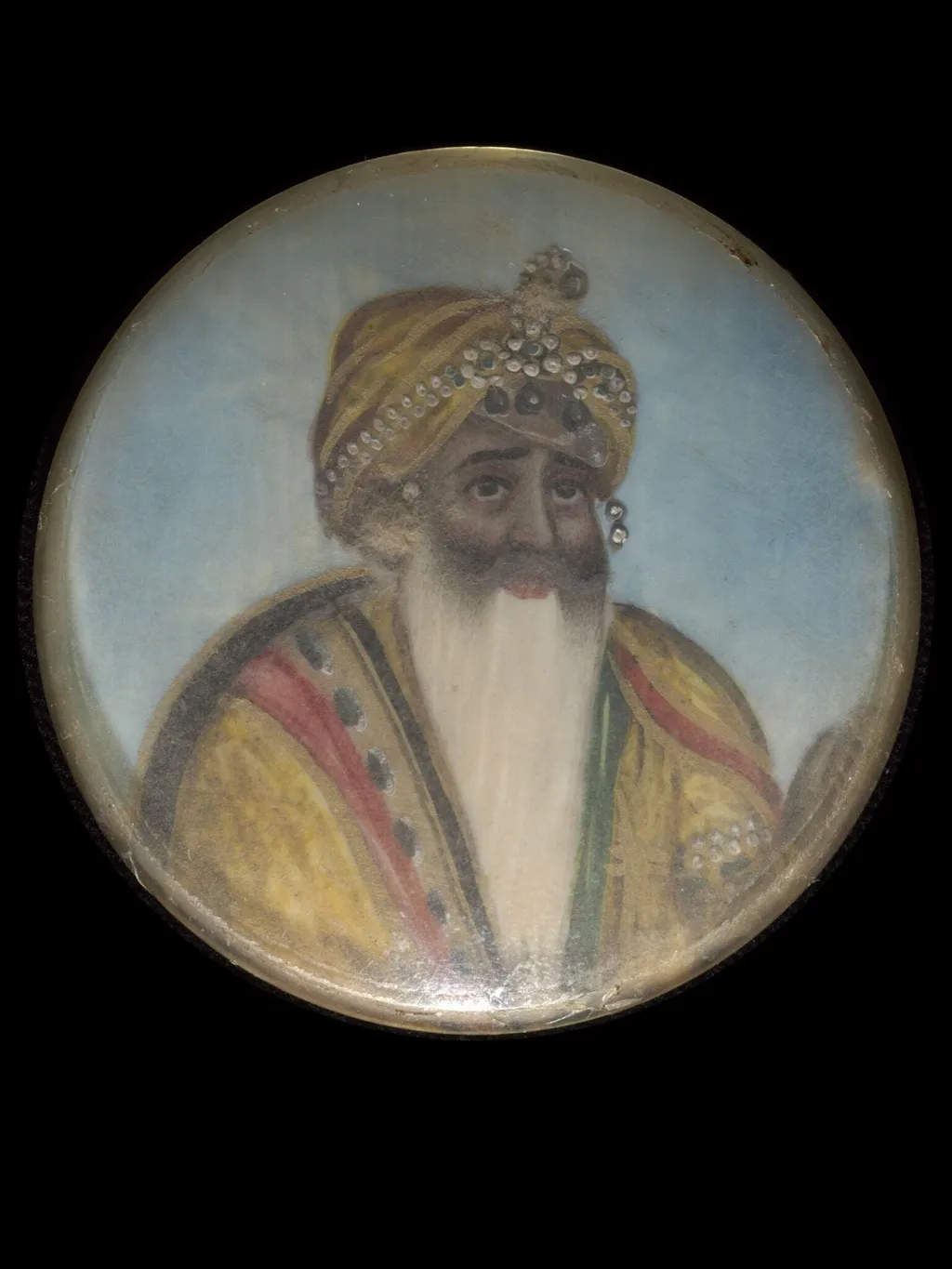
Sham Singh Atariwala is a paint painting by the Patna School of Painting artist Unknown. It dates from 1850 and is held in the collection of the Victoria and Albert Museum.
About this work
Overview
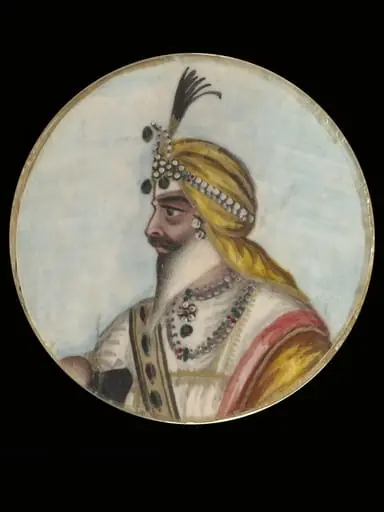
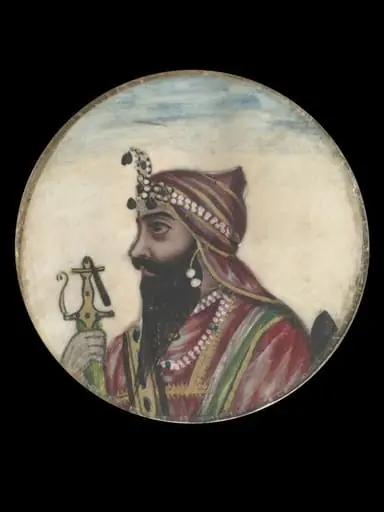
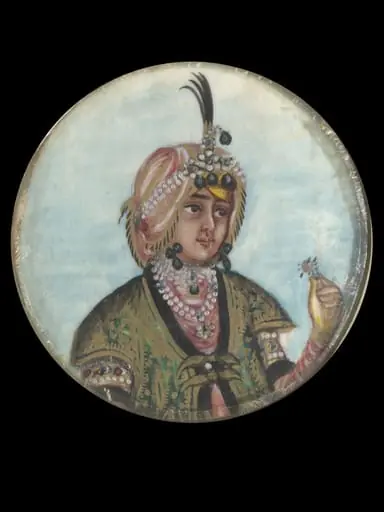
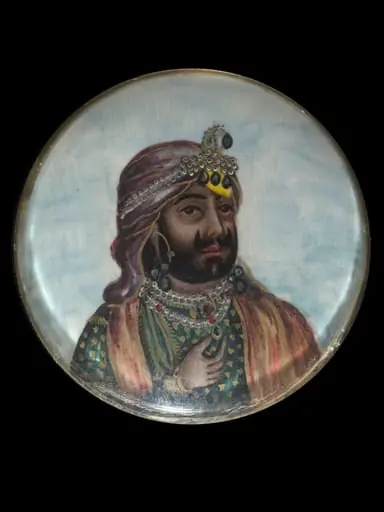
A small, circular portrait on ivory captures Sham Singh Atariwala, a Sikh general who fell in battle in 1846. Executed with swift, visible brushwork, the painting emphasizes texture and luminosity over fine detail. The surface retains a sense of immediacy, suggesting it was completed in a single sitting or under time constraints, possibly for a military or familial commemoration.
Subject & Meaning
Sham Singh Atariwala is portrayed in full regalia, his identity signaled by the ornate jeweled turban and striped robe, symbols of his rank and allegiance.
Sham Singh Atariwala is portrayed in full regalia, his identity signaled by the ornate jeweled turban and striped robe, symbols of his rank and allegiance. His stern expression and direct gaze convey authority and resolve, consistent with his role as a warrior-leader. The absence of narrative elements focuses attention on his presence, reinforcing the portrait’s function as a personal and political memorial.
Technique & Style
The artist employed thin layers of paint on ivory to achieve subtle tonal transitions, using chiaroscuro to model the face and highlight the reflective surfaces of the jewels. Brushstrokes remain visible, particularly in the robe’s stripes and beard, suggesting a rapid, confident hand. The plain blue-gray background isolates the figure, enhancing the three-dimensionality of his form through contrast.
History & Provenance
Created shortly after Sham Singh’s death in the First Anglo-Sikh War, the portrait likely originated within his inner circle or the Sikh court at Lahore. Its small scale and material suggest it was intended for private veneration rather than public display. The ivory support points to access to elite materials, possibly through trade networks or royal patronage.
Context
This work emerged during a period of political upheaval as the Sikh Empire resisted British expansion. Portraits of military leaders like Sham Singh served to affirm identity and legacy amid impending territorial loss. The style blends local Punjabi traditions with influences from Mughal and early colonial portraiture, reflecting a hybrid artistic culture under pressure.
Legacy
The portrait stands as a rare surviving example of Sikh military portraiture from the mid-19th century. Its directness and material economy distinguish it from more elaborate court paintings, offering insight into how leaders were visually remembered during times of crisis. It remains a key reference for understanding Sikh visual culture on the eve of colonial annexation.
Artist & collection

 Domestic Scene
 Giacomo and Cardinal Marco, investing Andrea, Abbot of San Zeno, with his Benefice
 The Nymph of Fontainebleau
 Portrait of a Woman
 Madonna and Child with Saints in the Enclosed Garden
 Venus and Minerva
 Family Group of Four on Sofa
 Wall painting from Room H of the Villa of P. Fannius Synistor at Boscoreale