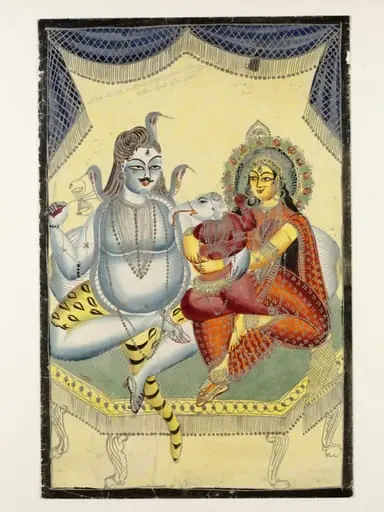
Artwork
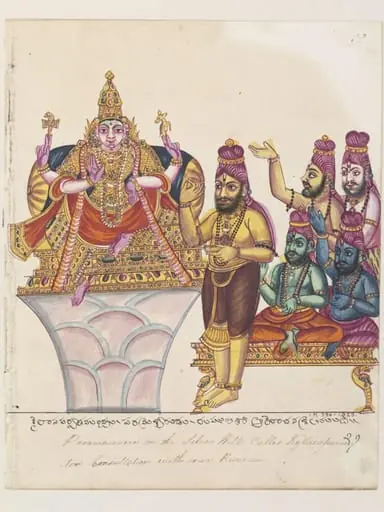
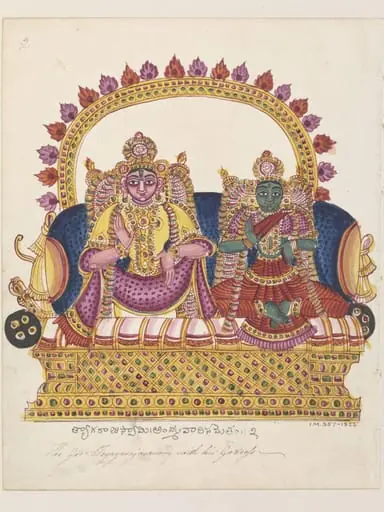
Shiva and Parvati seated on a canopied throne.
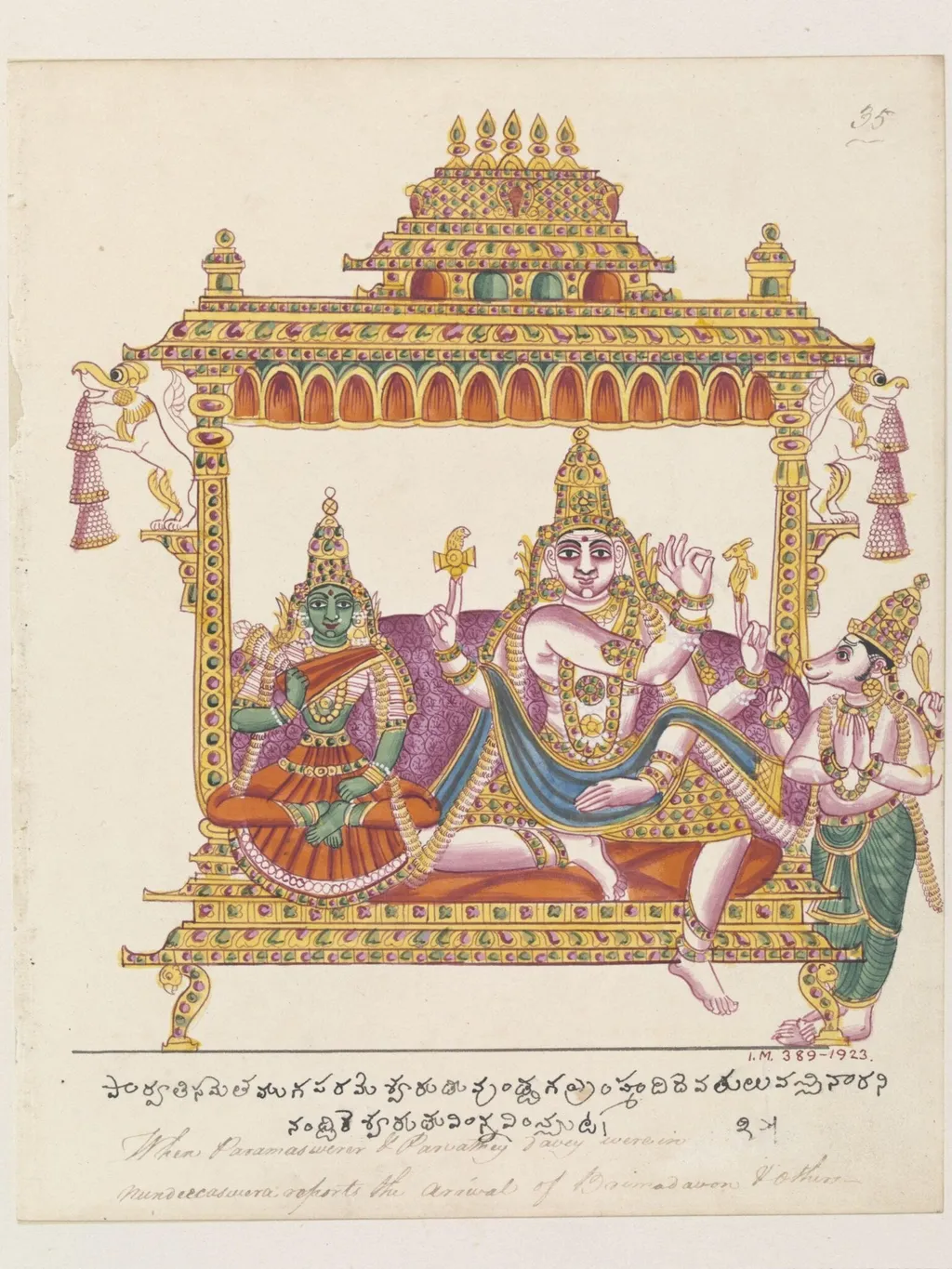
Shiva and Parvati seated on a canopied throne. is a paint painting by the Mughal Painting artist Unknown. It dates from 1820 and is held in the collection of the Victoria and Albert Museum. This painting portrays Shiva and Parvati seated on an elaborate, canopied throne, surrounded by richly detailed ornamentation.
About this work
Overview
This painting portrays Shiva and Parvati seated on an elaborate, canopied throne, surrounded by richly detailed ornamentation.
This painting portrays Shiva and Parvati seated on an elaborate, canopied throne, surrounded by richly detailed ornamentation. A third figure, Nandikeshvara, stands beside them, engaged in what appears to be a moment of divine communication. The composition is dense with color and pattern, characteristic of Indian courtly painting traditions. The scene captures a narrative moment from Hindu mythology, rendered with precision and symbolic richness.
Subject & Meaning
Shiva, identified by his blue sash and gesture, holds a small animal, likely a deer, symbolizing his role as lord of creatures. Parvati, seated beside him in red and gold, represents cosmic balance and devotion. Nandikeshvara, the attendant, delivers news of divine arrival, suggesting a moment of ritual or celestial assembly. Together, the trio embodies the interplay of power, grace, and divine order central to Shaivite theology.
Technique & Style
The work employs fine brushwork and layered pigments to achieve luminous jewel tones—deep reds, golds, and emerald greens—against a flat, patterned background. Gold leaf accents highlight the throne’s architectural canopy and the figures’ adornments. The figures are rendered with stylized proportions, emphasizing spiritual presence over naturalism. Intricate textile patterns and architectural details reflect the influence of Mughal and Rajput court aesthetics.
History & Provenance
This painting likely originated in a Rajput or Pahari court workshop during the 18th century, a period when devotional themes were frequently depicted in miniature formats. Its preservation in the Victoria and Albert Museum suggests it was collected during the British colonial era, possibly as part of a broader effort to document Indian artistic traditions. Its exact provenance prior to museum acquisition remains undocumented.
Context
Paintings of Shiva and Parvati in regal settings were common in North Indian courts, where rulers aligned themselves with divine authority. Such images served both devotional and political purposes, reinforcing the king’s role as earthly representative of cosmic order. The inclusion of Nandikeshvara, Shiva’s bull attendant, signals a narrative tied to temple rituals or mythic episodes involving divine messengers.
Legacy
This work exemplifies the enduring tradition of Hindu iconography in Indian painting, where mythological narratives were rendered with symbolic precision and aesthetic refinement. It continues to inform scholarly understanding of regional styles and religious visual culture. Its presence in major collections ensures its role as a reference point for studies of South Asian art and devotional practice.
Artist & collection

 Domestic Scene
 Giacomo and Cardinal Marco, investing Andrea, Abbot of San Zeno, with his Benefice
 The Nymph of Fontainebleau
 Portrait of a Woman
 Madonna and Child with Saints in the Enclosed Garden
 Venus and Minerva
 Family Group of Four on Sofa
 Wall painting from Room H of the Villa of P. Fannius Synistor at Boscoreale