Artwork
Shri Raga: An Illustration from a Ragamala Series
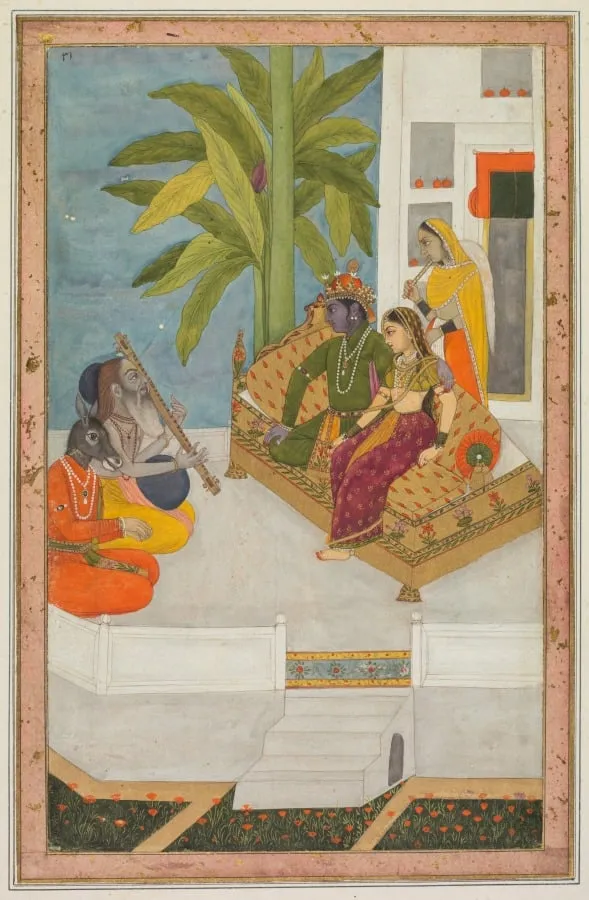
Shri Raga: An Illustration from a Ragamala Series is an unspecified painting by the Baroque artist Unknown. It dates from 1740 and is held in the collection of the Cleveland Museum of Art.
About this work
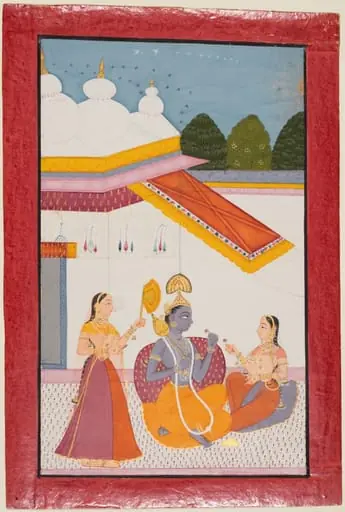
A musician with a vina (a stringed instrument) sits at his feet, while a horse-headed figure claps nearby.
You see a blue-skinned man on a golden throne, surrounded by flowers and jewels. A musician with a vina (a stringed instrument) sits at his feet, while a horse-headed figure claps nearby.
This painting is part of a *Ragamala*—a set of images that pair music with visual art. Each scene matches a specific melody or mood, like a song turned into a picture. The verse written for this one describes the man as a divine figure, loved by poets and scholars.
To see more like this, look up 18th century Indian art.
Overview
The painting depicts a blue‑toned deity seated upon an ornate golden throne, flanked by a musician playing a vina and a horse‑headed attendant who claps his hands. The setting includes a formal garden with poppy blossoms and a white terrace, while a house in the upper right shows orange windows. The composition is part of a Ragamala series, visualizing a specific musical mode.
Subject & Meaning
The central figure represents Shri Raga, described in accompanying verses as a beautifully built, blue‑skinned divinity who is perpetually accompanied by the auspicious goddess Lakshmi. The presence of the vina player and the clapping horse‑headed figure underscores the theme of music and celebration, reflecting the poetic praise scholars attribute to this personified raga.
Technique & Style
Executed in the 18th‑century Indian court style, the work combines vivid mineral pigments for the blue skin and gold leaf for the throne. Delicate brushwork renders floral garlands, jeweled ornaments, and the intricate details of the vina. The composition balances flat decorative planes with subtle modeling, characteristic of the period’s manuscript and panel paintings.
History & Provenance
The piece belongs to a Ragamala series, a tradition that pairs visual representations with specific melodic modes. Such series were popular in North Indian courts during the 1700s, often commissioned for private devotional or aesthetic collections. The painting’s provenance traces through regional collections before entering a museum context for public display.
Context
Ragamala paintings translate musical moods into visual narratives, allowing viewers to experience a raga’s emotional character through color, posture, and setting. This particular image aligns with verses that celebrate Shri Raga’s divine attributes and his association with Lakshmi, situating the work within a broader cultural practice of intertwining poetry, music, and visual art.
Legacy
The painting illustrates the enduring interplay between Indian classical music and visual culture, influencing later artistic productions that continue to explore synesthetic representations of sound. Its preservation offers insight into the aesthetic values and devotional practices of 18th‑century Indian courts.
Artist & collection

 Domestic Scene
 Giacomo and Cardinal Marco, investing Andrea, Abbot of San Zeno, with his Benefice
 The Nymph of Fontainebleau
 Portrait of a Woman
 Madonna and Child with Saints in the Enclosed Garden
 Venus and Minerva
 Family Group of Four on Sofa
 Wall painting from Room H of the Villa of P. Fannius Synistor at Boscoreale