Artwork
The Departure of a Dignitary from Middelburg
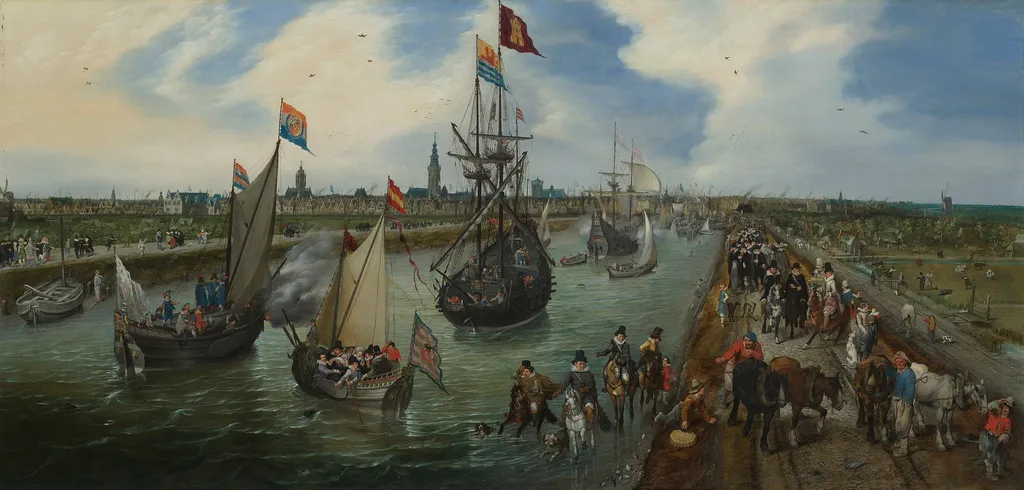
The Departure of a Dignitary from Middelburg is a drawing by the Baroque artist Unknown. It dates from 1615 and is held in the collection of the Rijksmuseum.
About this work
Overview
The artwork depicts the departure of a high-ranking individual from the harbor of Middelburg, with the warship De Zeehondt being pulled seaward by four horses.
The artwork depicts the departure of a high-ranking individual from the harbor of Middelburg, with the warship De Zeehondt being pulled seaward by four horses. A crowd of onlookers, ranging from common citizens to officials, gathers along the quay. The presence of Stadtholder Maurice’s yacht, firing a ceremonial salute, signals the significance of the occasion, though the identity of the dignitary remains unrecorded.
Subject & Meaning
The scene captures a moment of civic and military ritual, emphasizing the importance of the departing figure through the formal response of the state. The salute from the Stadtholder’s vessel underscores the political weight of the event, suggesting the individual held a position of authority. The varied ranks of spectators reflect the social hierarchy of the time, with the departure treated as a public affair of state.
Technique & Style
The artist employs precise linear draftsmanship and layered cross-hatching to render texture and depth, particularly in the ships, horses, and figures. The composition directs attention toward the central vessel, with careful attention to the arrangement of bodies and architectural elements along the harbor. The restrained palette and detailed rendering suggest a documentary intent, typical of Dutch topographical drawings of the period.
History & Provenance
The drawing originates from the Dutch Republic in the early 17th century, likely created as a record of a notable maritime event. Its survival indicates it was valued as a historical document, possibly commissioned by a local official or maritime authority. The absence of the dignitary’s name suggests the focus was on the ceremonial act rather than the individual, a common feature in civic records of the time.
Context
During the Dutch Golden Age, naval power and maritime trade were central to national identity. Public departures of warships, especially those associated with state interests, were occasions for display and protocol. The involvement of the Stadtholder’s yacht reflects the close ties between military, political, and commercial institutions, and the drawing serves as a visual testament to the ceremonial culture of the Republic’s port cities.
Legacy
This drawing contributes to a broader corpus of Dutch maritime records that document the intersection of daily life and state ceremony. Its detailed observation of social behavior and naval protocol offers insight into how authority was visually affirmed in public spaces. Though not widely known, it remains a valuable example of observational draftsmanship from a period rich in civic documentation.
Artist & collection

 Domestic Scene
 Giacomo and Cardinal Marco, investing Andrea, Abbot of San Zeno, with his Benefice
 The Nymph of Fontainebleau
 Portrait of a Woman
 Madonna and Child with Saints in the Enclosed Garden
 Venus and Minerva
 Family Group of Four on Sofa
 Wall painting from Room H of the Villa of P. Fannius Synistor at Boscoreale
 Het oorlogsschip Brielle op de Maas voor Rotterdam
 The Man-of-War Brielle on the River Maas off Rotterdam
 Embarkation of Troops on a Dutch River
 The Harbour in Amsterdam
 Het kielhalen van de scheepschirurgijn van admiraal Jan van Nes
 Untitled
 View of the Amsterdam Port with the Swedish Ship 'Lejonet'; the Lutheran Church beyond
 Reception of the White Monks by the Magistrate and the Notables of the City of Antwerp
 View of Dordrecht from the North
 The Keelhauling of the Ship’s Surgeon of Admiral Jan van Nes