Artwork
The Jagannath triad
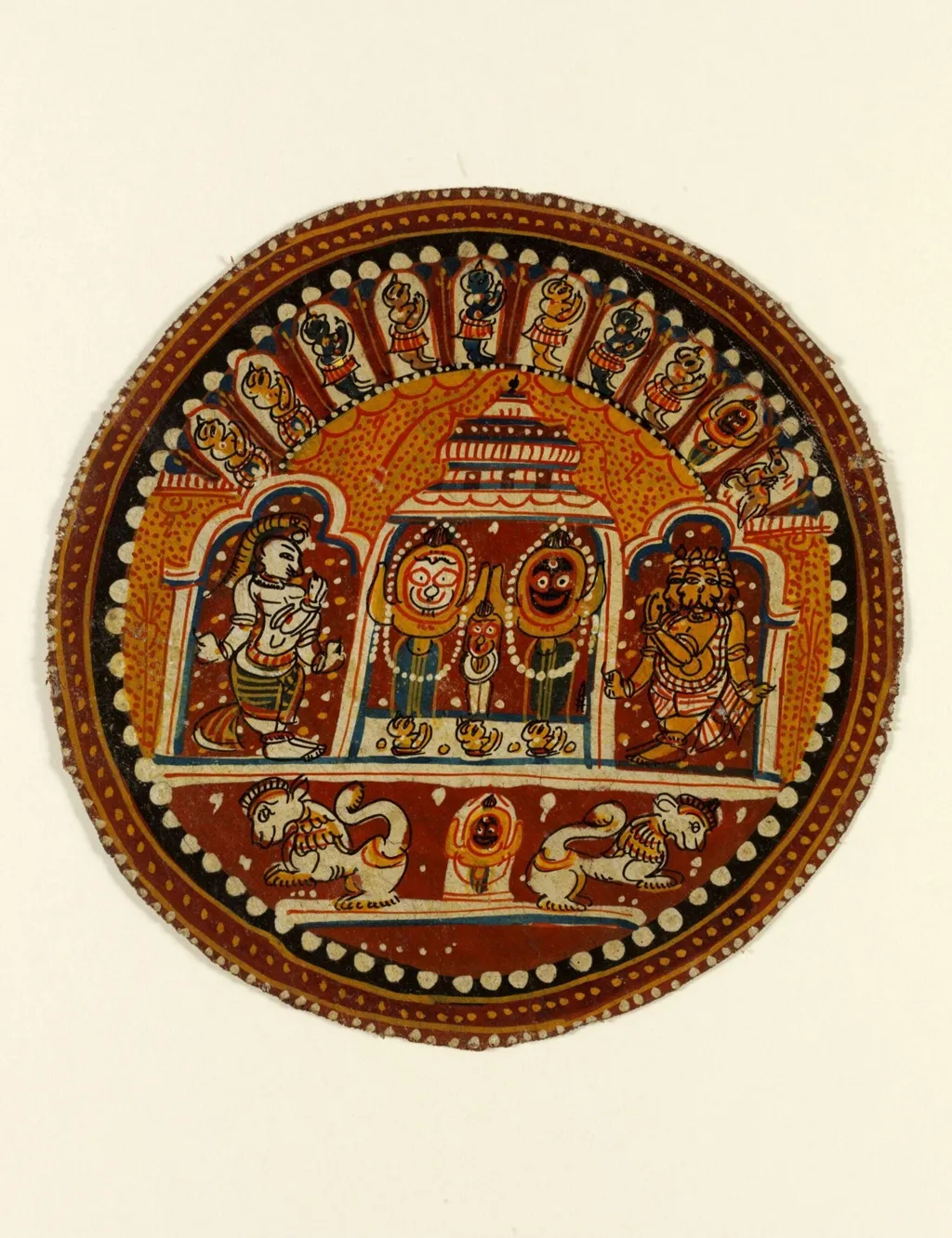
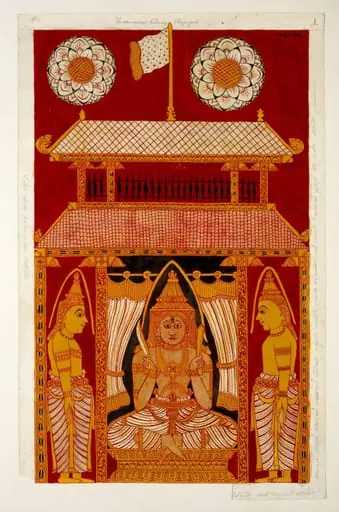
The Jagannath triad is a paint painting by Unknown. It dates from 1910 and is held in the collection of the Victoria and Albert Museum. The work is a circular tempera painting on cloth that portrays the Hindu deity Jagannath together with his siblings Balabhadra and Subhadra.
About this work
Overview
The work is a circular tempera painting on cloth that portrays the Hindu deity Jagannath together with his siblings Balabhadra and Subhadra. Flanking the central trio are depictions of Brahma on the right and Shiva on the left, while a procession of devotees crowns the upper edge. A pair of stylised lions frames a smaller image of Jagannath at the bottom of the composition.
Subject & Meaning
The central figures represent the Jagannath triad, a manifestation of Vishnu and his close kin, a theme central to the religious traditions of Odisha. The inclusion of Brahma and Shiva situates the scene within the broader Hindu pantheon, suggesting a synthesis of divine authority. The surrounding devotees and the lion guardians reinforce the notion of communal worship and protective power.
Technique & Style
The composition is organized around a central platform, with a roof‑like canopy above and decorative borders of white and gold dots framing the edge.
Executed in tempera, the pigments are applied to a cloth support, a medium that allows for vivid coloration yet shows signs of fading, especially in reds, yellows and blacks. The composition is organized around a central platform, with a roof‑like canopy above and decorative borders of white and gold dots framing the edge. Stylised lions and miniature figures are rendered with simplified, almost schematic lines.
History & Provenance
The painting originates from a tradition of devotional art associated with the Jagannath cult, likely produced in the eastern Indian subcontinent. Its circular format and cloth support align with portable ritual objects used in temple festivals. The work entered a European collection in the 19th century, eventually becoming part of the holdings of the Victoria and Albert Museum.
Context
Within the visual culture of Odisha, circular devotional panels were employed in processional contexts and temple ceremonies. The juxtaposition of major deities with attendant figures reflects a narrative strategy common in medieval Indian painting, where hierarchy is indicated by size and placement. The lions echo protective motifs found in temple architecture and royal insignia.
Artist & collection

 Domestic Scene
 Giacomo and Cardinal Marco, investing Andrea, Abbot of San Zeno, with his Benefice
 The Nymph of Fontainebleau
 Portrait of a Woman
 Madonna and Child with Saints in the Enclosed Garden
 Venus and Minerva
 Family Group of Four on Sofa
 Wall painting from Room H of the Villa of P. Fannius Synistor at Boscoreale