Artwork
Three religious mendicant couples
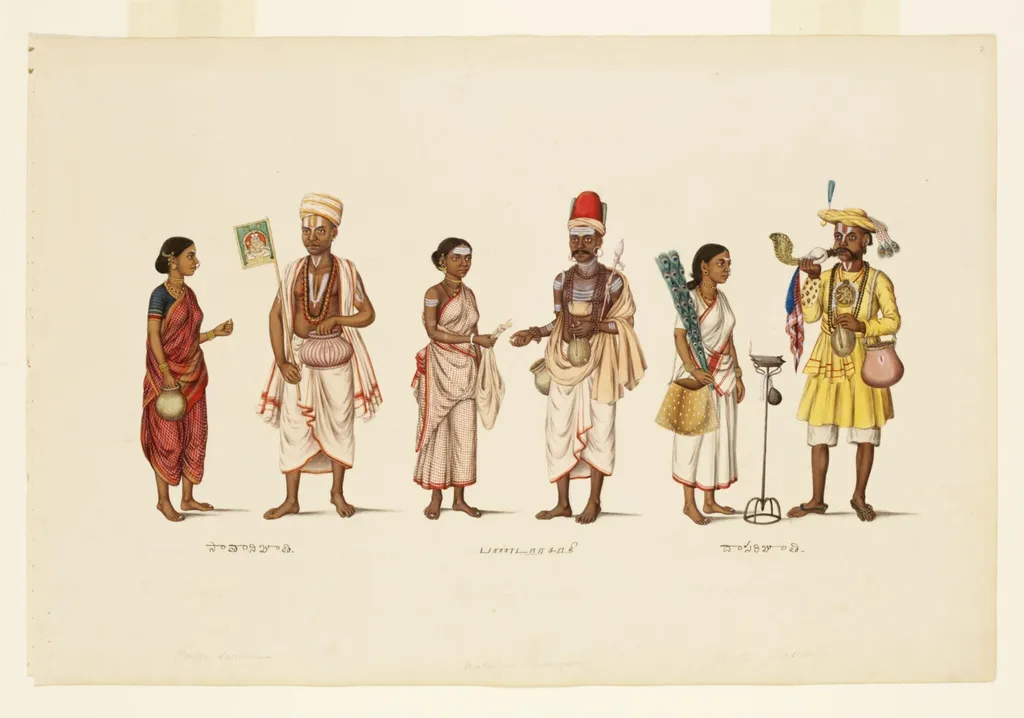
Three religious mendicant couples is a paint painting by the Patna School of Painting artist Unknown. It dates from 1830 and is held in the collection of the Victoria and Albert Museum. This painting is an example of a Company painting, a style created by Indian artists for British patrons in India.
About this work
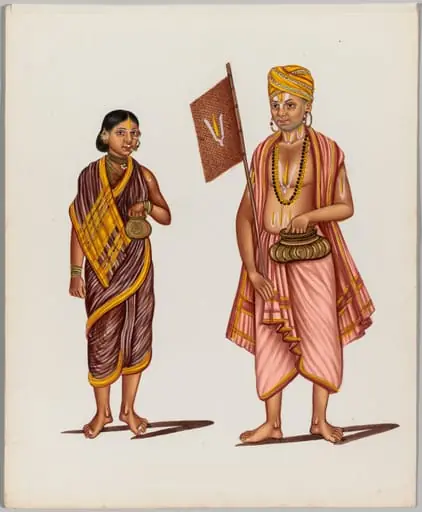
The couple on the left is special because they follow a specific philosopher named Ramanuja, who lived in the 11th century.
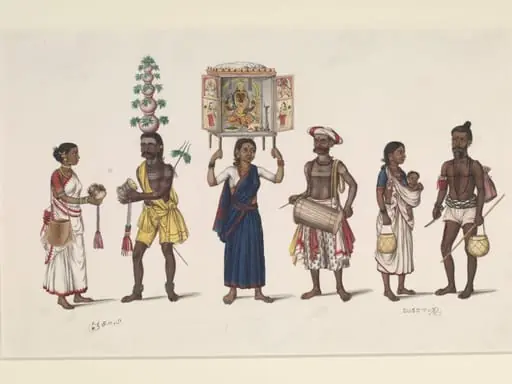
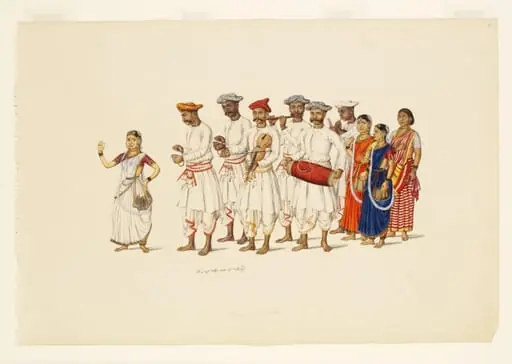
This painting shows three couples who are religious mendicants, or beggars.
They are dressed in simple clothes and have few belongings.
The couple on the left is special because they follow a specific philosopher named Ramanuja, who lived in the 11th century.
His image is on the man's flag, which helps identify them.
They are part of a larger group of paintings made by Indian artists for the British in India, called Company paintings.
You can learn more about this style at the museum where this painting is kept, the Victoria and Albert Museum.
Overview
This painting is an example of a Company painting, a style created by Indian artists for British patrons in India. It is one of 30 folios depicting various castes, occupations, and scenes.
Subject & Meaning
The painting depicts three couples of religious mendicants, each with distinct characteristics and identified by inscriptions in Telugu or Tamil. The couples represent different non-Brahmin groups, including followers of the 11th-century philosopher Ramanuja.
Technique & Style
The work is characterized by its detailed representation of the figures and their attributes, such as clothing, accessories, and ritual objects. The use of inscriptions in local languages adds to the painting's informative and ethnographic quality.
Artist & collection

 Domestic Scene
 Giacomo and Cardinal Marco, investing Andrea, Abbot of San Zeno, with his Benefice
 The Nymph of Fontainebleau
 Portrait of a Woman
 Madonna and Child with Saints in the Enclosed Garden
 Venus and Minerva
 Family Group of Four on Sofa
 Wall painting from Room H of the Villa of P. Fannius Synistor at Boscoreale