Artwork
Untitled
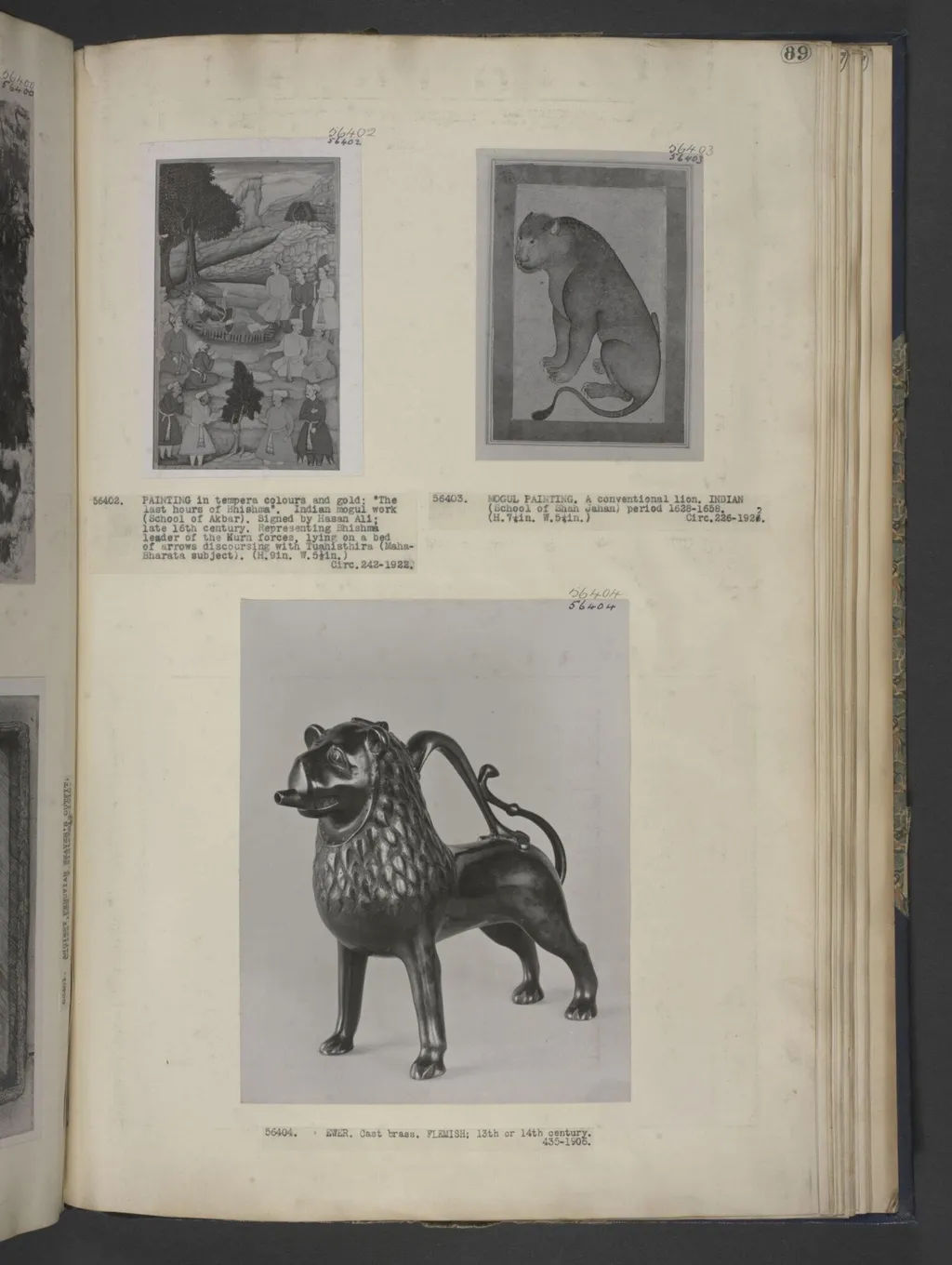
Untitled is a paint painting by the Baroque artist Unknown. It dates from 1628 and is held in the collection of the Victoria and Albert Museum. This rectangular painting on gold paper features a lion rendered in dark tones with subtle light shading across its face and chest.
About this work
Overview
This rectangular painting on gold paper features a lion rendered in dark tones with subtle light shading across its face and chest. A blue border frames the composition, while the reverse bears a handwritten note identifying it as a Mughal study from the Shah Jahan period. The work was acquired by the museum in 1922 as part of a set of ten items, purchased from a London dealer for £30.
Subject & Meaning
The lion stands on its hind legs, tail extended, with ears and muzzle rendered in precise detail. Its posture suggests alertness or imminent motion, consistent with Mughal depictions of power and royal symbolism. No narrative context is present; the image functions as a study of form and presence, reflecting the court’s interest in natural observation as an expression of authority.
Technique & Style
The lion’s fur is meticulously textured using fine brushwork, with attention to the curvature of the mane, the shape of the ears, and the anatomy of the limbs. Background elements are ambiguous—possibly rocks or foliage—rendered with minimal detail to focus attention on the animal. The use of gold paper enhances luminosity, while the restrained palette emphasizes tonal variation over color.
History & Provenance
The painting was acquired by the museum in 1922 from A. Churchill of Dover Street, London, as item number five in a set of ten works. The reverse inscription links it to the School of Shah Jahan, placing its creation between 1628 and 1658. Its journey from Mughal India to a London collection reflects the broader dispersal of South Asian court art during the 19th and early 20th centuries.
Context
Produced during the height of Mughal imperial patronage, this study aligns with a tradition of naturalistic animal portraiture favored by Shah Jahan’s atelier.
Produced during the height of Mughal imperial patronage, this study aligns with a tradition of naturalistic animal portraiture favored by Shah Jahan’s atelier. Unlike European Baroque, Mughal realism emerged from close observation of live animals in royal menageries, blending Persian aesthetics with Indian techniques. Such studies served both artistic and political ends, reinforcing the emperor’s dominion over nature.
Legacy
This work exemplifies the Mughal practice of isolating individual subjects for detailed study, a method that influenced later Indian and colonial-era art. Though not widely exhibited, its precise execution and provenance make it a valuable reference for understanding the technical priorities of 17th-century imperial workshops. It remains a quiet testament to the discipline of courtly observation.
Artist & collection

 Domestic Scene
 Giacomo and Cardinal Marco, investing Andrea, Abbot of San Zeno, with his Benefice
 The Nymph of Fontainebleau
 Portrait of a Woman
 Madonna and Child with Saints in the Enclosed Garden
 Venus and Minerva
 Family Group of Four on Sofa
 Wall painting from Room H of the Villa of P. Fannius Synistor at Boscoreale