Artwork
Bénitier in St. Peter's, Rome
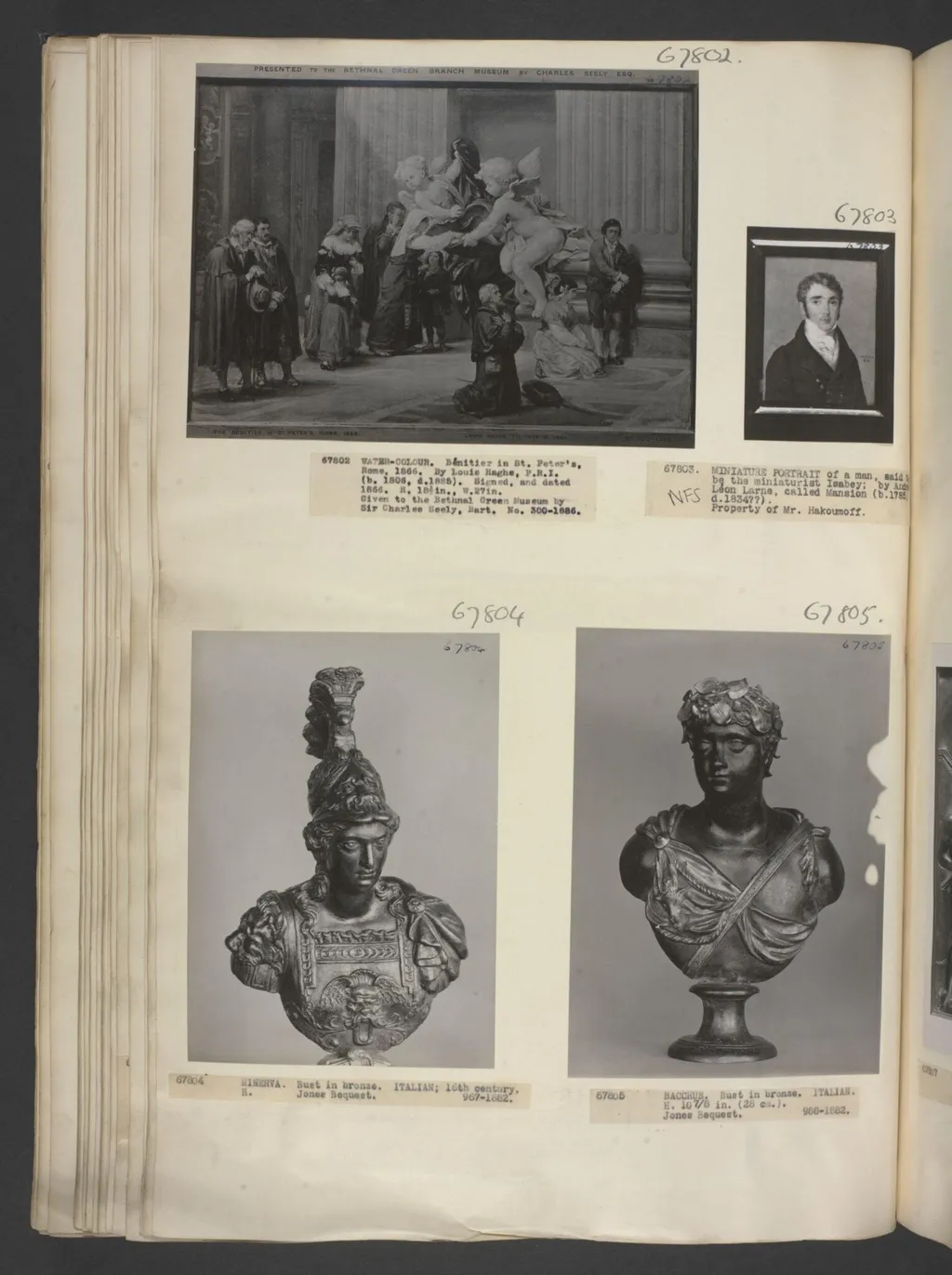
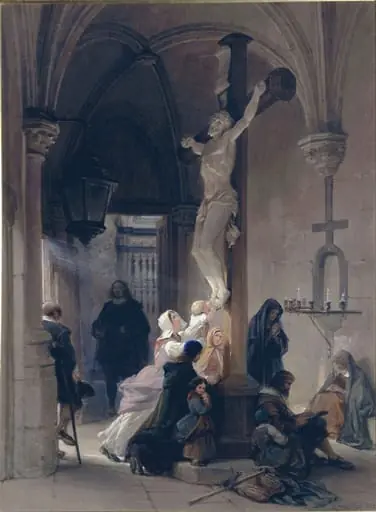
Bénitier in St. Peter's, Rome is a watercolor work on paper by the Biedermeier artist Haghe. It dates from 1866 and is held in the collection of the Victoria and Albert Museum.
About this work
Overview
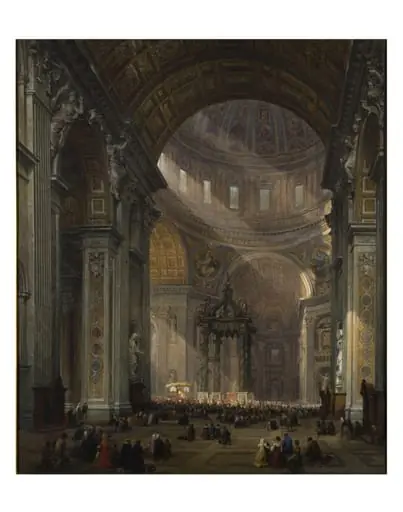
Created in 1866, this watercolour by Louis Haghe captures an interior scene within St. Peter’s Basilica in Rome. The work is signed and dated by the artist, confirming its origin and timing. Rendered in monochrome, it presents a moment of religious ritual with heightened emotional intensity, using tonal contrast to guide the viewer’s focus through the composition.
Subject & Meaning
The scene depicts a devotional act: a man in liturgical robes kneels beside a woman lying on the floor, while onlookers observe in silence or motion.
The scene depicts a devotional act: a man in liturgical robes kneels beside a woman lying on the floor, while onlookers observe in silence or motion. Above them, ethereal figures of angels suggest divine presence. The moment implies healing or prayer, rooted in Catholic tradition, where the benitier—holy water basin—serves as a conduit for spiritual grace, anchoring the narrative in ritual rather than myth.
Technique & Style
Haghe employed subtle gradations of grey to model form and depth, using chiaroscuro to isolate figures against a muted background. The absence of color sharpens the focus on gesture and posture. Delicate linework defines architectural details, while the dynamic arrangement of bodies creates rhythmic movement, reinforcing the scene’s emotional gravity without overt drama.
History & Provenance
The watercolour was produced during Haghe’s later career, following his work as a lithographer for topographical and ecclesiastical subjects. It likely originated as a study or commissioned record for a British or European patron interested in Roman religious sites. Its survival in private or institutional collections reflects its value as a documentary artifact of 19th-century devotional practice.
Context
In mid-19th-century Europe, detailed watercolours of sacred spaces were popular among travelers and scholars documenting religious architecture. Haghe’s work aligns with a broader trend of visual ethnography, where artists recorded rituals and interiors with precision. St. Peter’s, as a symbol of papal authority, attracted particular attention from artists seeking to capture its spiritual and spatial grandeur.
Legacy
Though not widely exhibited, the piece contributes to a corpus of 19th-century topographical watercolours that preserved the visual culture of Catholic liturgy before widespread photography. Its restrained aesthetic and attention to architectural authenticity offer insight into how artists of the period interpreted sacred space—not as spectacle, but as lived ritual.
Artist & collection
Artist
Louis Haghe made detailed watercolours of grand European interiors and everyday scenes in the 1800s.