Artwork
Vasanti Ragini
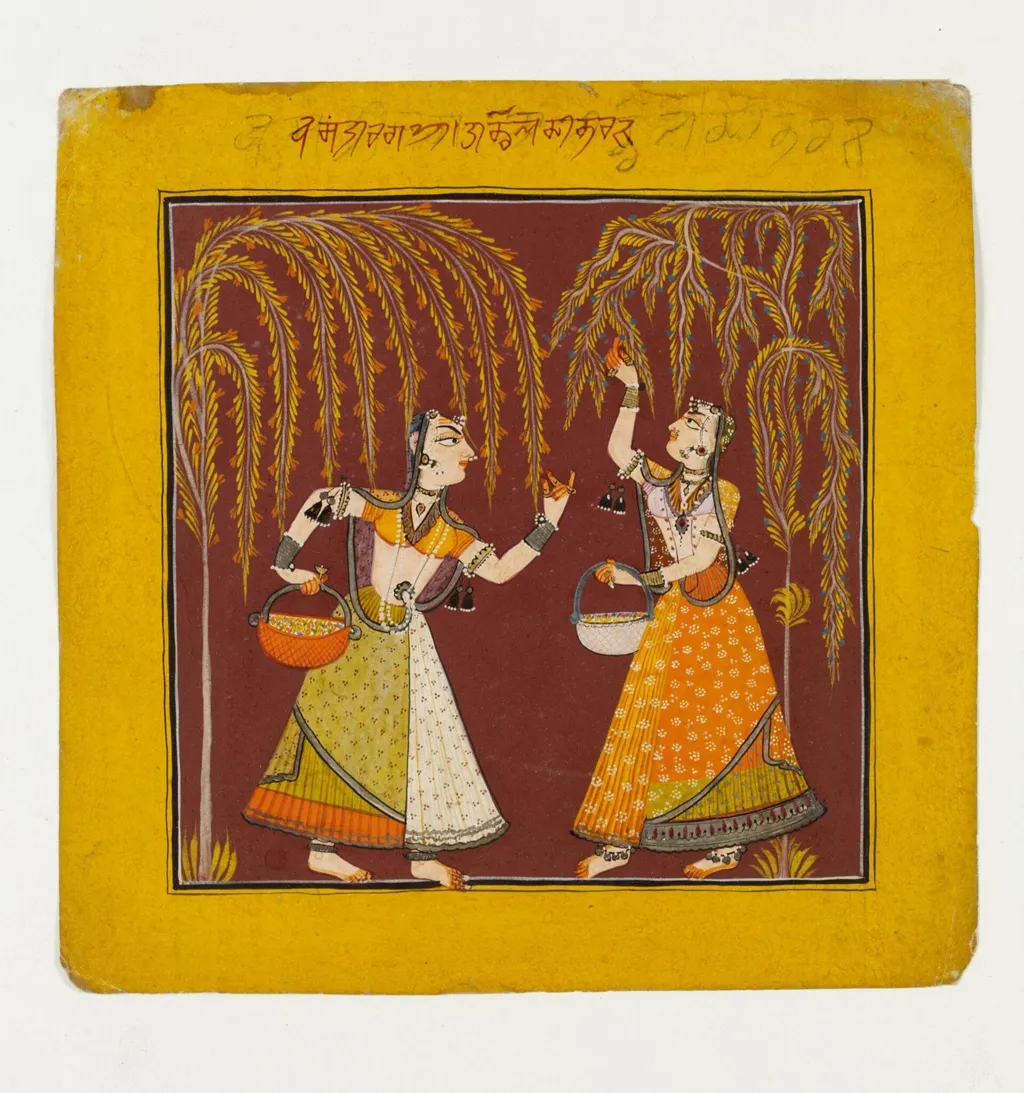
Vasanti Ragini is a paint painting by the Baroque artist Unknown. It dates from 1700 and is held in the collection of the Victoria and Albert Museum. Created around 1700, this painting belongs to the Ragamala series, a visual interpretation of Indian musical modes.
About this work
Overview
Executed in opaque watercolor on paper, the work features an inscription in Takri script along the upper edge, identifying its musical theme.
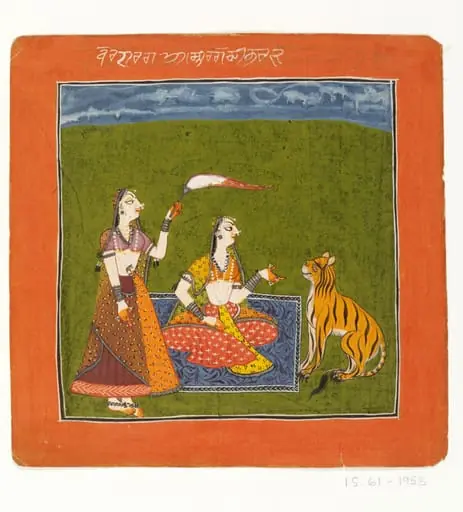
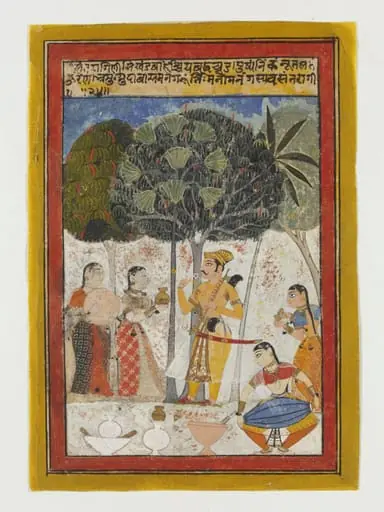
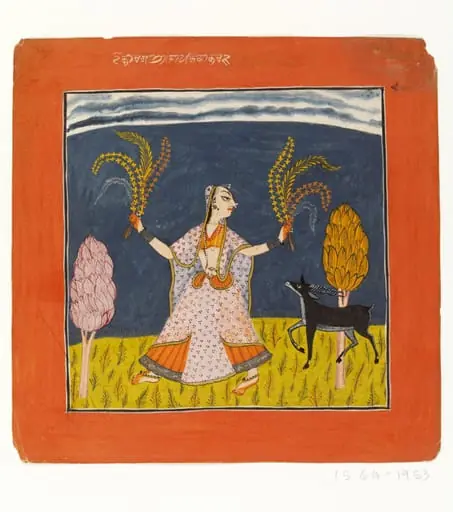
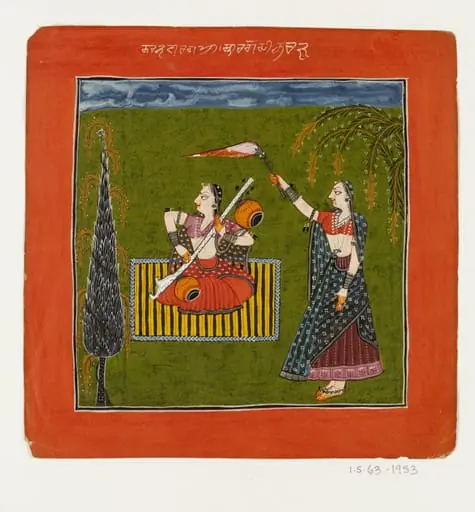
Created around 1700, this painting belongs to the Ragamala series, a visual interpretation of Indian musical modes. It depicts the Vasanti Ragini, associated with spring and courtly romance. Executed in opaque watercolor on paper, the work features an inscription in Takri script along the upper edge, identifying its musical theme. The composition centers on two women gathering blossoms, framed by tall palm trees against a rich red background.
Subject & Meaning
The two women, engaged in the quiet act of collecting flowers, embody the gentle, evocative mood of the Vasanti Ragini. Their interaction suggests a moment of intimacy, aligning with the raga’s association with longing and seasonal renewal. The blossoms symbolize transient beauty, a common metaphor in Indian poetic and musical traditions. The setting, neither urban nor rural, evokes an idealized natural space where emotion and nature harmonize.
Technique & Style
The painting uses opaque watercolor to achieve vivid, saturated hues—greens, oranges, reds, and golds—contrasting sharply with the deep red ground. Figures are rendered with soft modeling and dark outlines, giving them clarity without rigidity. The palm trees arch overhead like a canopy, directing focus to the women. Details in their clothing are delicately patterned, suggesting textile textures through fine brushwork rather than literal representation.
History & Provenance
This work originates from the Pahari school of painting, likely produced in a royal atelier in the Himalayan foothills during the early 18th century. Such Ragamala sets were commissioned by patrons interested in the fusion of music, poetry, and visual art. The presence of Takri script indicates a regional connection, possibly to the Kangra or Bilaspur courts. Its survival reflects the enduring value placed on these lyrical miniatures.
Context
Ragamala paintings emerged as a distinct genre in North India, translating musical modes into visual form. Each raga was linked to a time of day, season, or emotional state, and artists translated these into scenes of daily or mythic life. Vasanti Ragini, tied to spring, was often depicted with lovers or floral gathering. This painting reflects a broader cultural practice where music and art were seen as interwoven expressions of rasa, or aesthetic emotion.
Legacy
Though individual Ragamala paintings were once part of larger albums, many now reside in museum collections, studied for their synthesis of music, poetry, and visual form. This work contributes to understanding how Indian artists encoded abstract concepts into intimate, human-scale scenes. Its preservation allows continued engagement with pre-colonial aesthetic systems that valued nuance, symbolism, and emotional resonance over realism.
Artist & collection

 Domestic Scene
 Giacomo and Cardinal Marco, investing Andrea, Abbot of San Zeno, with his Benefice
 The Nymph of Fontainebleau
 Portrait of a Woman
 Madonna and Child with Saints in the Enclosed Garden
 Venus and Minerva
 Family Group of Four on Sofa
 Wall painting from Room H of the Villa of P. Fannius Synistor at Boscoreale