Artwork
Todi Ragini
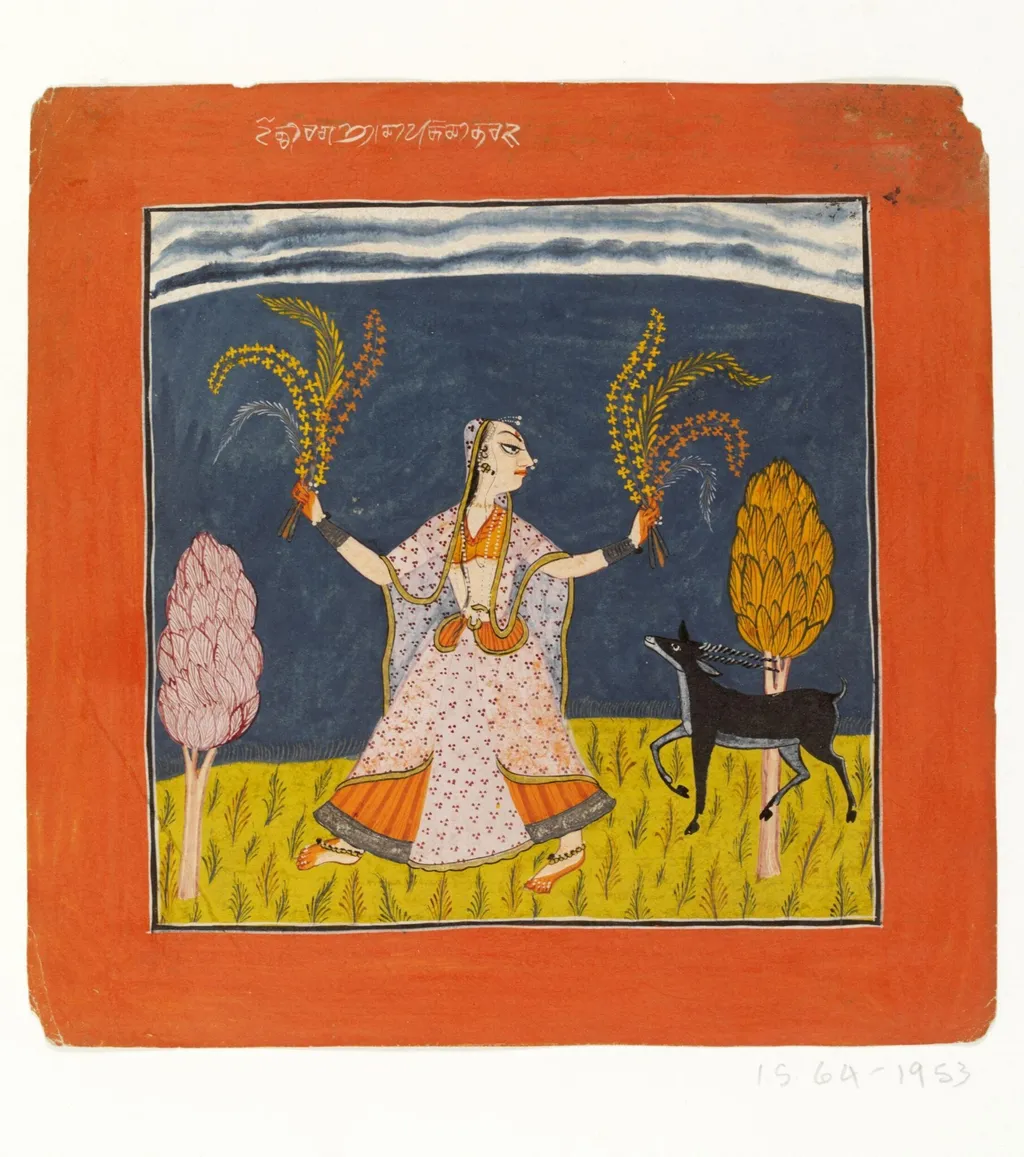
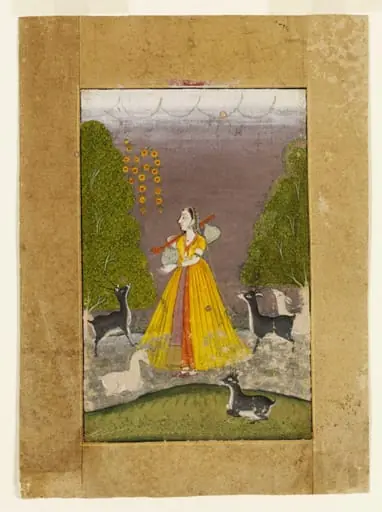
Todi Ragini is a paint painting by the Baroque artist Unknown. It dates from 1700 and is held in the collection of the Victoria and Albert Museum. This painting, dated around 1700, belongs to the Ragamala tradition, a series of visual interpretations of Indian musical modes.
About this work
Overview
This painting, dated around 1700, belongs to the Ragamala tradition, a series of visual interpretations of Indian musical modes.
This painting, dated around 1700, belongs to the Ragamala tradition, a series of visual interpretations of Indian musical modes. Executed in opaque watercolour on paper, it illustrates Todi Ragini, a raga associated with late morning and devotional mood. The composition centers on a solitary female figure, rendered with delicate detail, set against a natural landscape that enhances the raga’s contemplative character.
Subject & Meaning
The figure, a woman dressed in pink with floral embroidery, stands calmly beside a black deer, holding two bouquets of flowers. In Ragamala iconography, such pairings symbolize the raga’s emotional essence—here, tenderness and quiet devotion. The deer, often linked to grace and stillness in Indian art, reinforces the raga’s serene, introspective nature, while the flowers suggest offering and natural harmony.
Technique & Style
The artist employed opaque watercolour with fine brushwork to achieve luminous color and intricate detail. The woman’s attire, adorned with small red blossoms, and the textured grasses reflect a refined regional style, likely from the Pahari or Rajasthani school. The background features a dark blue sky and stylized trees, creating depth without perspective, typical of pre-colonial Indian miniature painting traditions.
History & Provenance
The painting was once part of the collection of Michael Rothenstein, a British artist and collector of South Asian art. It entered the British Museum’s holdings in 1953 as object IS.46 to 73-1953, acquired for £300. Its documented provenance reflects early 20th-century Western interest in Indian miniature painting, though its original commission and maker remain unknown.
Context
Ragamala paintings emerged in the 16th century as visual aids to musical modes, blending poetry, melody, and imagery. This work reflects the continued production of such themes in northern India during the early 18th century, a period when royal courts patronized artists to translate abstract musical concepts into lyrical scenes. It belongs to a broader cultural practice where art and music were deeply interwoven.
Legacy
As part of the British Museum’s collection, this painting contributes to scholarly understanding of Indian miniature traditions and their transmission beyond the subcontinent. While not widely exhibited, it remains a representative example of how regional artists encoded musical emotion into visual form, preserving a synesthetic cultural heritage that continues to inform studies of South Asian aesthetics.
Artist & collection

 Domestic Scene
 Giacomo and Cardinal Marco, investing Andrea, Abbot of San Zeno, with his Benefice
 The Nymph of Fontainebleau
 Portrait of a Woman
 Madonna and Child with Saints in the Enclosed Garden
 Venus and Minerva
 Family Group of Four on Sofa
 Wall painting from Room H of the Villa of P. Fannius Synistor at Boscoreale