Artwork
雪中芦に鴨|A Wild Duck near a Snow-laden Shore
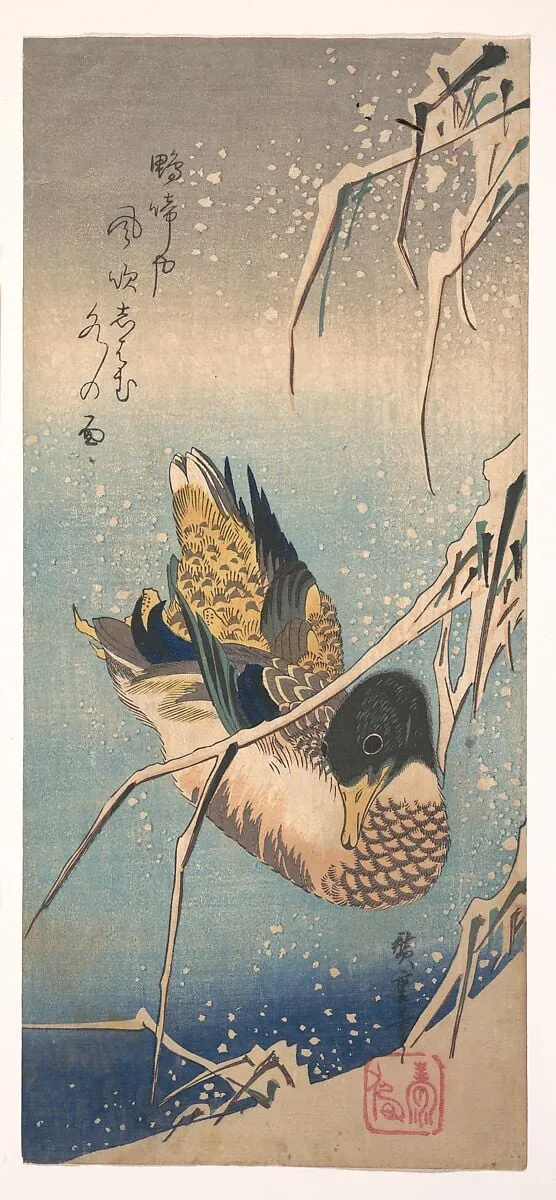
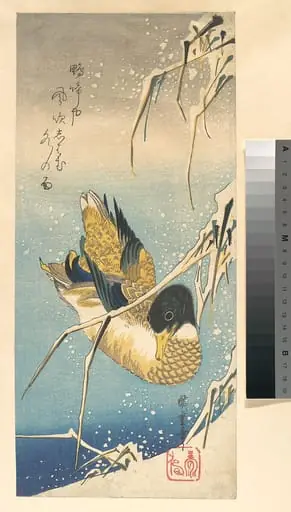
雪中芦に鴨|A Wild Duck near a Snow-laden Shore is an ink print by the Romanticist artist Utagawa Hiroshige. It dates from 1843 and is held in the collection of the Metropolitan Museum of Art.
About this work
Overview
Part of his later landscape series, the work reflects a shift from urban ukiyo-e themes toward quiet, seasonal nature scenes.
Created around 1843 by Utagawa Hiroshige, this woodblock print depicts a solitary wild duck on a snow-dusted shore. Part of his later landscape series, the work reflects a shift from urban ukiyo-e themes toward quiet, seasonal nature scenes. Rendered in ink and subtle color on paper, it exemplifies Hiroshige’s mastery of atmospheric tone and delicate composition, capturing a moment of stillness amid winter’s quiet.
Subject & Meaning
The duck, with its white body, black head, and yellow beak, stands alert on a frozen shoreline, wings slightly spread and beak open as if calling. Surrounded by snow-laden reeds and a muted blue expanse of water, the bird embodies resilience in a cold, barren landscape. The scene evokes transience and solitude, aligning with traditional Japanese aesthetics that find beauty in impermanence and quiet natural cycles.
Technique & Style
Hiroshige employed fine woodblock carving to render delicate snowflakes as lacy, scattered patterns across a pale gray sky. Soft gradations of blue and gray suggest depth in the water and atmosphere, while minimal color emphasizes the chill of winter. Lines are restrained, contours gentle, and textures implied rather than detailed—hallmarks of his mature style that prioritize mood over realism.
History & Provenance
This print emerged during Hiroshige’s later career, when he increasingly focused on landscape series like 'Eight Views of Omi' and 'The Fifty-Three Stations of the Tōkaidō.' Though specific early ownership records are sparse, it was likely produced for the popular print market in Edo, where seasonal nature prints were widely collected by urban dwellers seeking aesthetic respite.
Context
In the 1840s, Edo-period audiences grew fond of prints that evoked distant or tranquil natural settings, offering escape from crowded city life. Hiroshige’s focus on winter scenes, often overlooked in favor of spring or autumn, reflected a nuanced appreciation for quiet seasons. His work stood apart from contemporaries by emphasizing emotional atmosphere over narrative or spectacle.
Legacy
Hiroshige’s winter landscapes influenced later Japanese artists and Western impressionists, who admired his use of tone and spatial ambiguity. This print, though not among his most famous, exemplifies his quiet revolution in ukiyo-e: transforming the medium into a vehicle for contemplative nature poetry, where subtlety and mood carried greater weight than detail or drama.
Artist & collection
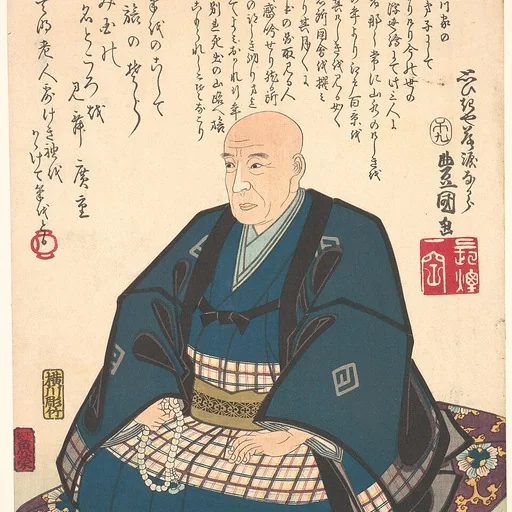
Artist
Utagawa Hiroshige (歌川 広重) or Andō Hiroshige (安藤 広重), born Andō Tokutarō (安藤 徳太郎; 1797 – 12 October 1858), was a Japanese ukiyo-e artist, considered the last great master of that tradition.