Artwork
Recumbent Goats
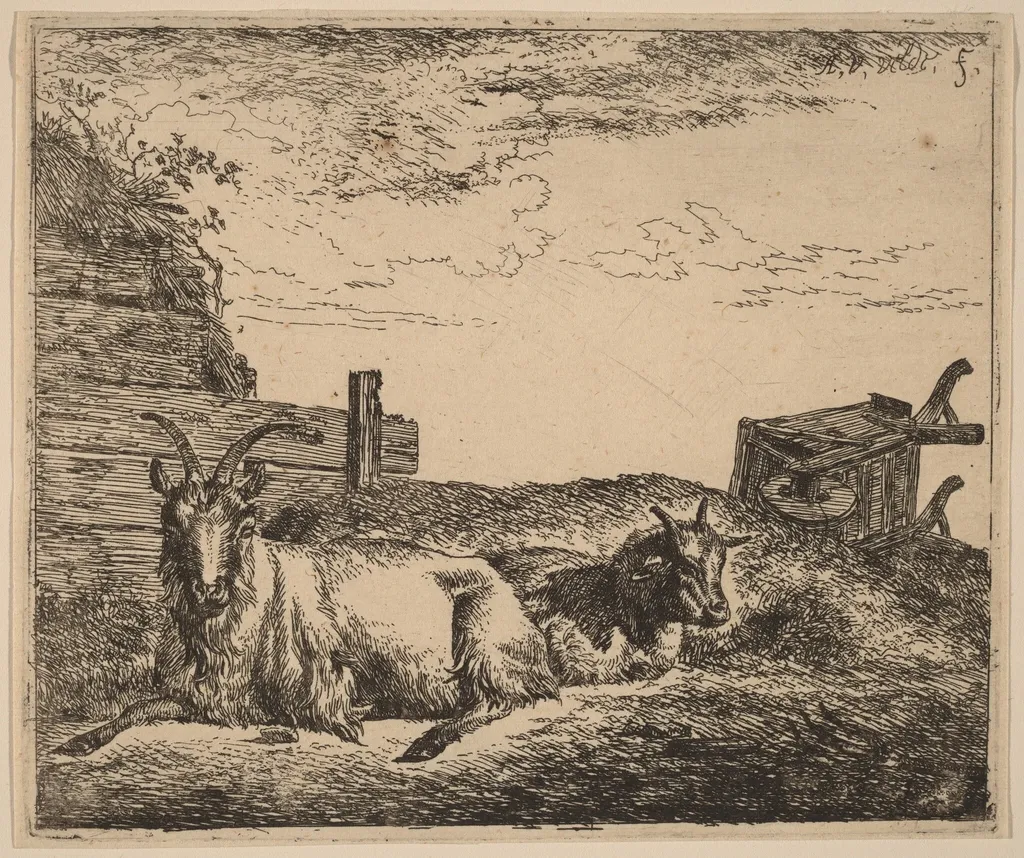
Recumbent Goats is an ink print by the Baroque artist Adriaen van de Velde. It dates from 1658 and is held in the collection of the National Gallery of Art.
About this work
Overview
The etching stands as a modest yet precise study of animal anatomy and environment, reflecting his broader interest in the pastoral.
Adriaen van de Velde, active in Amsterdam between 1636 and 1672, produced *Recumbent Goats* around 1658 as an etching. Though primarily known for paintings, his prints reveal a refined sensitivity to natural forms. This work exemplifies his focus on rural life, capturing animals within quiet, open landscapes. The etching stands as a modest yet precise study of animal anatomy and environment, reflecting his broader interest in the pastoral.
Subject & Meaning
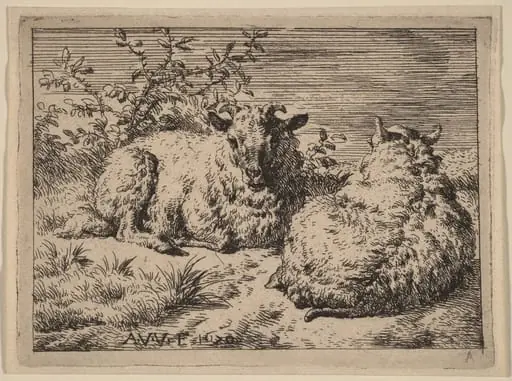
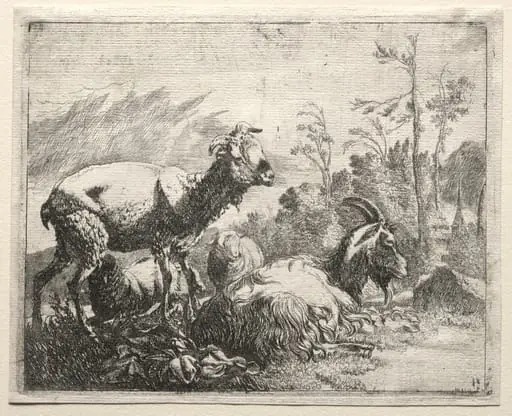
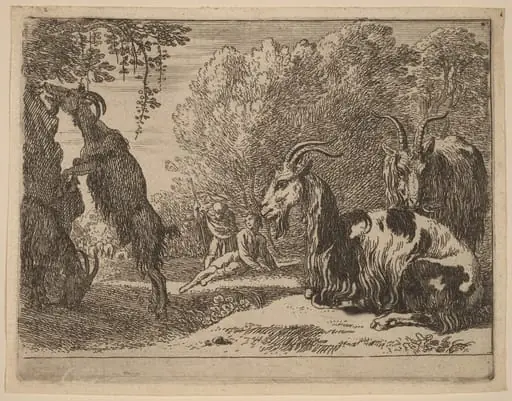
Two goats rest in a tranquil, unhurried posture—one with head lifted, the other lowered in repose. The scene lacks human figures, emphasizing the animals’ quiet autonomy within a modest countryside. The wooden fence suggests human presence without intrusion, reinforcing a sense of harmony between domesticated life and the natural world. The composition invites contemplation rather than narrative, aligning with Dutch traditions of observing everyday nature with quiet reverence.
Technique & Style
Van de Velde employed fine, controlled etching lines to render the goats’ wool, the fence’s grain, and the soft contours of their bodies. Contrasting areas of deep shadow and delicate highlights model form without heavy chiaroscuro, creating subtle volume. The background sky is suggested through sparse, wispy lines, avoiding detail to preserve atmospheric calm. His technique balances precision with restraint, avoiding theatricality while achieving tactile realism.
History & Provenance
Created during Van de Velde’s mature period, *Recumbent Goats* was likely made for collectors interested in prints of natural subjects. Though no early ownership records are widely documented, the work aligns with the Dutch print market’s demand for small-scale, finely detailed animal studies. Its survival in institutional collections suggests early recognition of its technical finesse, even if it never achieved broad fame.
Context
Van de Velde operated within the Dutch Italianate tradition, absorbing Italianate light and composition without relocating to Italy. His works often merged Dutch realism with idealized pastoral elements, though *Recumbent Goats* remains grounded in local observation. The print reflects a broader 17th-century Dutch interest in nature as subject—not as allegory, but as quiet, observable truth, distinct from the grandeur of Italian Baroque.
Legacy
Though overshadowed by his paintings, Van de Velde’s etchings influenced later animal and landscape printmakers through their restrained observation and technical clarity. *Recumbent Goats* exemplifies a quiet strand of Dutch printmaking that valued accuracy over drama. Its enduring presence in museum collections underscores its role as a refined example of 17th-century naturalism, appreciated for its calm precision rather than emotional intensity.
Own this work as a print
Artist & collection

Artist
Adriaen van de Velde, was a Dutch painter, draughtsman, and print artist. His favorite subjects were landscapes with animals and genre scenes. He also painted beaches, dunes, forests, winter scenes, portraits in…