Artwork
The Parthenon
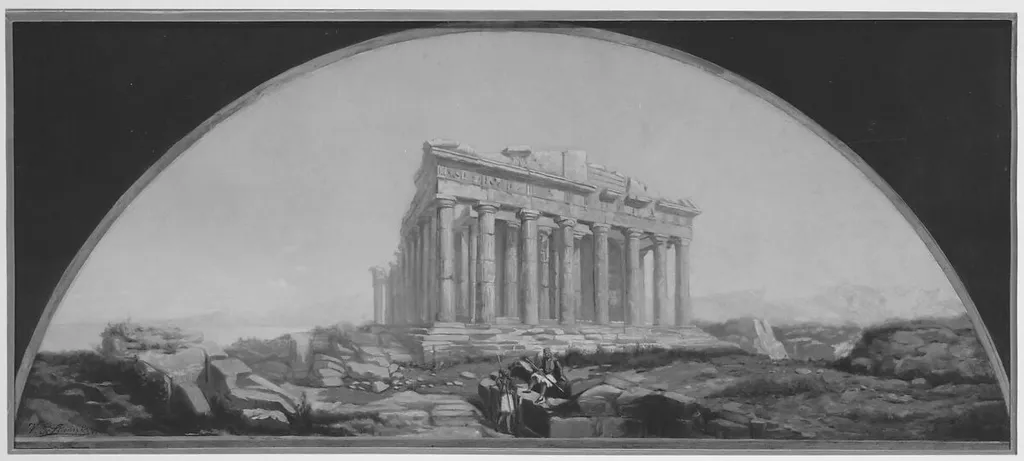
The Parthenon is an oil painting by the American Impressionist artist Vincent G. Stiepevich. It dates from 1880 and is held in the collection of the Metropolitan Museum of Art. Vincent G.
About this work
You see the Parthenon in Athens, bathed in golden afternoon light, its columns sharp against a pale sky.
This painting was made in 1880 by an American artist who never left the U.S. He worked from photographs and sketches sent by travelers. The colors feel almost too bright—like a postcard before postcards existed.
If you like this quiet, sunlit view of ancient ruins, look up *buildings*.
Overview
Vincent G. Stiepevich’s 1880 oil painting titled *The Parthenon* presents a sun‑lit view of the ancient Athenian temple. Executed on canvas, the work captures the marble structure bathed in a warm, golden afternoon glow, its columns sharply outlined against a pale sky.
Subject & Meaning
The composition focuses on the iconic silhouette of the Parthenon, emphasizing its classical geometry and the serene atmosphere of a quiet ruin. By isolating the temple in bright daylight, Stiepevich invites contemplation of antiquity’s enduring presence within a modern visual framework.
Technique & Style
Stiepevich employs a vivid palette that borders on the hyper‑real, with colors that recall the saturated tones of early postcards. The brushwork is smooth and precise, rendering the marble surfaces with a clarity that suggests a photographic source rather than direct observation.
History & Provenance
Although the artist never traveled abroad, he assembled the image from photographs and sketches supplied by travelers to Greece. Completed in 1880, the painting entered the American Wing collection, where it remains displayed as an example of 19th‑century American interest in classical architecture.
Context
The work reflects a broader 19th‑century fascination in the United States with European antiquities, often mediated through printed images. Stiepevich’s reliance on secondary visual material illustrates how American artists of the period accessed distant subjects without leaving the country.
Artist & collection

