Artwork
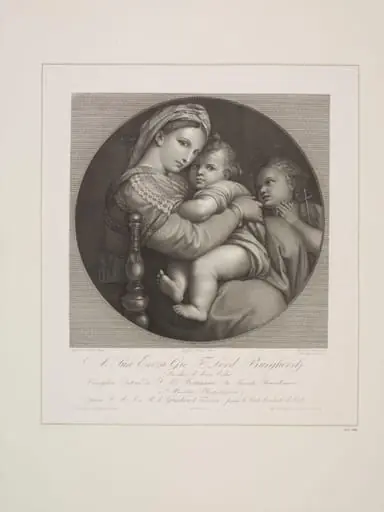
La Madonna della Casa d' Alba
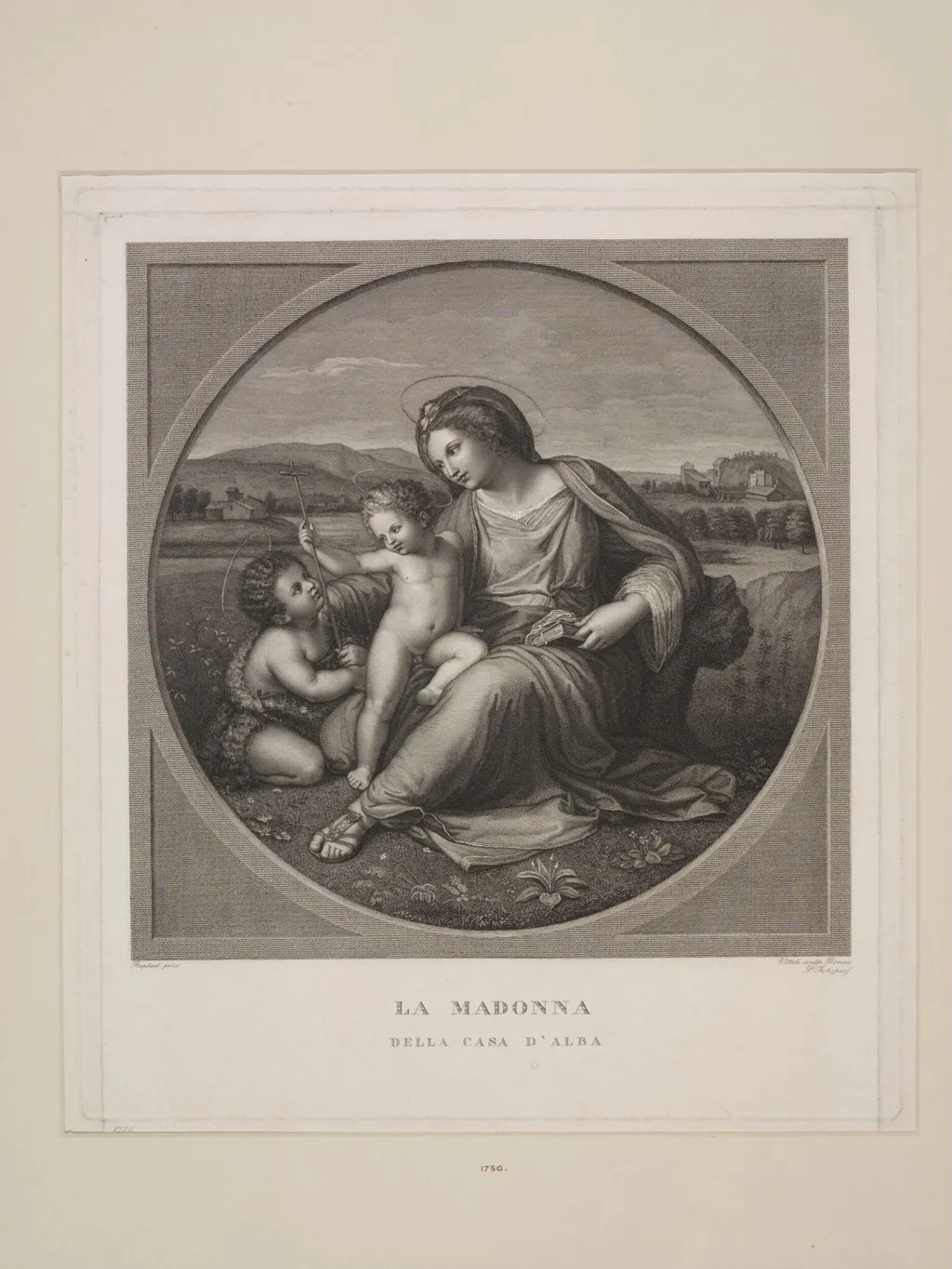
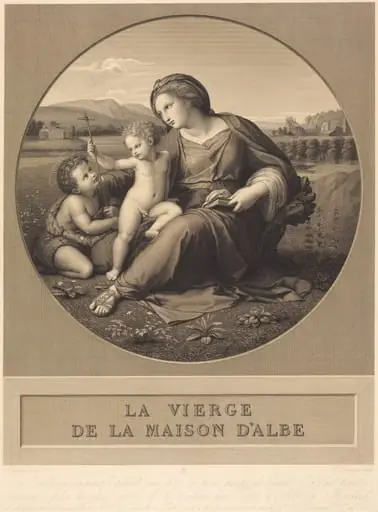
La Madonna della Casa d' Alba is a print by Pietro Marco Vitali. It dates from 1850 and is held in the collection of the Victoria and Albert Museum. This print, titled *La Madonna della Casa d'Alba*, is a reproductive engraving based on a lost painting by Raphael.
About this work
Overview
The work belongs to a tradition of disseminating Renaissance imagery through print, making high art accessible beyond elite collections.
This print, titled *La Madonna della Casa d'Alba*, is a reproductive engraving based on a lost painting by Raphael. Created in Rome by Pietro Marco Vitali and printed by P. Folo, it translates the original composition into a detailed black-and-white impression on paper. The work belongs to a tradition of disseminating Renaissance imagery through print, making high art accessible beyond elite collections.
Subject & Meaning
The image depicts the Virgin Mary seated with two children: one on her lap, the other kneeling beside her. Their intimate gaze and circular arrangement suggest familial tenderness and spiritual unity. The composition reflects the devotional tradition of the Madonna and Child, with the second child likely representing the young John the Baptist. The quiet interaction emphasizes humility and sacred connection rather than grandeur.
Technique & Style
Pietro Marco Vitali employed fine linear engraving to render the figures and landscape with precision. Delicate hatching defines fabric folds and facial features, while the background hills and distant architecture are suggested through subtle tonal gradations. The composition is tightly framed within an implied circular space, drawing focus to the central group and isolating them from the surrounding environment.
History & Provenance
The original painting, attributed to Raphael, was once owned by the Alba family in Rome, hence the print’s title. After the painting’s disappearance, Vitali’s engraving became one of the primary visual records of its composition. Printed in the 18th century, the work circulated among collectors and artists, preserving the image through reproduction when the source was no longer publicly accessible.
Context
In 18th-century Rome, reproductive engravings served as educational tools and cultural artifacts, bridging the gap between original masterpieces and wider audiences. Vitali’s print aligns with a broader practice of engraving Renaissance works to sustain their influence. This was a time when printmaking was central to art historical memory, especially for lost or inaccessible paintings.
Legacy
Though the original painting is lost, Vitali’s engraving remains a key document of its form and composition. It has been referenced in scholarly studies of Raphael’s devotional imagery and the transmission of Renaissance motifs through print. The work exemplifies how engraving preserved visual culture beyond the lifespan of its source, ensuring continuity in artistic tradition.
Artist & collection
Artist
Pietro Marco Vitali made religious prints in the late 1700s. His engraving La Madonna della Casa d'Alba shows the Virgin and Child in soft light, typical of the era’s devotional art. Look for the gentle folds in Mary’s…