Artwork
Greenwich Park
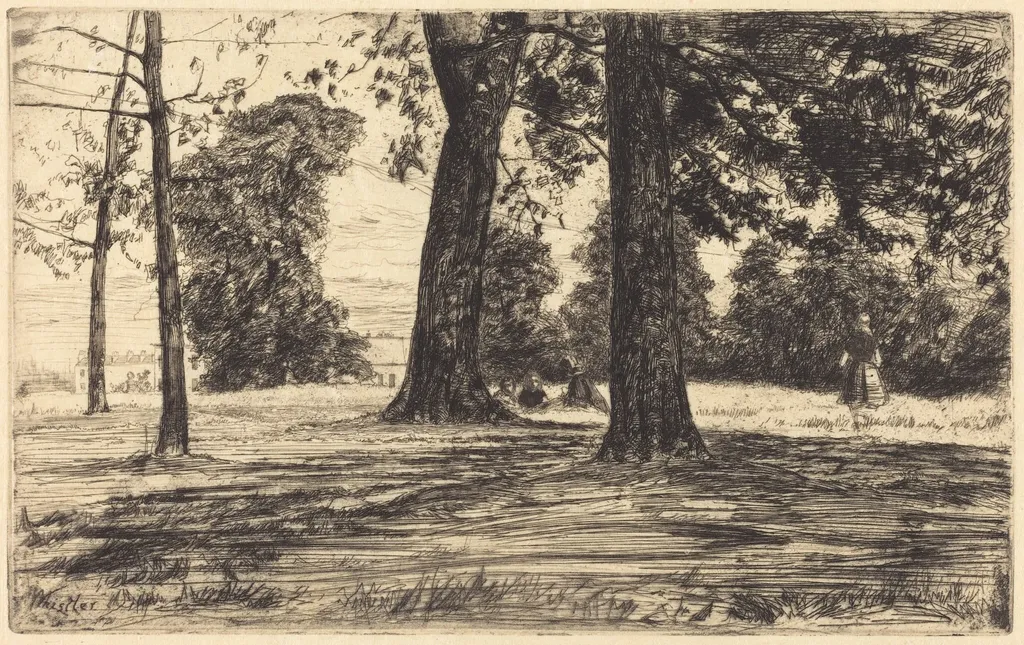
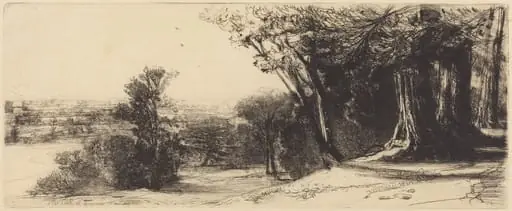
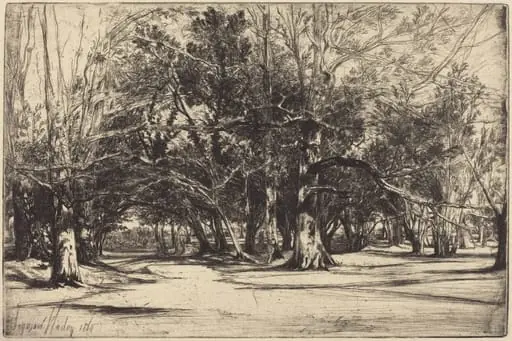
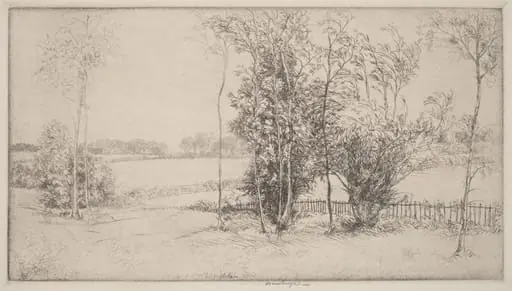
Greenwich Park is an ink print by the Impressionist artist James McNeill Whistler. It dates from 1859 and is held in the collection of the National Gallery of Art.
About this work
Overview
Created in 1859, *Greenwich Park* is an etching and drypoint on thin Japanese paper, made during James McNeill Whistler’s formative years in London.
Created in 1859, *Greenwich Park* is an etching and drypoint on thin Japanese paper, made during James McNeill Whistler’s formative years in London. The work exemplifies his early commitment to printmaking as a serious artistic medium, distinct from but complementary to his painting. Its delicate black-and-white tonality and restrained composition reflect his growing interest in subtle visual harmony over narrative detail.
Subject & Meaning
The scene depicts a tranquil stretch of Greenwich Park, framed by two tall trees and a winding path. A solitary figure walks beneath them, while a small group lingers near a tent in the distance. There is no overt story or moral; instead, the focus lies in the quietude of the moment, emphasizing atmosphere over event. The composition invites contemplation, aligning with Whistler’s view of art as an arrangement of form and tone.
Technique & Style
Whistler employed fine etched lines and drypoint burr to build texture and depth, particularly in the grassy ground and the bark of the trees. The overlapping strokes create a sense of luminosity and volume, with shadows suggested through dense, wavy lines rather than solid black. The thin, fibrous japon mince paper enhances the delicacy of the ink, allowing the paper’s texture to interact with the ink’s grain, producing a tactile, layered surface.
History & Provenance
Made shortly after Whistler settled in London, this print emerged from his active participation in the city’s printmaking circles. It was likely produced for private circulation among artists and collectors rather than mass distribution. The work remained within his personal collection for some time before entering institutional holdings, reflecting its status as an experimental study rather than a commercial product.
Context
In the late 1850s, British artists were revisiting etching as a medium for personal expression, moving away from reproductive prints toward original compositions. Whistler’s work aligned with this revival, influenced by Dutch and French printmakers who prioritized mood over detail. His focus on tonal gradation and spatial ambiguity placed him at the forefront of a shift toward modernist sensibilities in printmaking.
Legacy
Though not widely exhibited in his lifetime, *Greenwich Park* became a touchstone for later artists exploring the expressive potential of etching. Its emphasis on atmosphere, minimalism, and material sensitivity influenced the Aesthetic Movement and early 20th-century printmakers. The work endures as a quiet example of how technical restraint can evoke emotional resonance without overt symbolism.
Own this work as a print
Artist & collection
Artist
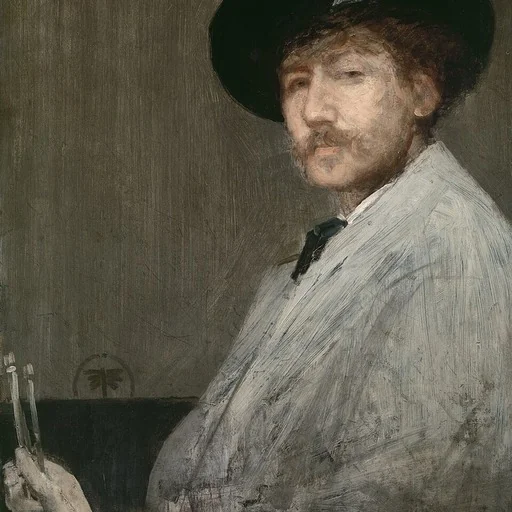
James Abbott McNeill Whistler was an American painter in oils and watercolor, and printmaker, active during the American Gilded Age and based primarily in the United Kingdom.

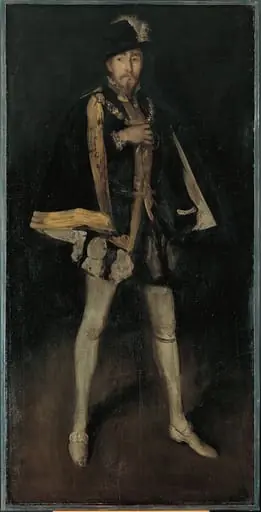 Arrangement in Black, No. 3: Sir Henry Irving as Philip II of Spain
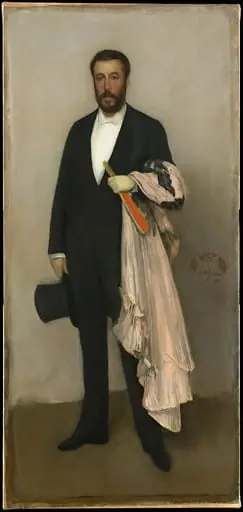 Arrangement in Flesh Colour and Black: Portrait of Theodore Duret
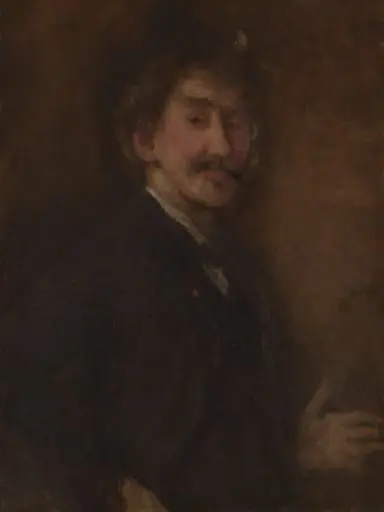 Gold and Brown: Self-Portrait
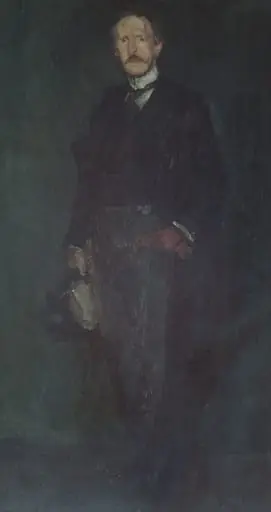 Edward Guthrie Kennedy
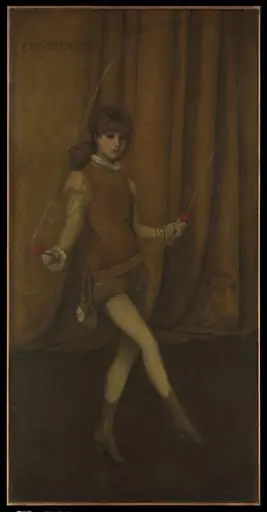 Harmony in Yellow and Gold: The Gold Girl—Connie Gilchrist
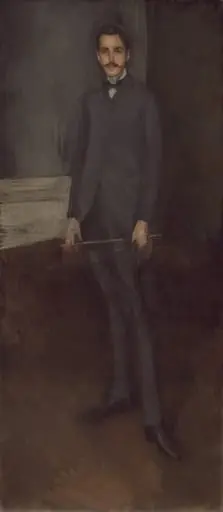 George W. Vanderbilt
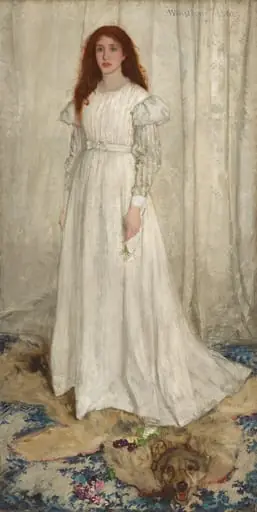 Symphony in White, No. 1: The White Girl
 Henry Irving as Philip II of Spain