Artwork
The Holly Field
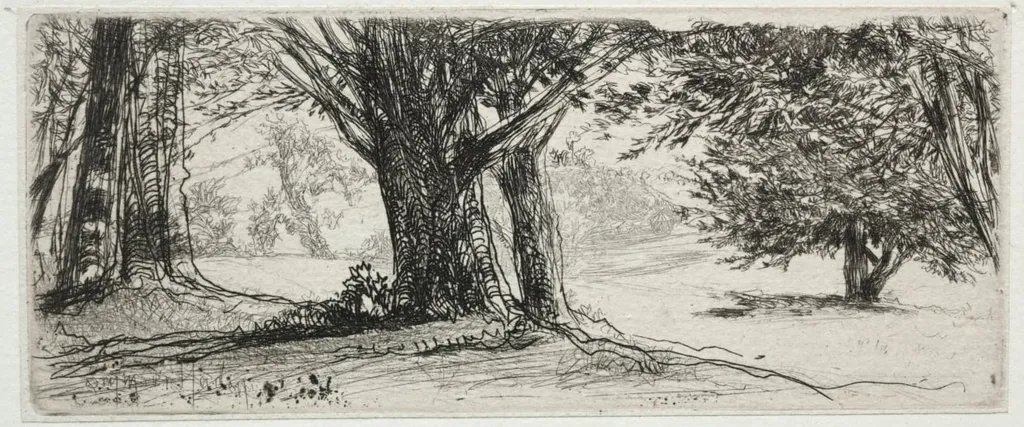
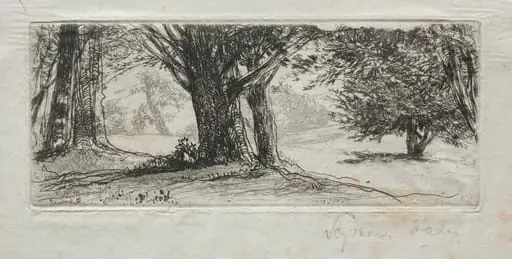
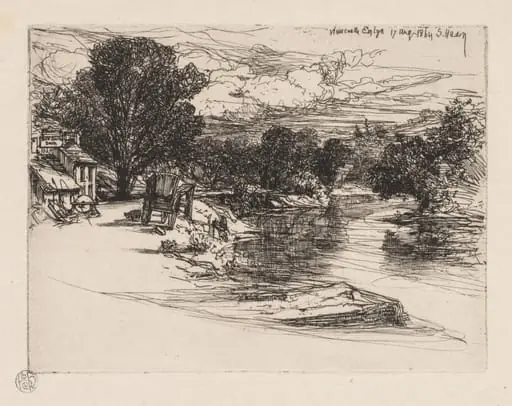
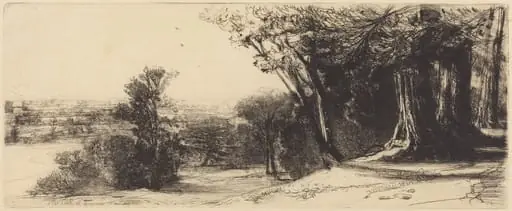
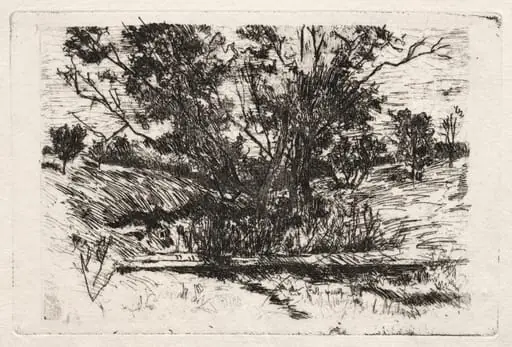
The Holly Field is a print by the Impressionist artist Francis Seymour Haden. It dates from 1860 and is held in the collection of the Cleveland Museum of Art.
About this work
Overview
Unlike oil paintings of the period, this piece relies on ink and line to evoke atmosphere rather than color.
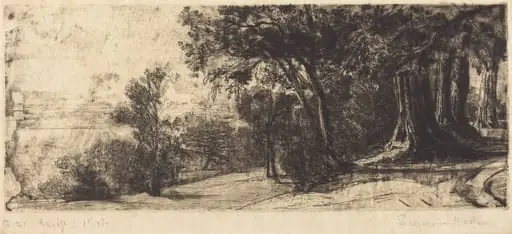
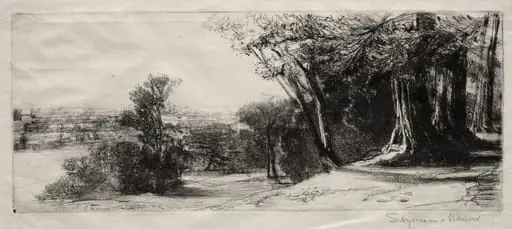
The Holly Field is an 1860 print by Francis Seymour Haden, executed in etching and drypoint. It depicts a quiet woodland scene with dense foliage and distant open ground. The work is part of the collection at The Cleveland Museum of Art, where it is recognized for its quiet observational tone and technical precision in tonal rendering. Unlike oil paintings of the period, this piece relies on ink and line to evoke atmosphere rather than color.
Subject & Meaning
The scene presents an unpopulated stretch of holly and deciduous trees, suggesting a secluded English countryside. There is no human presence, no narrative, only the quiet persistence of nature. The composition invites contemplation rather than storytelling, reflecting a 19th-century shift toward landscape as an end in itself. The stillness and absence of drama align with contemporary ideals of naturalism and introspective observation.
Technique & Style
Haden employed etching and drypoint to build subtle gradations of tone. Fine, overlapping lines create texture in the foliage, while broader strokes suggest depth in the background. The absence of color is compensated by nuanced ink densities, with darker areas anchoring the foreground and lighter tones receding into the distance. The technique emphasizes tactile surface and atmospheric modulation over sharp definition.
History & Provenance
Created in 1860, the print was made during Haden’s active period as a printmaker, following his medical career and concurrent engagement with the Etching Revival. It entered The Cleveland Museum of Art’s collection in the 20th century, likely through a donation or acquisition focused on British graphic art. Its preservation reflects growing institutional interest in 19th-century printmaking as a legitimate fine art form.
Context
Haden worked alongside contemporaries like James McNeill Whistler, contributing to a movement that elevated printmaking beyond reproduction to original artistic expression. The Holly Field reflects broader Victorian interests in naturalism and the pastoral, while resisting romanticized or dramatic interpretations. Its quietude contrasts with the industrializing landscape of mid-century Britain, offering a retreat into stillness.
Legacy
The work stands as an example of Haden’s influence on British printmaking, demonstrating how etching could convey mood through tonal subtlety rather than detail. It helped legitimize landscape printmaking as a serious genre. While not widely reproduced, it remains a touchstone in studies of 19th-century graphic art, valued for its restraint and technical discipline.
Artist & collection

![Forest on Lago Maggiore [Foresta sul Lago Maggiore], by Giberto Borromeo](https://artifactworldgallery.com/img/giberto-borromeo--forest-on-lago-maggiore-foresta-sul-lago-maggiore--6d25270befdb299f-w320.webp)