Artwork
Plate
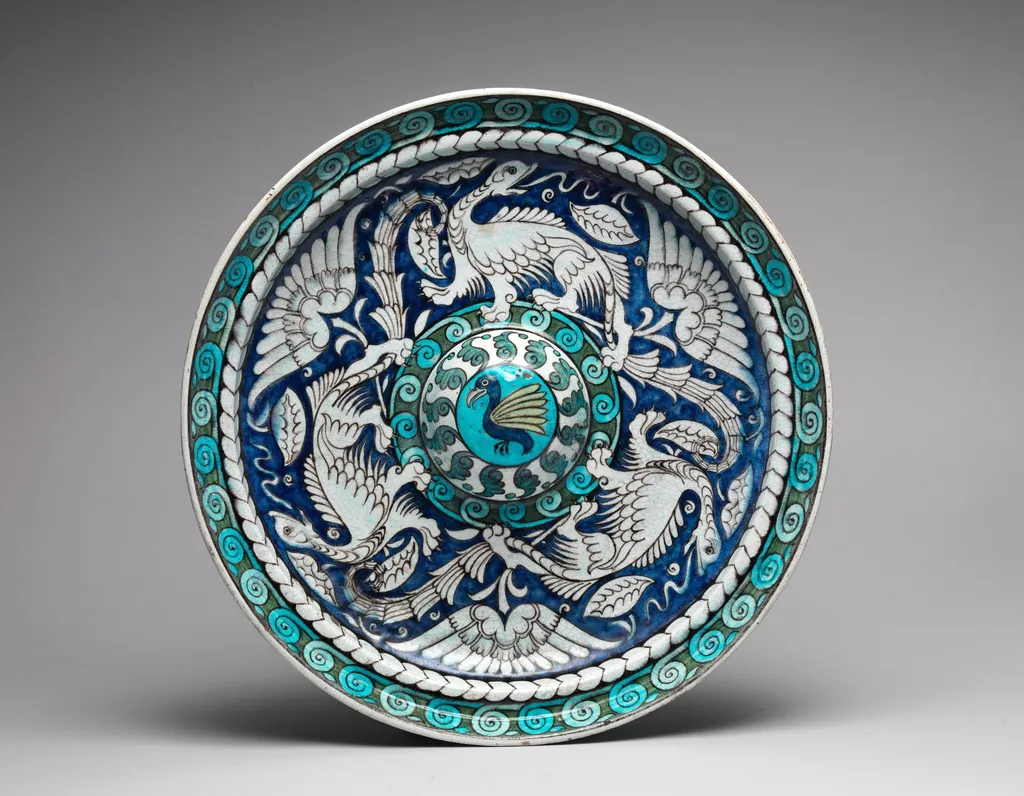
Plate is an unspecified painting by the Arts and Crafts movement artist William De Morgan. It dates from 1896 and is held in the collection of the Metropolitan Museum of Art.
About this work
Overview
This ceramic plate, created by William De Morgan in 1896, is part of the collection at The Metropolitan Museum of Art. It exemplifies De Morgan's distinctive decorative approach, featuring a complex design rendered in a limited color palette. As a functional yet highly artistic object, it reflects the aesthetic principles prevalent in late 19th-century decorative arts.
Subject & Meaning
Dominant motifs include stylized birds, some appearing in flight, others seemingly perched amidst foliage.
The plate's circular surface is adorned with an intricate blue and white pattern. Dominant motifs include stylized birds, some appearing in flight, others seemingly perched amidst foliage. Interspersed throughout the composition are swirling spirals and delicate leaf forms. The original description also mentions a dragon, which would integrate into this fantastical and organic decorative scheme, contributing to the plate's overall narrative of natural elements.
Technique & Style
Crafted from ceramic, the plate features a lustrous, glossy finish that enhances its detailed ornamentation. The design is executed entirely in shades of blue and white, a choice that imparts a sense of tranquility and visual clarity. This restricted palette, combined with the dense arrangement of natural and mythological forms, showcases a meticulous approach to surface decoration, characteristic of De Morgan's ceramic output.
Artist & collection
Artist
William De Morgan made richly colored ceramic plates and tiles in the late 1800s, often painting mythical scenes and intricate floral patterns in deep blues, greens, and ruby reds.
