Artwork
Eagle's Nest, Franconia Notch
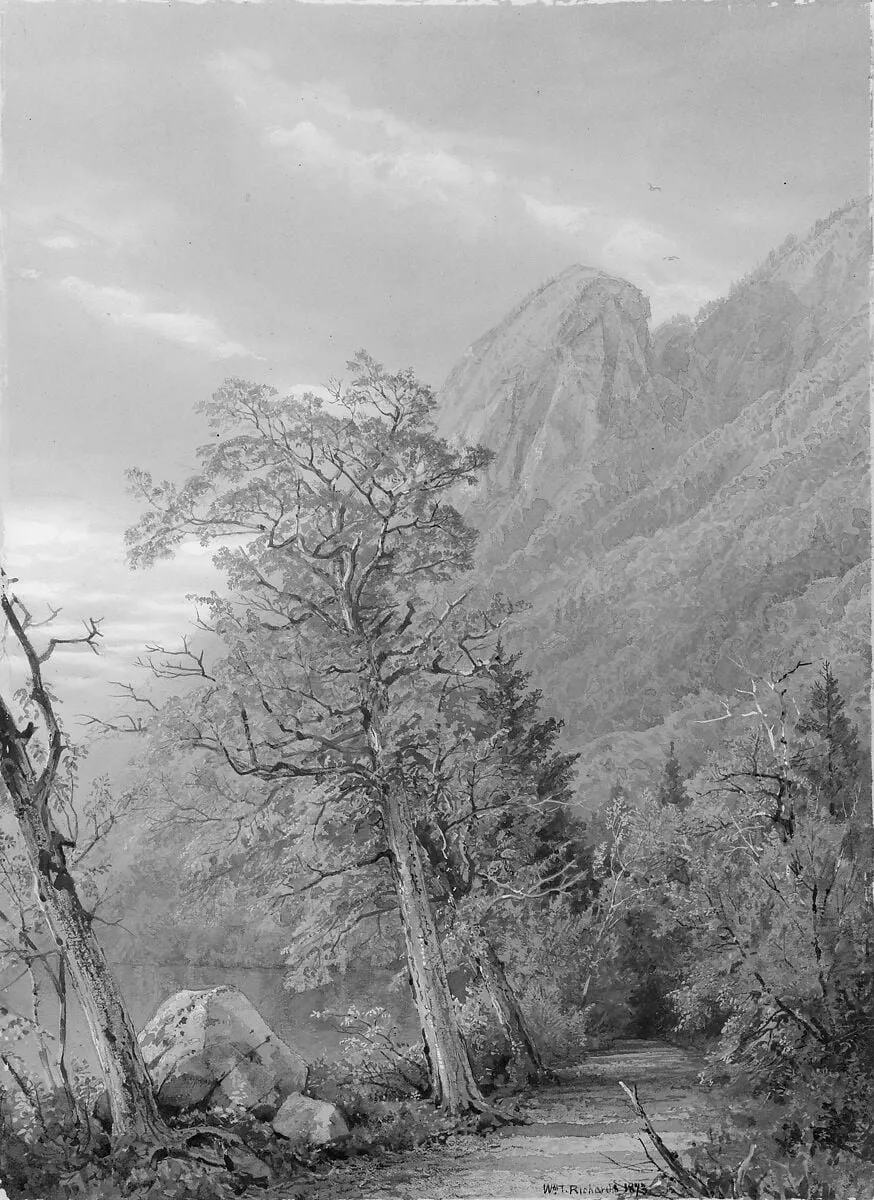
Eagle's Nest, Franconia Notch is a watercolor work on paper by the Hudson River School artist William Trost Richards. It dates from 1873 and is held in the collection of the Metropolitan Museum of Art.
About this work
You see a steep mountain slope covered in dark evergreens, a single bare tree jutting out near the top, and a pale sky above.
You see a steep mountain slope covered in dark evergreens, a single bare tree jutting out near the top, and a pale sky above.
Richards painted this in 1873, right when artists were leaving the studio to work outdoors. He used thin, overlapping washes—like watery layers of color—to build the misty feel of the forest. The bare tree stands out because he left the paper white underneath, letting light shine through.
If you like this quiet way of painting trees, look up the subject landscapes.
Overview
William Trost Richards’ 1873 work, Eagle’s Nest, Franconia Notch, is a small landscape executed in watercolor, gouache, and graphite on light‑tan wove paper. The composition presents a sharply inclined mountain slope clothed in dense, dark evergreens, a solitary leafless tree near the crest, and a pale sky that occupies the upper field.
Subject & Meaning
The painting isolates a single, stark tree against a backdrop of forested slope, emphasizing the quiet solitude of the high‑altitude environment. The contrast between the dark foliage and the illuminated tree suggests a moment of stillness within an otherwise rugged landscape.
Technique & Style
Richards applied thin, overlapping washes of watercolor and gouache, allowing the pigments to build a mist‑laden atmosphere. By leaving portions of the paper unpainted beneath the bare trunk, he creates a luminous effect that conveys the interplay of light and shadow on the tree’s surface.
History & Provenance
Created during a period when American artists were increasingly painting en plein air, the work reflects the shift from studio‑based practice to direct observation of nature. It now forms part of the American Wing collection, where it is displayed alongside other 19th‑century landscape studies.
Artist & collection