Artwork
The Mount Washington Range, from Mount Kearsarge
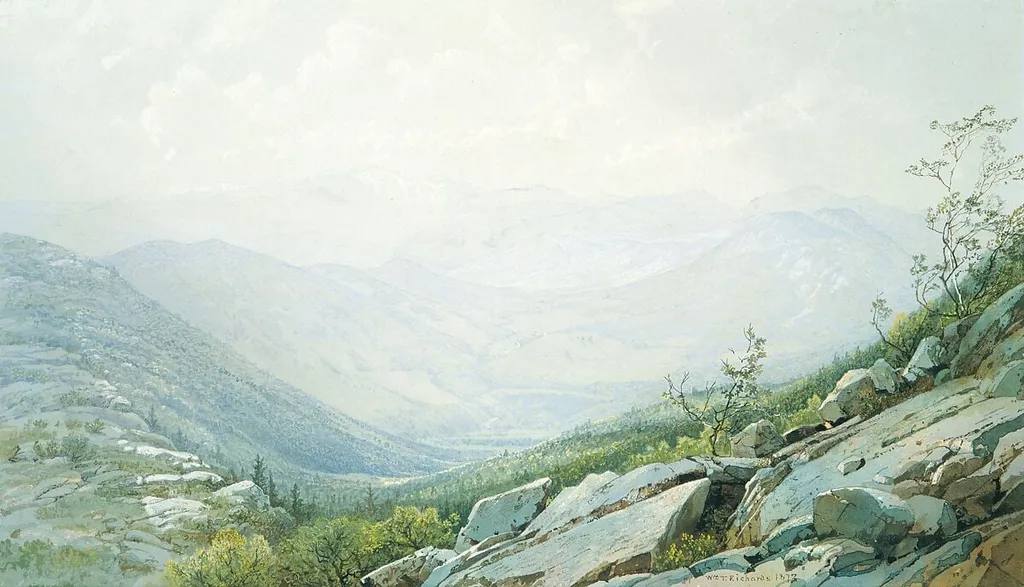
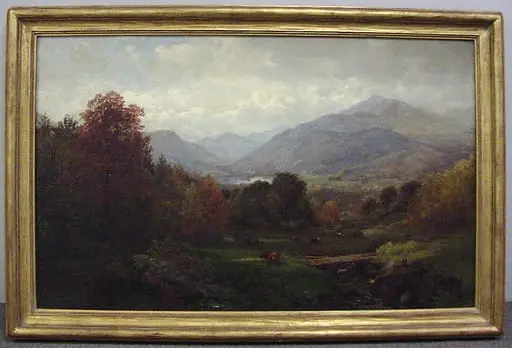
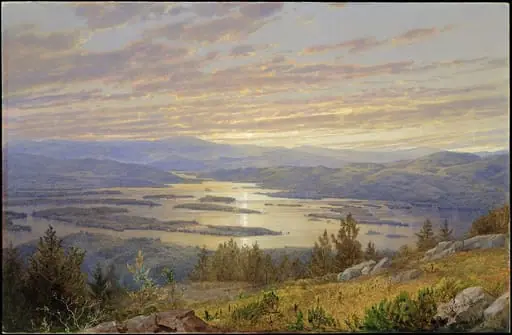
The Mount Washington Range, from Mount Kearsarge is a gouache work on paper by the Hudson River School artist William Trost Richards. It dates from 1872 and is held in the collection of the Metropolitan Museum of Art.
About this work
Overview
Depicting the White Mountains of New Hampshire, the composition views the distant Mount Washington range from the vantage point of Mount Kearsarge.
The Mount Washington Range, from Mount Kearsarge is a 1872 watercolor, gouache, and graphite work by American artist William Trost Richards. Depicting the White Mountains of New Hampshire, the composition views the distant Mount Washington range from the vantage point of Mount Kearsarge. Richards employs a meticulous technique characteristic of his mature style, utilizing tiny, overlapping strokes of watercolor and opaque gouache to render atmospheric depth and geological texture. The light gray-green wove paper serves as an active element, allowing its tone to unify the hazy peaks and soft cloud formations. Executed during a period when Richards transitioned from the broad romanticism of the Hudson River School toward a more precise, scientific observation of nature, this piece exemplifies his dedication to capturing specific light conditions and topographical accuracy. The work reflects the 19th-century American fascination with the sublime wilderness while demonstrating the artist's mastery of the watercolor medium to convey both the grandeur of the landscape and the delicate nuances of the atmosphere.
Subject & Meaning
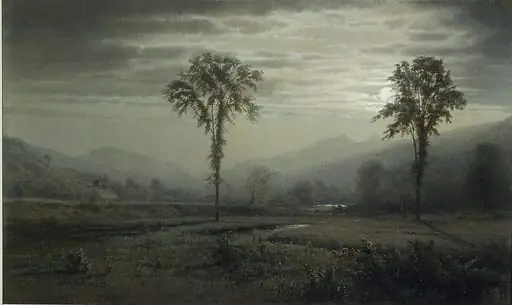
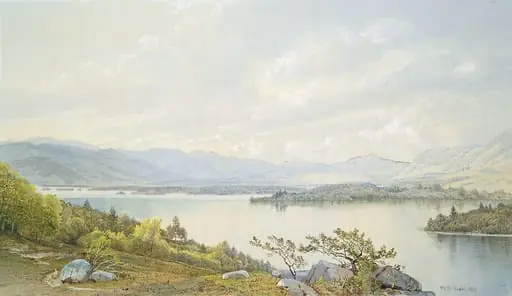
The artwork portrays a tranquil mountain range beneath a gentle, overcast sky. Richards focused on the distinctive forms of Mount Kearsarge and Mount Washington, among other peaks, rendering them with a sense of both clarity and atmospheric distance. The composition emphasizes the vastness and quietude of the natural landscape, inviting contemplation of the New England wilderness. The peaks appear defined yet softened by the ambient light and atmospheric conditions.
Technique & Style
Richards employed watercolor, gouache, and graphite on a light gray-green paper, allowing the paper's inherent tone to contribute to the overall cool palette. He built the scene using numerous small, overlapping strokes, creating a soft, textured effect. Opaque gouache was selectively applied to highlight areas, such as the distant snow, imbuing them with a luminous quality. This technique effectively conveys depth and atmospheric perspective without relying on strong contrasts or deep shadows.
Artist & collection