Artwork
The Prodigal Son in Misery
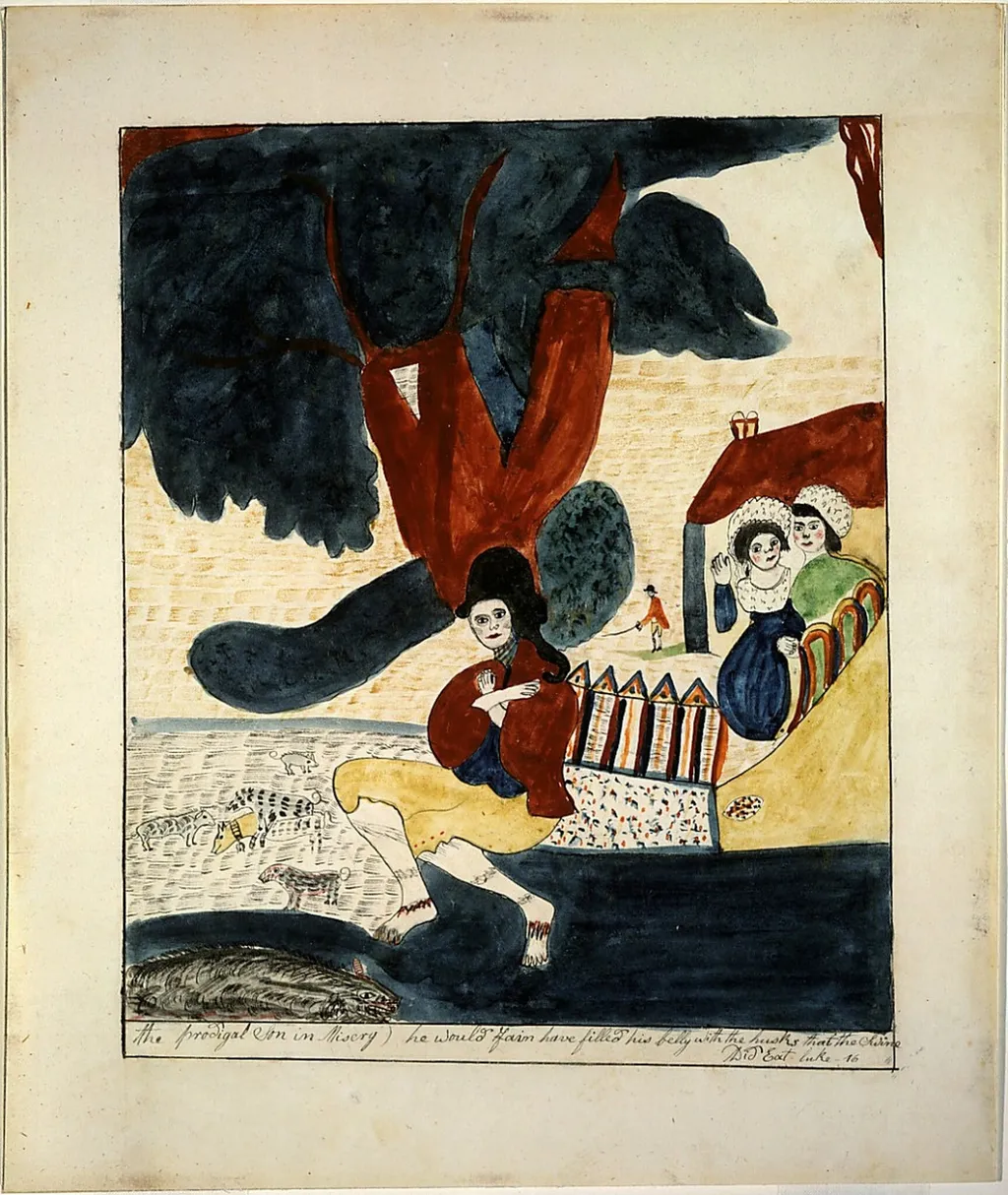
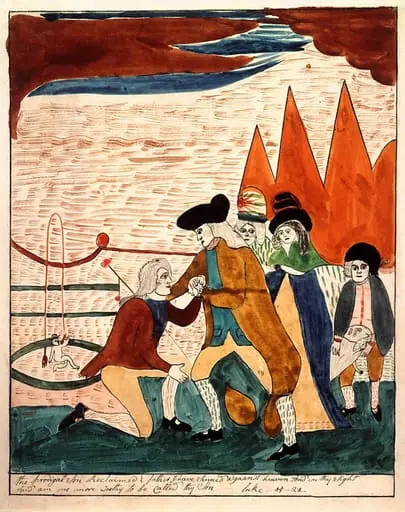
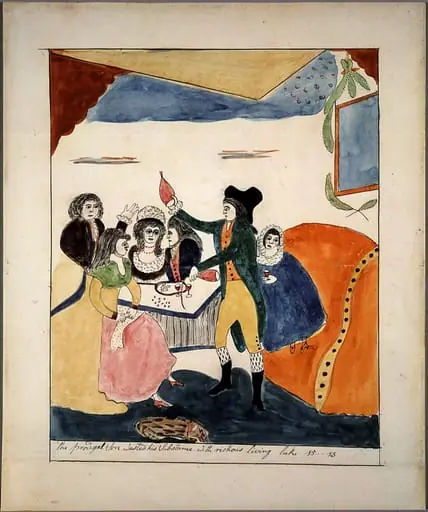
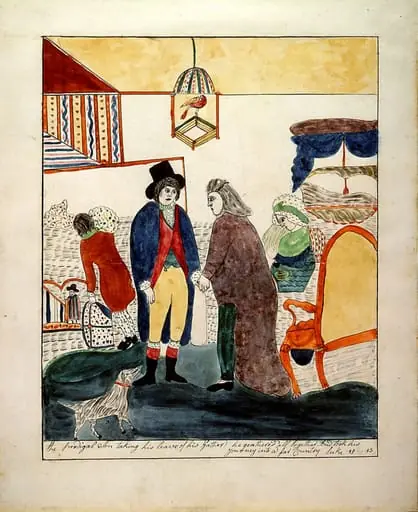
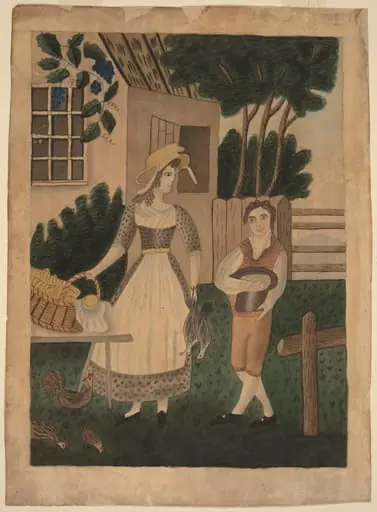
The Prodigal Son in Misery is an ink drawing by the Romanticist artist Mary Ann Willson. It dates from 1815 and is held in the collection of the National Gallery of Art.
About this work
Overview
This piece stands as one of the earliest known American watercolor drawings to engage with biblical narrative through a distinctly regional aesthetic.
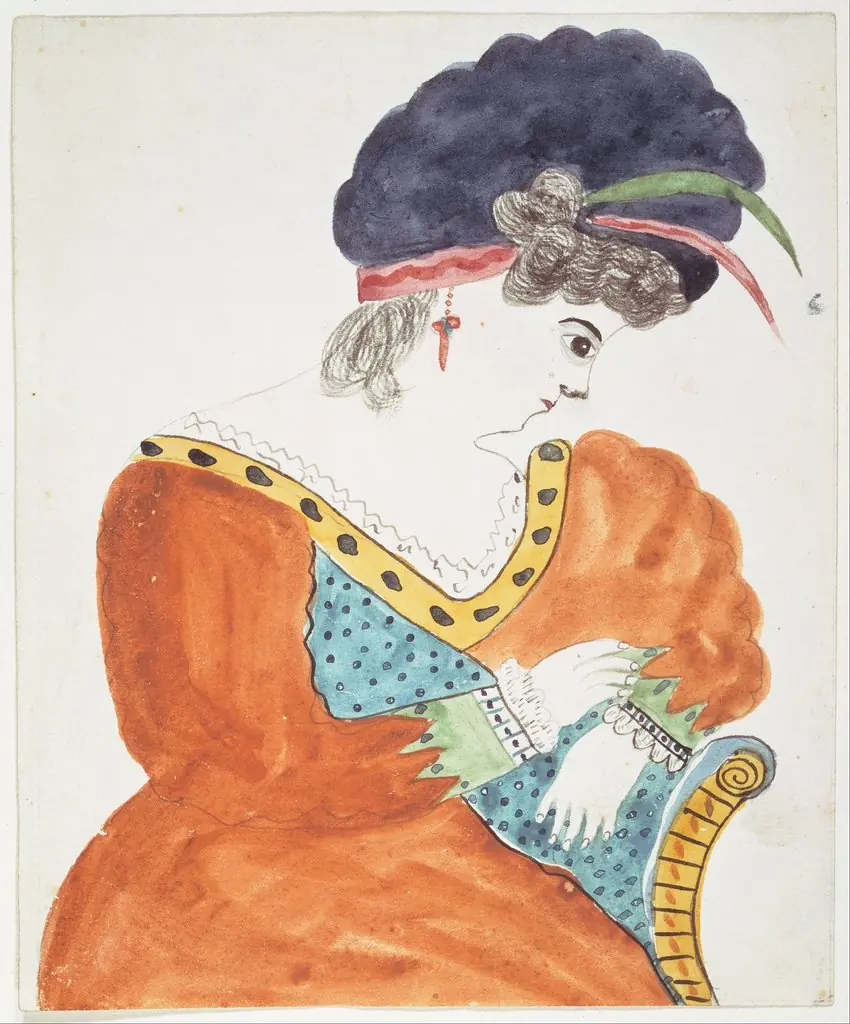
Created around 1815 by Mary Ann Willson, *The Prodigal Son in Misery* is a small watercolor and ink drawing that reflects the visual language of early American folk art. Willson, active between 1810 and 1825, left behind a limited body of work, most of which was unknown until its rediscovery in a 1944 exhibition. This piece stands as one of the earliest known American watercolor drawings to engage with biblical narrative through a distinctly regional aesthetic.
Subject & Meaning
The drawing illustrates the biblical parable of the Prodigal Son, depicting him in a state of destitution, seated among pigs and eating scraps. Two women observe from beneath a shelter, their distance emphasizing his isolation. The scene conveys moral consequence without overt judgment, focusing instead on physical hardship and solitude. The title, inscribed at the base, anchors the image in scriptural tradition while inviting viewers to reflect on themes of loss and redemption.
Technique & Style
Willson employed pen and black ink to define bold, unmodulated outlines, then applied flat washes of watercolor to create vivid, unblended fields of color—yellow fields, dark storm clouds, and a striped fence. The lack of shading or perspective reinforces a decorative, two-dimensional quality. This direct approach, prioritizing clarity over realism, aligns with the conventions of folk art, where symbolic expression outweighs naturalistic detail.
History & Provenance
Little is known of Mary Ann Willson’s life beyond her artistic activity in rural New York during the early 1800s. Her works remained obscure until 1944, when a collection of her drawings was exhibited as part of a survey of American Primitive art. *The Prodigal Son in Misery* was among the pieces that drew scholarly attention, establishing her as an early practitioner of watercolor in America despite the absence of archival records about her training or patrons.
Context
In early 19th-century America, religious imagery was commonly adapted for domestic and educational use, especially in communities with limited access to trained artists. Willson’s work reflects this trend, translating biblical stories into accessible visual forms using locally available materials. Her style, untrained yet deliberate, resonates with other self-taught artists of the period who interpreted sacred narratives through personal, regional lenses.
Legacy
Willson’s drawings, including this one, are now recognized as significant examples of early American watercolor and folk expression. Though her oeuvre is small and her biography sparse, her work contributes to broader understandings of how religious themes were visually negotiated outside academic traditions. Her use of color and form influenced later scholarship on self-taught artists and the diversity of early American visual culture.
Artist & collection
Artist
Mary Ann Willson (active 1810 to 1825) was an American folk artist whose work remained undiscovered for over a century, until it appeared in an exhibition of American Primitive paintings in 1944.