Artwork
H Beard Print Collection
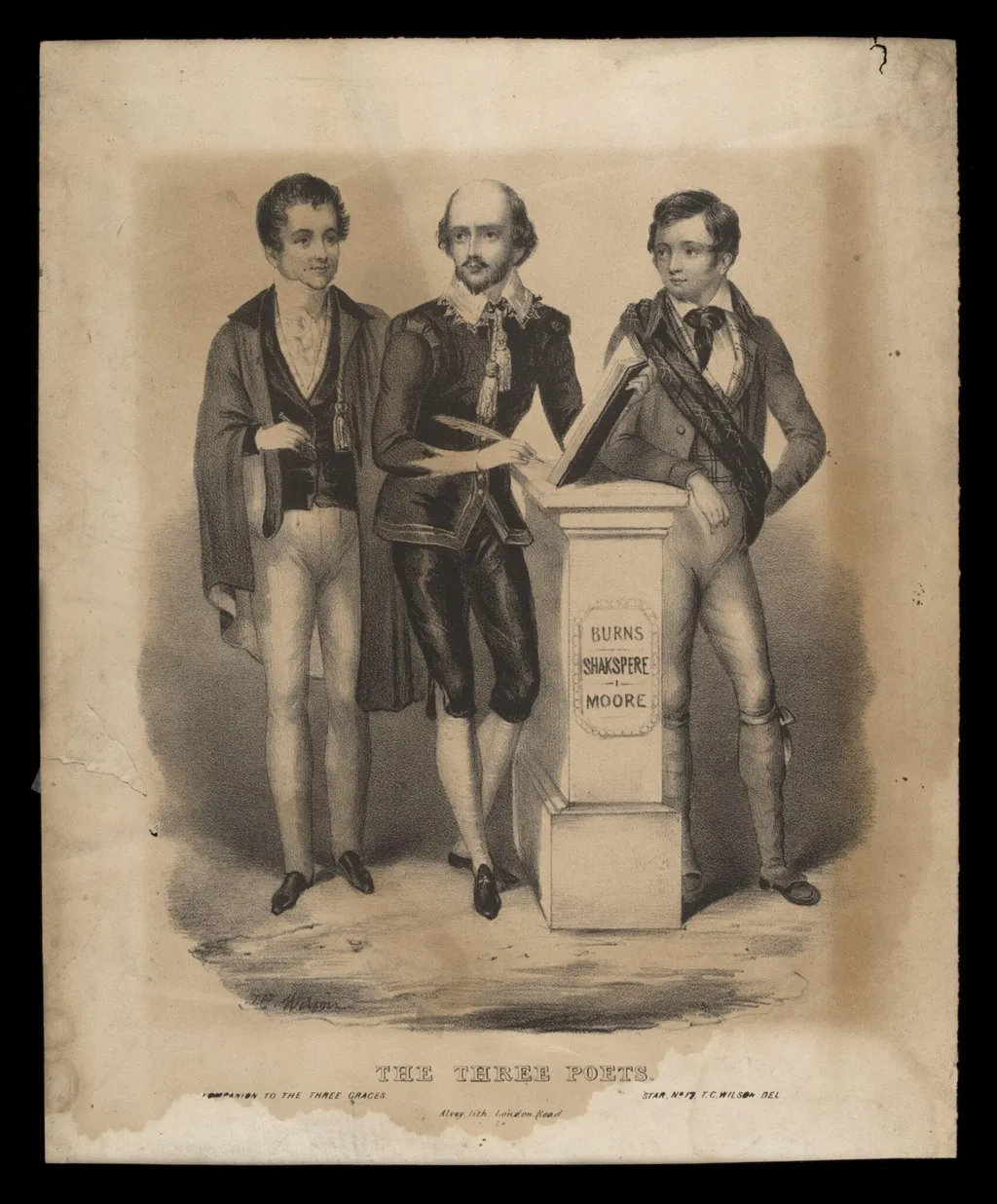
H Beard Print Collection is a print by T. C. Wilson. It dates from 1850 and is held in the collection of the Victoria and Albert Museum. This print is part of the H.
About this work
The print is titled H Beard Print Collection by Wilson, T. C.
It depicts The Three Poets: Burns, Shakespeare, and Moore. This print was created in the early 19th century and printed in London by Alvey. The fact that it was printed in London adds context to its creation.
You can learn more about similar prints by visiting the Victoria and Albert Museum.
Overview
It portrays three prominent literary figures—Robert Burns, William Shakespeare, and Thomas Moore—arranged in a single compositional field.
This print is part of the H. Beard Print Collection, attributed to T. C. Wilson. It portrays three prominent literary figures—Robert Burns, William Shakespeare, and Thomas Moore—arranged in a single compositional field. Produced in London during the early 1800s, it was published by Alvey, a known printer of illustrated literary subjects at the time. The work reflects a broader 19th-century interest in commemorating national literary heritage through accessible printed imagery.
Subject & Meaning
The print unites three poets associated with British and Irish literary tradition: Shakespeare as the foundational dramatist, Burns as the voice of Scottish vernacular poetry, and Moore as a popular Romantic lyricist. Their collective depiction suggests an effort to canonize national literary identity. The arrangement implies equality among them, though stylistic differences in their rendering may reflect contemporary perceptions of their relative stature or cultural resonance.
Technique & Style
Executed as a printed image using standard engraving or etching methods of the period, the work relies on fine linear detail to define facial features and clothing. The figures are presented in profile or three-quarter view, typical of 19th-century portrait prints. Background elements are minimal, focusing attention on the subjects. The tone is formal and restrained, consistent with the era’s preference for dignified, commemorative portraiture in mass-produced prints.
History & Provenance
The print was produced in London by Alvey, a publisher active in the early 19th century specializing in literary and historical prints. It entered the H. Beard Collection, a private assemblage of 19th-century British prints focused on theatrical and literary subjects. The collection’s existence indicates a market for such imagery among middle-class audiences seeking cultural enrichment through affordable art.
Context
During the early 1800s, Britain experienced a surge in the production of printed portraits of literary and historical figures, fueled by rising literacy and public interest in national identity. Publishers like Alvey met this demand by creating affordable images for homes and schools. The inclusion of Burns alongside Shakespeare and Moore reflects the expanding cultural recognition of Scottish writers within the broader British canon.
Legacy
This print survives as a modest example of popular visual culture from the early Victorian era. It contributes to the historical record of how literary figures were visually codified for public consumption. While not artistically groundbreaking, it offers insight into the mechanisms of cultural memory and the role of print in shaping collective literary reverence during a period of expanding educational access.
Artist & collection
Artist
T. C. Wilson was an American state legislator in Colorado. She was listed as a merchant from Victor, Colorado. She and W. A. Spooner represented Teller County and Park County. She chaired the Committee on Revision and…