Artwork
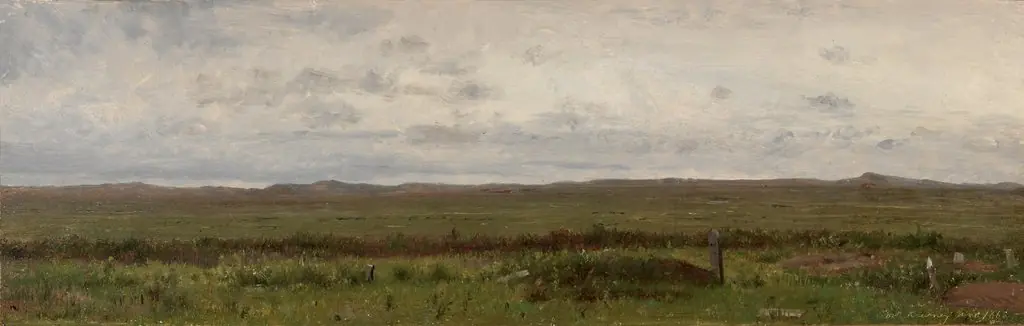
Graves of Travellers, Fort Kearny, Nebraska
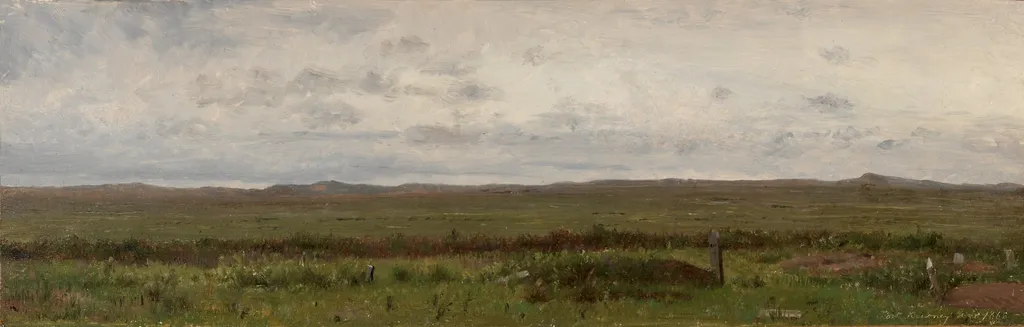
Graves of Travellers, Fort Kearny, Nebraska is an unspecified painting by the Hudson River School artist Worthington Whittredge. It dates from 1866 and is held in the collection of the Cleveland Museum of Art.
About this work
Overview
The painting reflects his firsthand experience traveling through the American frontier, translating the land’s stillness into a composed, contemplative image.
Painted in 1866 by Worthington Whittredge, this landscape captures a quiet stretch of prairie near Fort Kearny, Nebraska. Whittredge, a key figure in the Hudson River School, rendered the scene with careful observation, emphasizing the vastness of the western terrain. The painting reflects his firsthand experience traveling through the American frontier, translating the land’s stillness into a composed, contemplative image.
Subject & Meaning
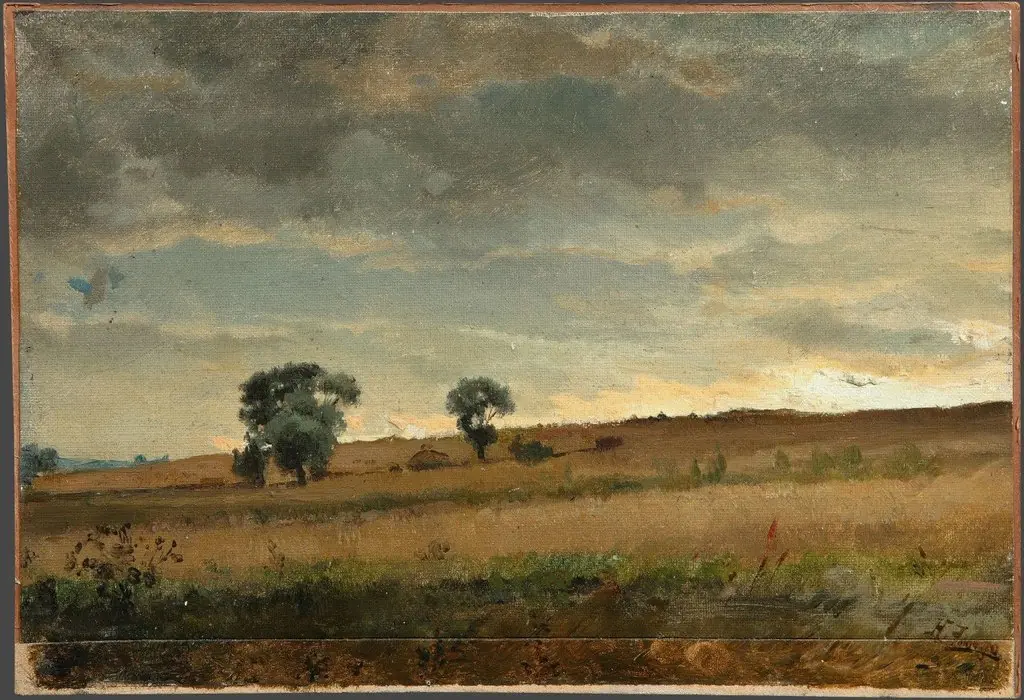
The painting centers on a series of low, unadorned mounds in the distance, marked by small white stones—graves of travelers who perished along the Oregon Trail. Their isolation and simplicity suggest the quiet mortality of those who ventured westward. The absence of human figures heightens the sense of loss and solitude, turning the landscape itself into a memorial to the unseen lives lost in the expansion of the nation.
Technique & Style
Whittredge employed a restrained palette of muted greens, browns, and grays to convey the subdued tones of the Nebraska prairie. Brushwork is precise yet unobtrusive, with attention to the texture of grass and the soft diffusion of light beneath overcast skies. The composition balances horizontal expanse with subtle vertical markers, guiding the eye toward the distant graves without dramatic emphasis, reinforcing the painting’s quiet solemnity.
History & Provenance
Created shortly after the Civil War, the painting emerged during a period of national reflection on westward expansion and its human cost. Whittredge likely based the scene on his 1860s travels with surveying parties. The work entered The Cleveland Museum of Art’s collection in the 20th century, where it remains as a documented example of 19th-century American landscape painting tied to real geographic and historical contexts.
Context
Fort Kearny served as a critical waystation for emigrants heading west along the Oregon and California Trails. By 1866, the fort’s role had diminished, but its surrounding landscape retained the traces of those who died en route. Whittredge’s depiction aligns with broader 19th-century American interests in documenting the land’s history through its physical remnants, offering a sober counterpoint to more celebratory frontier imagery.
Legacy
Though less known than the grand vistas of Bierstadt or Church, Whittredge’s restrained approach influenced later generations of landscape painters who favored introspection over spectacle. This work stands as a quiet testament to the personal toll of westward movement, preserving a somber, unromanticized record of the American frontier that continues to inform historical and artistic understandings of the era.
Artist & collection

Artist
Thomas Worthington Whittredge (May 22, 1820 – February 25, 1910) was an American artist of the Hudson River School.