Artwork
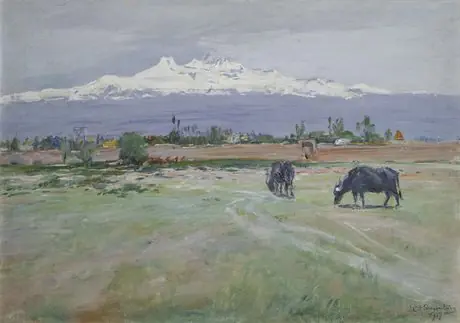
Mounth Ararat from Ejmiadzin
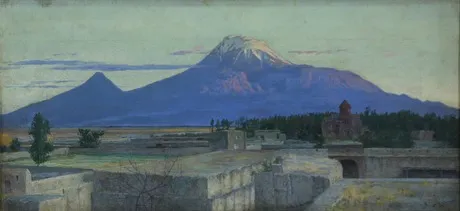
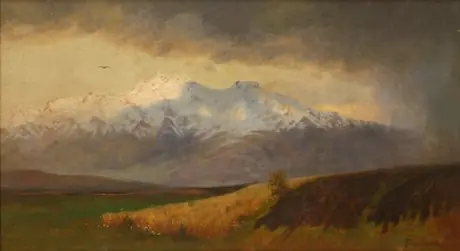
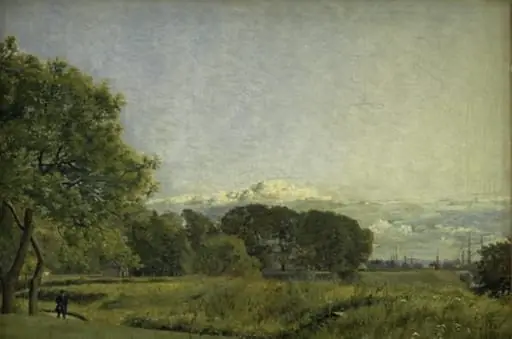
Mounth Ararat from Ejmiadzin is an oil painting by the Post-Impressionist artist Yeghishe Tadevosyan. It dates from 1898 and is held in the collection of the National Gallery of Armenia.
About this work
Overview
Painted in 1898 by Yeghishe Tadevosyan, this oil on canvas depicts the distant silhouette of Mount Ararat as seen from the town of Ejmiadzin.
Painted in 1898 by Yeghishe Tadevosyan, this oil on canvas depicts the distant silhouette of Mount Ararat as seen from the town of Ejmiadzin. The work belongs to the artist’s landscape series and reflects influences from both Russian realist and Symbolist traditions. It is currently part of the permanent collection at the National Gallery of Armenia, where it remains one of the most recognized depictions of the region’s sacred geography.
Subject & Meaning
The painting centers on Mount Ararat, a symbol of Armenian cultural and spiritual identity, framed by the architectural and natural elements of Ejmiadzin. The composition positions the mountain as a silent, enduring presence, while the foreground—comprising trees, dwellings, and a stone structure—grounds the scene in daily life. The mountain’s prominence suggests reverence, not merely topographical accuracy, aligning the view with collective memory and religious significance.
Technique & Style
Tadevosyan employed a muted, atmospheric palette dominated by cool blues and purples for the mountain, contrasting with earthy greens and browns in the foreground. Brushwork is deliberate but not overly detailed, favoring tonal transitions over sharp definition. The layering of planes—foreground vegetation, midground buildings, and distant peak—creates spatial depth without relying on linear perspective, reflecting a post-impressionist sensitivity to light and mood.
History & Provenance
Created during a period of cultural revival in Armenian art, the painting was completed before the Soviet era but later absorbed into state collections. It has remained in the National Gallery of Armenia since at least the early 20th century, with no documented changes in ownership. Its preservation reflects its status as a representative work of late 19th-century Armenian painting, valued for its regional authenticity rather than political alignment.
Context
Tadevosyan worked amid broader artistic movements in the Russian Empire, including the Peredvizhniki’s focus on national themes and Mir Iskusstva’s emphasis on aesthetic harmony. His choice to depict Ararat from Ejmiadzin—a site of the Armenian Apostolic Church’s headquarters—echoes a growing interest in sacred landscapes as expressions of national identity. The painting emerged during a time when Armenian artists sought to define a visual language distinct from imperial centers.
Legacy
The painting endures as a reference point in Armenian art history for its quiet dignity and compositional restraint. While not widely exhibited abroad, it is frequently studied in regional curricula and reproduced in publications on Armenian culture. Tadevosyan’s approach to landscape—emphasizing emotional resonance over dramatic effect—has influenced later generations of Armenian painters who continued to explore the relationship between land and memory.
Artist & collection
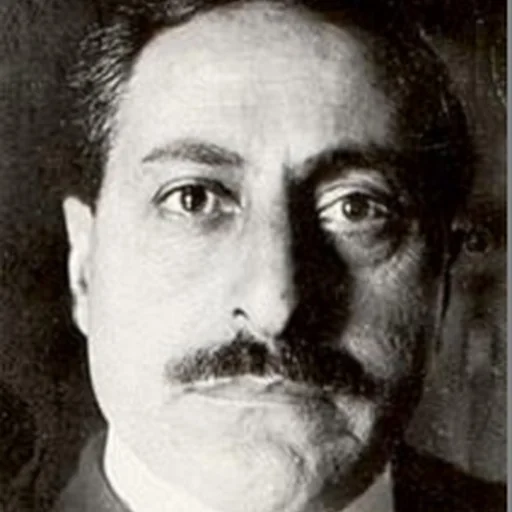
Artist
Yeghishe Martirosi Tadevosyan (Armenian: Եղիշե Մարտիրոսի Թադևոսյան; 24 September 1870 – 22 January 1936) was a Soviet Armenian painter, associated with the Peredvizhniki and Mir Iskusstva movements.