Artwork
A charioteer riding through a rocky landscape with an entourage of footmen and musicians, page from a Razm-nama (Book of Wars) adapted from the Sanskrit Mahabharata and translated into Persian by Mir Ghiyath al-Din Ali Qazvini, known as Naqib Khan (P
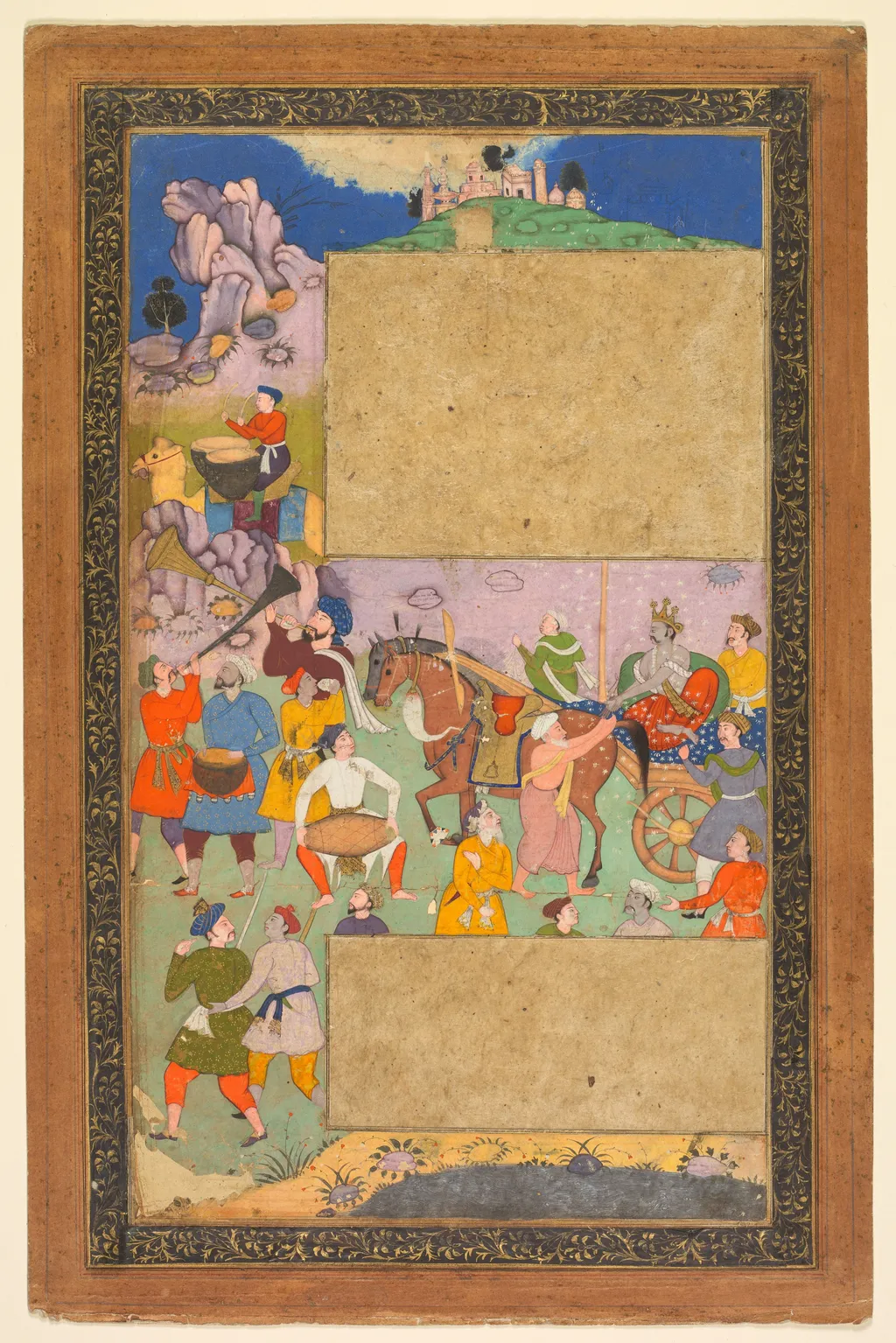
A charioteer riding through a rocky landscape with an entourage of footmen and musicians, page from a Razm-nama (Book of Wars) adapted from the Sanskrit Mahabharata and translated into Persian by Mir Ghiyath al-Din Ali Qazvini, known as Naqib Khan (P is an unspecified painting by the Mughal Painting artist Yusuf Ali. It dates from 1616 and is held in the collection of the Cleveland Museum of Art.
About this work
Overview
This 1616 illustrated page, created by the Indian artist Yusuf Ali, forms part of a Razm‑nama—a Persian‑language book of wars derived from the Sanskrit epic Mahabharata. The manuscript was translated into Persian by Mir Ghiyath al‑Din Ali Qazvini, known as Naqib Khan. The work is now in the collection of the Cleveland Museum of Art.
Subject & Meaning
The scene depicts a charioteer traversing a rugged hillside, accompanied by foot soldiers and musicians. The composition suggests a moment of military procession rather than combat, emphasizing the ceremonial aspect of the journey within the epic’s narrative.
Technique & Style
Yusuf Ali employs a vivid palette of reds, blues and greens against a muted, greenish terrain. The image is divided horizontally: a sparse, rocky upper section and a densely populated lower register filled with riders, infantry and instrumentalists. An empty chariot occupies the central axis, creating a visual pause amid the surrounding activity.
History & Provenance
The illustrated page originates from a Persian adaptation of the Mahabharata commissioned in the early 17th century. After remaining in private collections, it entered the Cleveland Museum of Art’s holdings, where it is displayed as part of the museum’s South Asian manuscript collection.
Context
Razm‑nama manuscripts were popular in Safavid Persia, serving both as literary works and as visual records of heroic warfare. The integration of Indian artistic conventions with Persian calligraphic tradition reflects the cultural exchanges between the Mughal and Safavid courts during this period.
Artist & collection

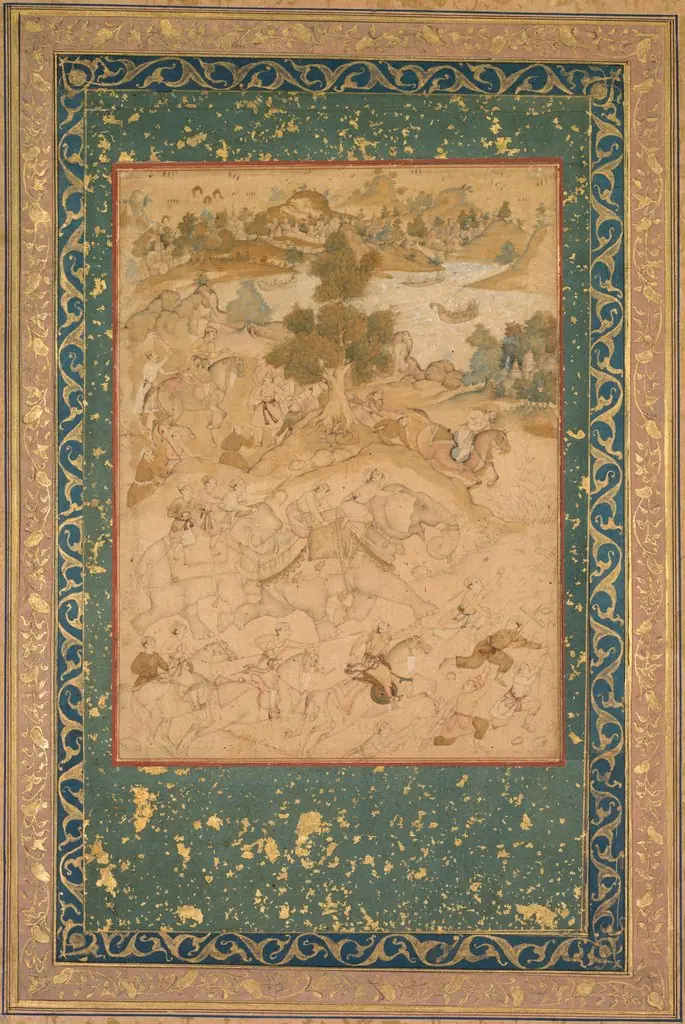 Akbar supervising the capture of wild elephants at Malwa in 1564, painting 90 from an Akbar-nama (Book of Akbar) of Abu’l Fazl (Indian 1551–1602)
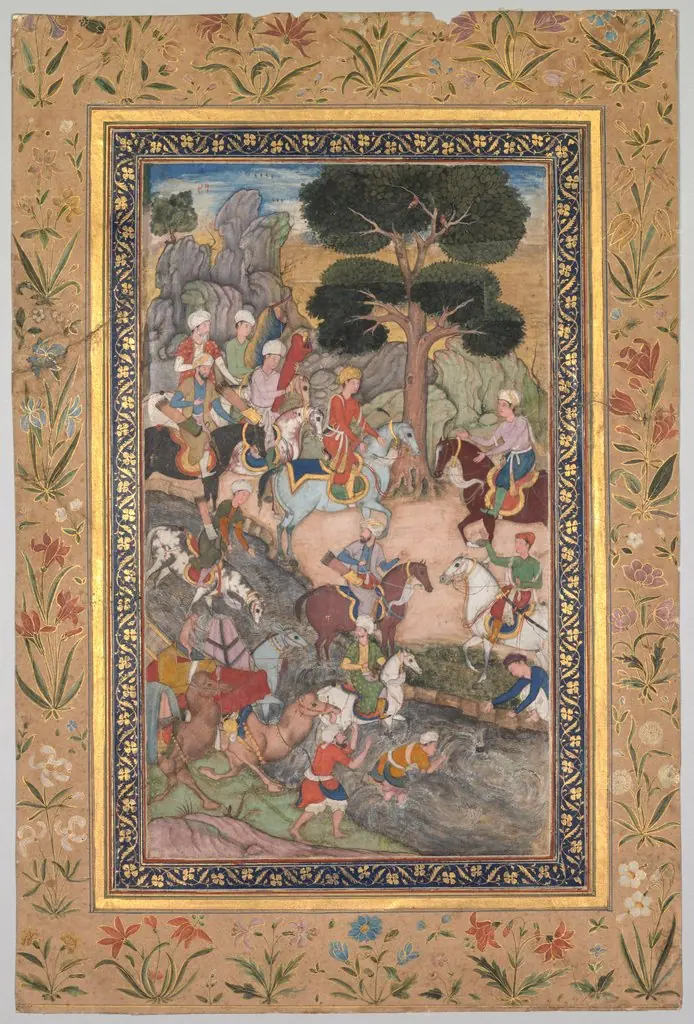 Babur meeting with Sultan Ali Mirza at the Kohik River, from a Babur-nama (Memoirs of Babur)
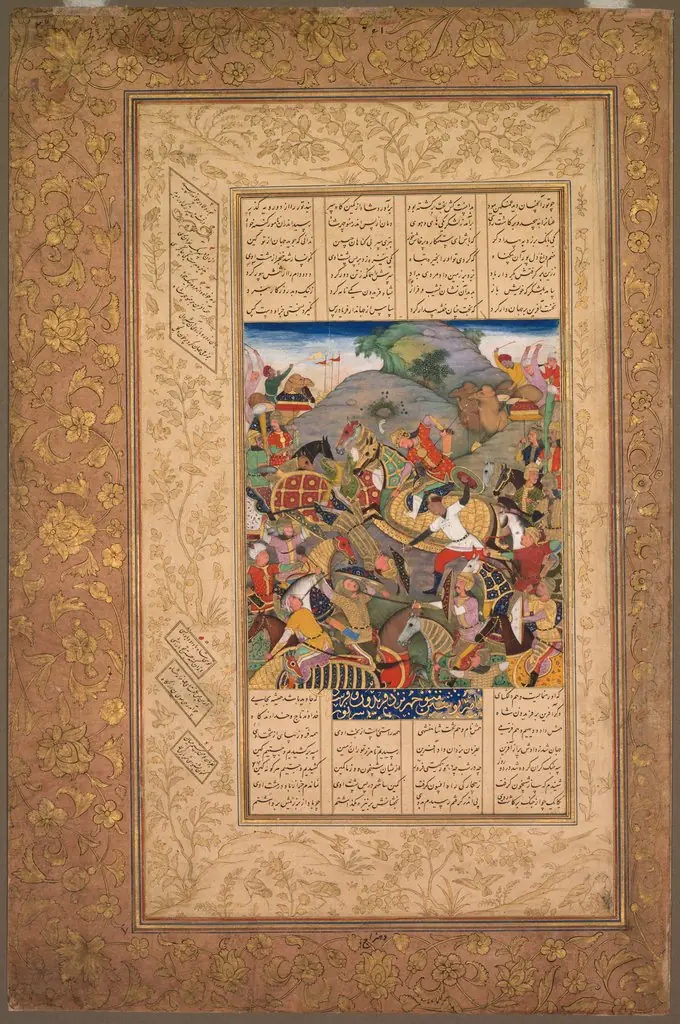 Battle between Manuchihr and Tur, from a Shah-nama (Book of Kings) of Firdausi (Persian, c. 934–1020)