Artist
Federico Zuccari
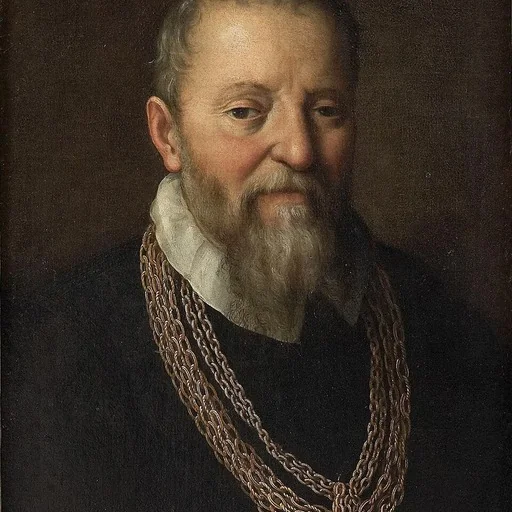
Italian, 1539–1609
Federico Zuccari was an Italian Renaissance artist. 7 works are cataloged here, principally at Cleveland Museum of Art. Federico Zuccari was born in Sant'Angelo in Vado.
Overview
Federico Zuccaro, also known as Federico Zuccari and Federigo Zucchero (c. 1540/1541 – July/August 1609), was an Italian painter, draughtsman, architect and writer. He worked in various cities in Italy, as well as in other countries such as Spain, France, the Spanish Netherlands and England. He was an important representative of late Mannerism in Italian art.
Life and work
Zuccaro was born in Sant'Angelo in Vado, near Urbino (Marche), then in the Duchy of Urbino. His parents were the painter Ottaviano de Zucharellis, who changed his surname to Zuccaro in 1569, and Antonia Neri. He was the third child of eight. His siblings were called Taddeo, Bartolomea, Federico, Iacopo, Lucio, Maurizio, Aloysio and Marco Antonio. In 1550, when he was just 11 years old, his parents brought him to Rome to study law but Federico preferred a career in art. He trained and worked in the workshop of his elder brother Taddeo who had become a successful painter in Rome. He became quickly integrated into the team of his brother and assisted with the workshop's commissions. Around 1560 he was able to join a group of artists who worked for pope Pius IV at the Vatican where he made decorations for the Casino in the garden and the cycle with the History of Moses at the Belvedere which were commenced in 1560. He helped his brother on the fresco decorations at the Villa Farnese at Caprarola.
He left his work on this commission to travel to Venice to work for a private Venetian patron, Giovanni Grimani, the patriarch of Aquileia. He made decorations for the Palazzo Grimani di Santa Maria Formosa in Venice and painted frescoes and the altarpiece of the patriarch's chapel in San Francesco della Vigna. During this period in Venice, he met the prominent architect Palladio and the Florentine writer Anton Francesco Doni. They were active in various literary and artistic academies to which they introduced him. He collaborated with Palladio on the design of sets for the theater company Compagnia della Calza degli Accesi and in March 1565 they visited together Cividale del Friuli. He tried unsuccessfully to obtain the commissions for the decoration of the Scuola di San Rocco and the wall with the Paradise fresco in the Doge's Palace. He used his period in Venice to copy works of other masters of the 15th and 16th centuries, including some pages of the precious Grimani Breviary, a manuscript illumination produced by Flemish artists between 1515 and 1520.
In 1565, Zuccaro left Venice and traveled to Florence where he had been introduced to some important people by his Florentine friends in Venice. He arrived not long before the elaborate wedding of the Grand Duke of Tuscany Francesco I de' Medici with Joanna of Austria in December 1565. Giorgio Vasari, who was in charge of the organisation of the artistic and decorative preparations for the festive occasion, entrusted him with the painting of some stories in grisaille. These served as decorations of the fake arch and the great drop scene that closed off one of the sides of the Sala dei Cinquecento in the Palazzo Vecchio, where the wedding was to take place. A preparatory sketch in colour depicting hunting scenes near Florence is the only item that survives in relation to his contribution. After returning to Rome in 1566, he found artistic success with his Annunciation (lost) in the church of the Jesuits in Piazza del Collegio Romano and frescoes in the Villa d'Este at Tivoli. His brother Taddeo died suddenly, aged 37, on 2 September 1566. He took over all the ongoing commissions of his brother. This kept him busy for many years. He worked extensively on the fresco decorations at the Villa Farnese at Caprarola. In summer 1569, a conflict over payments arose between Zuccaro and Cardinal Farnese. As a result, Federico was sent away from Caprarola where he was replaced by Jacopo Bertoia of Parma. U
Draughtsman
He was a prolific draughtsman and left a large number of preliminary studies for his paintings. He is the author of one of the most complete illustrations of the Divina Commedia of Dante which he created between 1586 and 1588 during his stay in Spain. The set of 88 sheets was kept by the artist throughout his life and were part of his estate at the time of his death. The sheets are now in the collection of the Uffizi in Florence. He created around in 1595 a series of 20 drawings, which illustrate the early life of his older brother Taddeo, starting with the hardships and disappointments during the period of his training in Rome until his first artistic successes at the age of 18. In addition to 16 scenes depicting Taddeo's life, the series includes four drawings of allegorical Virtues flanking the Zuccaro emblem. The set is kept at the Getty Center.
Art writer
Zuccaro also published books on art theory and art history. In his book L'idea de' Pittori, Scultori, ed Architetti (1607) he sets out a complex theoretical exposition on the idea of design.
Selected fresco projects
The fresco projects he worked on include:
Sala Regia in the Apostolic Palace, Rome Decoration of the Casina Pio IV, Rome Chapel of St. Hyacinth in the Basilica of Saint Sabina, Rome Grimani Chapel, San Francesco della Vigna, Venice Monumental staircase, Palazzo Grimani, Venice Pucci Chapel in the church of Trinità dei Monti, Rome San Marcello al Corso, Rome Cathedral of Orvieto (1570) Oratorio del Gonfalone, Rome (1573) The Last Judgement on the ceiling of the dome of the Florence Cathedral. Started by Giorgio Vasari and unfinished at the time of his death, it was completed by Zuccari between 1576 and 1579 with the assistance of Bartolomeo Carducci, Domenico Passignano and Stefano Pieri.
Collections represented

Museum

Museum

Museum

Museum
Artists in a similar vein