Artist
Sterling Ruby
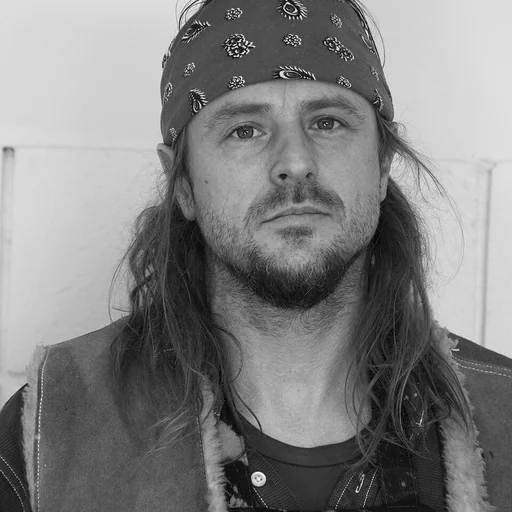
German, b. 1972
Sterling Ruby is a German artist. 2 works are cataloged here, principally at Museum of Modern Art. Sterling Ruby was born in Bitburg.
Overview
Sterling Ruby (born January 21, 1972) is an American artist who works in a large variety of media including ceramics, painting, drawing, collage, sculpture, video, and textiles. Often, his work is presented in large and densely packed installations. The artist has cited a diverse range of sources and influences including aberrant psychologies (particularly schizophrenia and paranoia), urban gangs and graffiti, hip-hop culture, craft, punk, masculinity, violence, public art, prisons, globalization, American domination and decline, waste and consumption. In opposition to the minimalist artistic tradition and influenced by the ubiquity of urban graffiti, the artist's works often appear scratched, defaced, camouflaged, dirty, or splattered. Proclaimed as one of the most interesting artists to emerge this century by New York Times art critic Roberta Smith, Ruby's work examines the psychological space where individual expression confronts social constraint. Sterling Ruby currently lives and works in Los Angeles. His studio is located in Vernon, south of downtown Los Angeles.
Early life and education
Sterling Ruby was born on an American military base in Bitburg, Germany to a Dutch mother and an American father. His family relocated to the United States shortly after his birth, first to Baltimore, Maryland, and then to the rural town of New Freedom, Pennsylvania. There he attended the largely agrarian Kennard-Dale High School. After graduating from high school, Ruby worked in construction in Washington D.C. Ruby attended The Pennsylvania School of Art and Design, (now the Pennsylvania College of Art and Design, PCA&D). In 2002, he received a BFA from the School of the Art Institute of Chicago. While attending the Art Institute he worked for the Video Data Bank, then under the direction of Kate Horsfield. In 2003, he moved to Los Angeles to attend the MFA program at Art Center College of Design in Pasadena, California. While at Art Center he studied with artists Diana Thater and Richard Hawkins, and theorists Sylvère Lotringer and Laurence Rickels. While attending graduate school at Art Center he was the teaching assistant for artist Mike Kelley.
Work
Collage Collage plays a significant role in the artist's prolific and interdisciplinary practice. Formal and thematic concerns are reflected by an exhaustive range of subject matter which is developed over the course of a number of years. The titles of the collage series include Mapping, DRFTRS, TRANSCOMPOSITIONAL, SPCE, EXHM, and BC. The artist has described collage as an "illicit merger", suggesting a transgressive nature for the medium.
EXHM In the series EXHM, titled with the artist's invented abbreviation for the word exhumation, The artist repurposes the large cardboard pieces used to protect the studio floor from the urethane that is poured during the creation of his urethane sculptures. Cutting into the cardboard and rearranging formal compositions he finalizes the works by inserting pictures of burial grounds, prescription packages and other found images as a way of creating an autobiographical archeology or dig site. BC
His bleached denim and canvas collages are titled BC which refers simply to Bleach Collage, but also references the art historical dating reference BC (Before Christ) or BCE (Before the Common Era). For this series of works, the artist repurposes rags, fabric scraps, clothing, and denim that have personal as well as studio history. These patchwork collages are playful, almost pop-like, resembling the craft of quilt making. These works reference the utilitarian beauty of Gee's Bend quilts as well as Japanese Boro textiles. ECLPSE The ECLPSE collages are made from cardboard salvaged from the floor coverings in the artist's studio. The shapes are reminiscent of suns, moons and overlapping landscapes, are painted in bright, primary colors. Ruby has said of these compositions: 'They continue with themes, theories and concepts that have been central to my previous work, but I have been trying to make them abstract and formal, my attempt to connect to the historical lineage of Suprematism.' SCALES SCALES are constructed mobiles. These works, which the artist views as three-dimensional manifestations of his collages, feature identical monochrome shapes to those evident in the ECLPSE series. These cardboard shapes are juxtaposed with identifiable scraps of materials and objects from his studio.
Bronzes Ruby's large bronze sculptures are generally poured in smaller sections, which he then joins together in an almost quilt-like fashion. Traditionally, bronze casting foundries grind the joining welds out of the final sculpture to hide this step in the fabrication process. For his large bronze sculptures, Ruby forgoes grinding the welds, which retain a rainbow patina.
Stoves In 2012, a series of fully functional stoves of the artist's own design were produced. These stoves, executed in bronze, cast iron or steel, were based on the kind of cast iron pot-belly stoves found in farm houses. There is an autobiographical element to these works, as the artist grew up on a farm in rural Pennsylvania, that for a time was heated only by a wood-burning stove. The Stoves highlight Ruby's interest in themes of functionality and utilitarianism. In 2013, the artist installed the 17-foot tall STOVE in a public square in Basel, Switzerland as part of Parcours, Art Basel. The stove was lit at the beginning of the fair, and a fire was maintained in the stove during the run of the fair. A second series of four large scale stoves were exhibited as part of the 2015 Gwangju Biennial in Gwangju Korea. The stoves which stood about 17 feet high
Fashion and design
Collaborations with Raf Simons In 2008, Sterling Ruby designed the interior for clothing designer Raf Simons' Tokyo store, using images of bleached fabric to create a splattered wallpaper that covered its walls and ceilings. In 2009, Simons used denim bleached by the artist to create a collection of denim wear jeans and jackets. In 2012, Simons created satin fabrics with images of four of Sterling Ruby's recent paintings. Raf Simons created three dresses and a coat from these fabrics. They were presented as part of Raf Simons' debut haute couture collection for Dior. In 2013, these dresses were exhibited as part of the Esprit Dior exhibition at the Museum of Contemporary Art in Shanghai. On January 15, 2014, Ruby and Simons collaborated on Raf Simons/Sterling Ruby Fall/Winter 2014 menswear collection presented during Paris Fashion Week. In 2017, after Simons moved over to Calvin Klein, Ruby was enlisted to redesign the interior of their New York showroom, as well as the brand's Paris headquarters. Ruby also designed two runways for Calvin Klein, Calvin Klein RTW Fall 2017 in February 2017, and RTW Spring 2018 runway in September 2017. Ruby also reimagined the interior of Calvin Klein’s Madison Avenue flagship store, painting the walls safety yellow, constructing matching yellow floor-to-ceiling scaffolding and filling the space with geometric plinths and large-scale soft sculpture candles. In 2020, Raf Simons announced a redux collection. It featured some clothing from the Fall Winter 2014 Sterling Ruby collection. S.R. STUDIO. LA. CA. In Spring 2019, Ruby announced the launch of a ready-to-wear collection S.R. STUDIO. LA. CA. [16] The collection has evolved from ten years of experimentation and development in Ruby’s work in soft sculpture, quilts, backdrops and garments. Ruby described the collection, saying “I’ve always been interested in the behavioral power that comes with clothing. For years I have been privately exploring garments as a medium, as something that impacts the way one can think, feel, and move.” Sterling Ruby’s designs were unique as they incorporated much of his past contemporary art skills and works. In addition, he added artwork, specifically photographs, from his wife Melanie Schiff. These images were of candles and weeds, and he printed them on silk dresses. Onto his denim pieces, he added U.S flag decals which reflected particular sculptures he created in the past. He also added a print of another one of his past sculptures onto some garments; this pattern was of animal skulls in different types of wigs. When Ruby described the difference between the production of fashion and art, he said he doesn’t see any difference in the making. But he did say he finds the creation of fashion more rewarding as you see people walking around in the world wearing art you have created. S.R. STUDIO. LA. CA. debuted in June 2019 at Pitti Immagine Uomo 96 in Florence, Italy. Ruby was the featured Special Guest designer on June 13.
Exhibitions
SUPERMAX 2008 For "SUPERMAX 2008," a solo exhibition curated by Philipp Kaiser at the Museum of Contemporary Art, Los Angeles, Pacific Design Center, Ruby correlated the architecture of the museum with the architecture of the California prison system. "SUPERMAX" is a reference to the special units of American maximum security prisons where prisoners in solitary confinement can be on lockdown for up to 23 hours a day. The dense installation of "SUPERMAX 2008" included poured urethane sculptures, aerosol paintings, geometric sculptures made of formica or brass, and soft sculptures in the form of blood drops and collages. The expressive exhibition distanced the artist's work from the ideology of Minimal art and integrated the seemingly disparate artworks included in Ruby's art practice. SOFTWORK In 2012-2013 the artist presented the exhibition titled SOFT WORK at the Geneva Contemporary Art Center, FRAC Champagne-Ardenne, Bonniers Konsthall in Stockholm, and MACRO in Rome. This traveling exhibition consisted of soft sculptures in various forms. A catalog to accompany this exhibition was published by Buchhandlung Walther König. The works from the SOFT WORK exhibition were acquired by the Museum of Contemporary Art, Los Angeles as a complete set in 2015. Ruby had exhibited at institutions including the Ullens Center for Contemporary Art, Beijing; Museum of Modern Art, New York; Museum of Contemporary Art, Chicago; Institute of Contemporary Art, Philadelphia; Walker Art Center, Minneapolis; Garage Centre for Contemporary Culture, Moscow; Saatchi Gallery, London; MACRO, Rome; Baibokov Projects, Moscow. His work was included in the 2014 Whitney Biennial, the 2014 Taipei Biennial, and the 2014 Gwangju Biennial, and Made in L.A. 2016: a, the, though, only at The Hammer Museum. In addition to his solo exhibition at the Museum of Contemporary Art, Los Angeles ("SUPERMAX 2008"), Ruby has been the subject of solo exhibitions at the Drawing Center, New York; La Galleria d'Arte Moderna e Contemporanea, Bergamo, Italy, and the Winterpalais in Vienna. The traveling exhibition SOFT WORK was exhibited at FRAC Champagne-Ardenne, Riems, France and the Centre d'Art Contemporain, Geneva, Switzerland; and Bonniers Konsthall, Stockholm, Sweden and Museo d'Arte Contemporanea, Rome, Italy. In 2019, Ruby's solo exhibition Sterling Ruby: Sculpture at the Nasher Sculpture Center was the first museum exhibition to survey the great variety of sculptural work of one the most significant contemporary artists working today. The exhibition featured nearly 30 large-scale sculptures spanning his career.
Notable works in public collections
Dihedral (2006), Seattle Art Museum Pelvic Mirror/Peace Head Version (2007), Los Angeles County Museum of Art Alpha Tier 2 (2008), Museum of Modern Art, New York Inscribed Plinth/LA Shotgun LX13/C. Noland Conjugal Visit (2008), Museum of Contemporary Art, Chicago Basin Theology/Nicap (2010), Nasher Sculpture Center, Dallas SOFT WORK (2011-2013), Museum of Contemporary Art, Los Angeles SP257 (2013), The Guggenheim, New York SP267 (2013), San Francisco Museum of Modern Art Vampire 108 (2013), Montreal Museum of Fine Arts Basin Theology/CRL-40.941 NOMAD (2014), Whitney Museum of American Art, New York Basin Theology/Excited Red Excedrin (2015), Tate, London The Jungle (2016), Centre Georges Pompidou, Paris Double Candle (2018), Hirshhorn Museum and Sculpture Garden, Washington, DC
Collections represented

Museum