Artist
Salvador Dalí
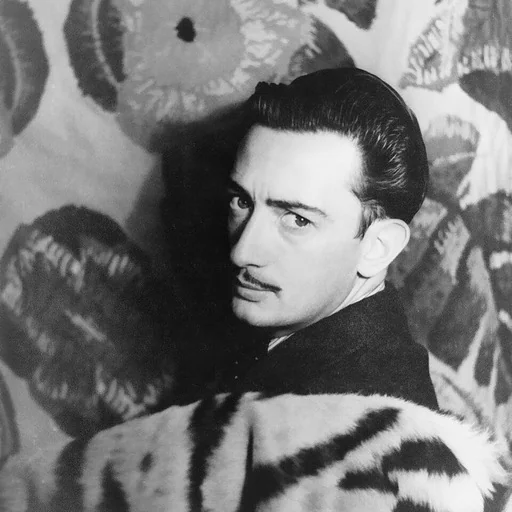
Spanish, 1904–1989
Salvador Dalí was a Spanish Surrealism artist. 12 works are cataloged here, principally at Museum of Modern Art. Salvador Dalí was born in Figueres.
Overview
Salvador Domingo Felipe Jacinto Dalí i Domènech, Marquess of Dalí de Púbol (11 May 1904 – 23 January 1989), known as Salvador Dalí, was a Spanish surrealist artist renowned for his technical skill, precise draftsmanship, and the striking and bizarre images in his work. Born in Figueres in Catalonia, Dalí received his formal education in fine arts in Madrid. Influenced by Impressionism and the Renaissance masters from a young age, he became increasingly attracted to Cubism and avant-garde movements. He moved closer to Surrealism in the late 1920s and joined the Surrealist group in 1929, soon becoming one of its leading exponents. His best-known work, The Persistence of Memory, was completed in August 1931. Dalí lived in France throughout the Spanish Civil War (1936 to 1939) before leaving for the United States in 1940 where he achieved commercial success. He returned to Spain in 1948 where he announced his return to the Catholic faith and developed his "nuclear mysticism" style, based on his interest in classicism, mysticism, and recent scientific developments. Dalí's artistic repertoire included painting, sculpture, film, graphic arts, animation, fashion, and photography, at times in collaboration with other artists. He also wrote fiction, poetry, autobiography, essays, and criticism. Major themes in his work include dreams, the subconscious, sexuality, religion, science and his closest personal relationships. To the dismay of those who held his work in high regard, and to the irritation of his critics, his eccentric and ostentatious public behavior often drew more attention than his artwork. His public support for the Francoist regime, his commercial activities and the quality and authenticity of some of his late works have also been controversial. His life and work were an important influence on other Surrealists, pop art, popular culture, and contemporary artists such as Jeff Koons and Damien Hirst. There are two major museums devoted to Salvador Dalí's work: the Dalí Theatre-Museum in Figueres, Spain, and the Salvador Dalí Museum in St. Petersburg, Florida, U.S.
Early life
Salvador Dalí was born on 11 May 1904, at 8:45 am, on the first floor of Carrer Monturiol, 20 in the town of Figueres, in the Empordà region, close to the French border in Catalonia, Spain. Dalí's older brother, who had also been named Salvador (born 12 October 1901), had died of gastroenteritis nine months earlier, on 1 August 1903. His father, Salvador Luca Rafael Aniceto Dalí Cusí (1872–1950) was a middle-class lawyer and notary, an anti-clerical atheist and Catalan federalist, whose strict disciplinary approach was tempered by his wife, Felipa Domènech Ferrés (1874–1921), who encouraged her son's artistic endeavors. In the summer of 1912, the family moved to the top floor of Carrer Monturiol 24 (presently 10). Dalí later attributed his "love of everything that is gilded and excessive, my passion for luxury and my love of oriental clothes" to an "Arab lineage", claiming that his ancestors were descendants of the Moors. Dalí was haunted by the idea of his dead brother throughout his life, mythologizing him in his writings and art. Dalí said of him, "[we] resembled each other like two drops of water, but we had different reflections." He "was probably the first version of myself but conceived too much in the absolute". Images of his brother would reappear in his later works, including Portrait of My Dead Brother (1963). Dalí also had a sister, Anna Maria, who was three years younger, and whom Dalí painted 12 times between 1923 and 1926. His childhood friends included future FC Barcelona footballers Emili Sagi-Barba and Josep Samitier. During holidays at the Catalan resort town of Cadaqués, the trio played football together. Dalí attended the Municipal Drawing School at Figueres in 1916 and also discovered modern painting on a summer vacation trip to Cadaqués with the family of Ramon Pichot, a local artist who made regular trips to Paris. The next year, Dalí's father organized an exhibition of his charcoal drawings in their family home. He had his first public exhibition at the Municipal Theatre in Figueres in 1918, a site he would return to decades later. In early 1921 the Pichot family introduced Dalí to Futurism. That same year, Dalí's uncle Anselm Domènech, who owned a bookshop in Barcelona, supplied him with books and magazines on Cubism and contemporary art. On 6 February 1921, Dalí's mother died of uterine cancer. Dalí was 16 years old and later said his mother's death "was the greatest blow I had experienced in my life. I worshipped her ... I could not resign myself to the loss of a being on whom I counted to make invisible the unavoidable blemishes of my soul." After the death of Dalí's mother, Dalí's father married her sister. Dalí did not resent this marriage, because he had great love and respect for his aunt.
Madrid, Barcelona and Paris
In 1922, Dalí moved into the Residencia de Estudiantes (Students' Residence) in Madrid and studied at the Real Academia de Bellas Artes de San Fernando (San Fernando Royal Academy of Fine Arts). A lean 1.72 metres (5 ft 7+3⁄4 in) tall, Dalí already drew attention as an eccentric and dandy. He had long hair and sideburns, coat, stockings, and knee-breeches in the style of English aesthetes of the late 19th century. At the Residencia, he became close friends with Pepín Bello, Luis Buñuel, Federico García Lorca, and others associated with the Madrid avant-garde group Ultra. The friendship with Lorca had a strong element of mutual passion, but Dalí said he rejected the poet's sexual advances. Dalí's friendship with Lorca was to remain one of his most emotionally intense relationships until the poet's death at the hands of Nationalist forces in 1936 at the beginning of the Spanish Civil War. Also in 1922, he began what would become a lifelong relationship with the Prado Museum, which he felt was, 'incontestably the best museum of old paintings in the world.' Each Sunday morning, Dalí went to the Prado to study the works of the great masters. 'This was the start of a monk-like period for me, devoted entirely to solitary work: visits to the Prado, where, pencil in hand, I analyzed all of the great masterpieces, studio work, models, research.' Those paintings by Dalí in which he experimented with Cubism earned him the most attention from his fellow students, since there were no Cubist artists in Madrid at the time. Cabaret Scene (1922) is a typical example of such work. Through his association with members of the Ultra group, Dalí became more acquainted with avant-garde movements, including Dada and Futurism. One of his earliest works to show a strong Futurist and Cubist influence was the watercolor Night-Walking Dreams (1922). At this time, Dalí also read Freud and Lautréamont who were to have a profound influence on his work. In May 1925, Dalí exhibited eleven works in a group exhibition held by the newly formed Sociedad Ibérica de Artistas in Madrid. Seven of the works were in his Cubist mode and four in a more realist style. Several leading critics praised his work. Dalí held his first solo exhibition at Galeries Dalmau in Barcelona, from 14 to 27 November 1925. This exhibition, before his exposure to Surrealism, included twenty-two works and was a critical and commercial success. In April 1926, Dalí made his first trip to Paris, where he met Pablo Picasso, whom he revered. Picasso had already heard favorable reports about Dalí from Joan Miró, a fellow Catalan who later introduced him to many Surrealist friends. As he developed his own style over the next few years, Dalí made some works strongly influenced by Picasso and Miró. Dalí was also influenced by the work of Yves Tanguy, and he later allegedly told Tanguy's niece, "I pinched everything from your uncle Yves." Dalí left the Royal Academy in 1926, shortly before his final exams. His mastery of painting skills at that time was evidenced by his realistic The Basket of Bread, painted in 1926. Later that year he exhibited again at Galeries Dalmau, from 31 December 1926 to 14 January 1927, with the support of the art critic Sebastià Gasch. The show included twenty-three paintings and seven drawings, with the "Cubist" works displayed in a separate section from the "objective" works. The critical response was generally positive with Composition with Three Figures (Neo-Cubist Academy) singled
1929 to World War II
In 1929, Dalí collaborated with Surrealist film director Luis Buñuel on the short film Un Chien Andalou (An Andalusian Dog). His main contribution was to help Buñuel write the script for the film. Dalí later claimed to have also played a significant role in the filming of the project, but this is not substantiated by contemporary accounts. In August 1929, Dalí met his lifelong muse and future wife Gala, born Elena Ivanovna Diakonova. She was a Russian immigrant ten years his senior, who at that time was married to Surrealist poet Paul Éluard. In works such as The First Days of Spring, The Great Masturbator and The Lugubrious Game Dalí continued his exploration of the themes of sexual anxiety and unconscious desires. Dalí's first Paris exhibition was at the recently opened Goemans Gallery in November 1929 and featured eleven works. In his preface to the catalog, André Breton described Dalí's new work as "the most hallucinatory that has been produced up to now". The exhibition was a commercial success but the critical response was divided. In the same year, Dalí officially joined the Surrealist group in the Montparnasse quarter of Paris. The Surrealists hailed what Dalí was later to call his paranoiac-critical method of accessing the subconscious for greater artistic creativity. Meanwhile, Dalí's relationship with his father was close to rupture. Don Salvador Dalí y Cusi strongly disapproved of his son's romance with Gala and saw his connection to the Surrealists as a bad influence on his morals. The final straw was when Don Salvador read in a Barcelona newspaper that his son had recently exhibited in Paris a drawing of the Sacred Heart of Jesus Christ, with a provocative inscription: "Sometimes, I spit for fun on my mother's portrait". Outraged, Don Salvador demanded that his son recant publicly. Dalí refused, perhaps out of fear of expulsion from the Surrealist group, and was violently thrown out of his paternal home on 28 December 1929. His father told him that he would be disinherited and that he should never set foot in Cadaqués again. The following summer, Dalí and Gala rented a small fisherman's cabin in a nearby bay at Port Lligat. He soon bought the cabin, and over the years enlarged it by buying neighboring ones, gradually building his beloved villa by the sea. Dalí's father would eventually relent and come to accept his son's companion. In 1931, Dalí painted one of his most famous works, The Persistence of Memory, which developed a surrealistic image of soft, melting pocket watches. The general interpretation of the work is that the soft watches are a rejection of the assumption that time is rigid or deterministic. This idea is supported by other images in the work, such as the wide expanding landscape, and other limp watches shown being devoured by ants. Dalí had two important exhibitions at the Pierre Colle Gallery in Paris in June 1931 and May–June 1932. The earlier exhibition included sixteen paintings of which The Persistence of Memory attracted the most attention. Some of the notable features of the exhibitions were the proliferation of images and references to Dalí's muse Gala and the inclusion of Surrealist Objects such as Hypnagogic Clock and Clock Based on the Decomposition of Bodies. Dalí's last, and largest, the exhibition at the Pierre Colle Gallery was held in June 1933 and included twenty-two paintings, ten drawings, and two objects. One critic noted Dalí's precise draftsmanship and attention to detail, describin
World War II
The outbreak of World War II in September 1939 saw the Dalís in France. Following the German invasion, they were able to escape because on 20 June 1940 they were issued visas by Aristides de Sousa Mendes, Portuguese consul in Bordeaux, France. They crossed into Portugal and subsequently sailed on the Excambion from Lisbon to New York in August 1940. Dalí and Gala were to live in the United States for eight years, splitting their time between New York and the Monterey Peninsula, California. Dalí spent the winter of 1940–41 at Hampton Manor, the residence of Caresse Crosby, in Caroline County, Virginia, where he worked on various projects including his autobiography and paintings for his upcoming exhibition. Dalí announced the death of the Surrealist movement and the return of classicism in his exhibition at the Julien Levy Gallery in New York in April–May 1941. The exhibition included nineteen paintings (among them Slave Market with the Disappearing Bust of Voltaire and The Face of War) and other works. In his catalog essay and media comments, Dalí proclaimed a return to form, control, structure and the Golden Section. Sales however were disappointing and the majority of critics did not believe there had been a major change in Dalí's work. On 2 September 1941, he hosted A Surrealistic Night in an Enchanted Forest in Monterey, a charity event which attracted national attention but raised little money for charity. The Museum of Modern Art held two major, simultaneous retrospectives of Dalí and Joan Miró from November 1941 to February 1942, Dalí being represented by forty-two paintings and sixteen drawings. Dalí's work attracted significant attention of critics and the exhibition later toured eight American cities, enhancing his reputation in America. In October 1942, Dalí's autobiography, The Secret Life of Salvador Dalí was published simultaneously in New York and London and was reviewed widely by the press. Time magazine's reviewer called it "one of the most irresistible books of the year". George Orwell later wrote a scathing review in the Saturday Book. A passage in the autobiography in which Dalí claimed that Buñuel was solely responsible for the anti-clericalism in the film L'Age d'Or may have indirectly led to Buñuel resigning his position at MoMA in 1943 under pressure from the State Department. Dalí also published a novel Hidden Faces in 1944 with less critical and commercial success. In the catalog essay for his exhibition at the Knoedler Gallery in New York in 1943, Dalí continued his attack on the Surrealist movement, writing: "Surrealism will at least have served to give experimental proof that total sterility and attempts at automatizations have gone too far and have led to a totalitarian system. ... Today's laziness and the total lack of technique have reached their paroxysm in the psychological signification of the current use of the college [collage]". The critical response to the society portraits in the exhibition, however, was generally negative. In November–December 1945 Dalí exhibited new work at the Bignou Gallery in New York. The exhibition included eleven oil paintings, watercolors, drawings, and illustrations. Works included Basket of Bread, Atomic and Uranian Melancholic Ideal, and My Wife Nude Contemplating her own Body Transformed into Steps, the Three Vertebrae of a Column, Sky and Architecture. The exhibition was notable for works in Dalí's new classicism style and those heralding his "atomic period". Durin
Postwar in United States (1946–48)
In 1946, Dalí worked with Walt Disney and animator John Hench on an unfinished animated film Destino. Dalí exhibited new work at the Bignou Gallery from November 1947 to January 1948. The 14 oil paintings and other works in the exhibition reflected Dalí's increasing interest in atomic physics. Notable works included Dematerialization Near the Nose of Nero (The Separation of the Atom), Intra-Atomic Equilibrium of a Swan's Feather, and a study for Leda Atomica. The proportions of the latter work were worked out in collaboration with a mathematician. In early 1948, Dalí's 50 Secrets of Magic Craftsmanship was published. The book was a mixture of anecdotes, practical advice on painting, and Dalínian polemics.
Later years in Spain
In 1948, Dalí and Gala moved back into their house in Port Lligat, on the coast near Cadaqués. For the next three decades, they would spend most of their time there, spending winters in Paris and New York. Dalí's decision to live in Spain under Franco and his public support for the regime prompted outrage from many anti-Francoist artists and intellectuals. Pablo Picasso refused to mention Dalí's name or acknowledge his existence for the rest of his life. In 1960, André Breton unsuccessfully fought against the inclusion of Dalí's Sistine Madonna in the Surrealist Intrusion in the Enchanter's Domain exhibition organized by Marcel Duchamp in New York. Breton and other Surrealists issued a tract to coincide with the exhibition denouncing Dalí as "the ex-apologist of Hitler ... and friend of Franco". In December 1949, Dalí's sister Anna Maria published her book Salvador Dalí Seen by his Sister. Dalí was angered by passages that he considered derogatory towards his wife Gala and broke off relations with his family. When Dalí's father died in September 1950, Dalí learned that he had been virtually disinherited in his will. A two-year legal dispute followed over paintings and drawings Dalí had left in his family home, during which Dalí was accused of assaulting a public notary.
As Dalí moved further towards embracing Catholicism he introduced more religious iconography and themes in his painting. In 1949, he painted a study for The Madonna of Port Lligat (first version, 1949) and showed it to Pope Pius XII during an audience arranged to discuss Dalí's marriage to Gala. This work was a precursor to the phase Dalí dubbed "Nuclear Mysticism", a fusion of Einsteinian physics, classicism, and Catholic mysticism. In paintings such as The Madonna of Port Lligat, The Christ of Saint John of the Cross and The Disintegration of the Persistence of Memory, Dalí sought to synthesize Christian iconography with images of material disintegration inspired by nuclear physics. His later Nuclear Mysticism works included La Gare de Perpignan (1965) and The Hallucinogenic Toreador (1968–70). Dalí's keen interest in natural science and mathematics was further manifested by the proliferation of images of DNA and rhinoceros horn shapes in works from the mid-1950s. According to Dalí, the rhinoceros horn signifies divine geometry because it grows in a logarithmic spiral. Dalí was also fascinated by the Tesseract (a four-dimensional cube), using it, for example, in Crucifixion (Corpus Hypercubus). Dalí had been extensively using optical illusions such as double images, anamorphosis, negative space, visual puns and trompe-l'œil since his Surrealist period and this continued in his later work. At some point, Dalí had a glass floor installed in a room near his studio in Port Lligat. He made extensive use of it to study foreshortening, both from above and from below, incorporating dramatic perspectives of figures and objects into his paintings. He also experimented with the bulletist technique pointillism, enlarged half-tone dot grids and stereoscopic images. He was among the first artists to employ holography in an artistic manner. In Dalí's later years, young artists such as Andy Warhol proclaimed him an important influence on pop art. In 1960, Dalí began work on his Theatre-Museum in his home town of Figueres. It was his largest single project and a main focus of his energy through to 1974, when it opened. He continued to make additions through the mid-1980s. In 1955, Da
Final years and death
In 1968, Dalí bought the Castle of Púbol for Gala, and from 1971 she would retreat there for weeks at a time, Dalí having agreed not to visit without her written permission. His fears of abandonment and estrangement from his longtime artistic muse contributed to depression and failing health. In 1980, at age 76, Dalí's health deteriorated sharply and he was treated for depression, drug addiction, and Parkinson-like symptoms, including a severe tremor in his right arm. There were also allegations that Gala had been supplying Dalí with pharmaceuticals from her own prescriptions. Gala died on 10 June 1982, at the age of 87. After her death, Dalí moved from Figueres to the castle in Púbol, where she was entombed. In 1982, King Juan Carlos bestowed on Dalí the title of Marqués de Dalí de Púbol (Marquess of Dalí de Púbol) in the nobility of Spain, Púbol being where Dalí then lived. The title was initially hereditary, but at Dalí's request was changed to life-only in 1983. In May 1983, what was said to be Dalí's last painting, The Swallow's Tail, was revealed. The work was heavily influenced by the mathematical catastrophe theory of René Thom. However, some critics have questioned how Dalí could have executed a painting with such precision given the severe tremor in his painting arm. From early 1984, Dalí's depression worsened and he refused food, leading to severe undernourishment. Dalí had previously stated his intention to put himself into a state of suspended animation as he had read that some microorganisms could do. In August 1984 a fire broke out in Dalí's bedroom and he was hospitalized with severe burns. Two judicial inquiries found that the fire was caused by an electrical fault and no findings of negligence were made. After his release from hospital Dalí moved to the Torre Galatea, an annex to the Dalí Theatre-Museum. There have been allegations that Dalí was forced by his guardians to sign blank canvases that could later be used in forgeries. It is also alleged that he knowingly sold otherwise-blank lithograph paper which he had signed, possibly producing over 50,000 such sheets from 1965 until his death. As a result, art dealers tend to be wary of late graphic works attributed to Dalí. In July 1986, Dalí had a pacemaker implanted. On his return to his Theatre-Museum he made a brief public appearance, saying:
When you are a genius, you do not have the right to die, because we are necessary for the progress of humanity. In November 1988, Dalí entered hospital with heart failure. On 5 December 1988, he was visited by King Juan Carlos, who confessed that he had always been a serious devotee of Dalí. Dalí gave the king a drawing, Head of Europa, which would turn out to be Dalí's final drawing. On the morning of 23 January 1989, Dalí died of cardiac arrest at the age of 84. He is buried in the crypt below the stage of his Theatre-Museum in Figueres. The location is across the street from the church of Sant Pere, where he had his baptism, first communion, and funeral, and is only 450 metres (1,480 ft) from the house where he was born.
Exhumation
On 26 June 2017, it was announced that a judge in Madrid had ordered the exhumation of Dalí's body in order to obtain samples for a paternity suit. Joan Manuel Sevillano, manager of the Fundación Gala Salvador Dalí (The Gala-Salvador Dalí Foundation), denounced the exhumation as inappropriate. The exhumation took place on the evening of 20 July, and his DNA was extracted. On 6 September 2017, the Foundation stated that the tests carried out proved conclusively that Dalí and the claimant were not related. On 18 May 2020, a Spanish court dismissed an appeal from the claimant and ordered her to pay the costs of the exhumation.
Symbolism
From the late 1920s, Dalí progressively introduced many bizarre or incongruous images into his work which invite symbolic interpretation. While some of these images suggest a straightforward sexual or Freudian interpretation (Dalí read Freud in the 1920s) others (such as locusts, rotting donkeys, and sea urchins) are idiosyncratic and have been variously interpreted. Some commentators have cautioned that Dalí's own comments on these images are not always reliable.
Food
Food and eating have a central place in Dalí's thoughts and work. He associated food with beauty and sex and was obsessed with the image of the female praying mantis eating her mate after copulation. Bread was a recurring image in Dalí's art, from his early work The Basket of Bread to later public performances such as in 1958 when he gave a lecture in Paris using a 12-meter-long baguette an illustrative prop. He saw bread as "the elementary basis of continuity" and "sacred subsistence". The egg is another common Dalínian image. He connects the egg to the prenatal and intrauterine, thus using it to symbolize hope and love. It appears in The Great Masturbator, The Metamorphosis of Narcissus and many other works. There are also giant sculptures of eggs in various locations at Dalí's house in Portlligat as well as at the Dalí Theatre-Museum in Figueres. The radial symmetry of the sea urchin intrigued Dalí. He had enjoyed eating them with his father at Cadaqués and, along with other foods, they became a recurring theme in his work. The famous "melting watches" that appear in The Persistence of Memory suggest Einstein's theory that time is relative and not fixed. Dalí later claimed that the idea for clocks functioning symbolically in this way came to him when he was contemplating Camembert cheese.
Animals
The rhinoceros and rhinoceros horn shapes began to proliferate in Dalí's work from the mid-1950s. According to Dalí, the rhinoceros horn signifies divine geometry because it grows in a logarithmic spiral. He linked the rhinoceros to themes of chastity and to the Virgin Mary. However, he also used it as an obvious phallic symbol as in Young Virgin Auto-Sodomized by the Horns of Her Own Chastity. Various other animals appear throughout Dalí's work: rotting donkeys and ants have been interpreted as pointing to death, decay, and sexual desire; the snail as connected to the human head (he saw a snail on a bicycle outside Freud's house when he first met him); and locusts as a symbol of waste and fear. The elephant is also a recurring image in his work; for example, Dream Caused by the Flight of a Bee Around a Pomegranate a Second Before Awakening. The elephants are inspired by Gian Lorenzo Bernini's sculpture base in Rome of an elephant carrying an ancient obelisk.
Science
Dalí's life-long interest in science and mathematics was often reflected in his work. His soft watches have been interpreted as references to Einstein's theory of the relativity of time and space. Images of atomic particles appeared in his work soon after the atomic bombing of Hiroshima and Nagasaki and strands of DNA appeared from the mid-1950s. In 1958 he wrote in his Anti-Matter Manifesto: "In the Surrealist period, I wanted to create the iconography of the interior world and the world of the marvelous, of my father Freud. Today, the exterior world and that of physics have transcended the one of psychology. My father today is Dr. Heisenberg." The Disintegration of the Persistence of Memory (1954) harks back to The Persistence of Memory (1931) and in portraying that painting in fragmentation and disintegration has been interpreted as a reference to Heisenberg's quantum mechanics.
Endeavors outside painting
Dalí was a versatile artist. Some of his more popular works are sculptures and other objects, and he is also noted for his contributions to theater, fashion, and photography, among other areas.
Collections represented

Museum

Museum
Artists in a similar vein