Artist
Richard Hunt
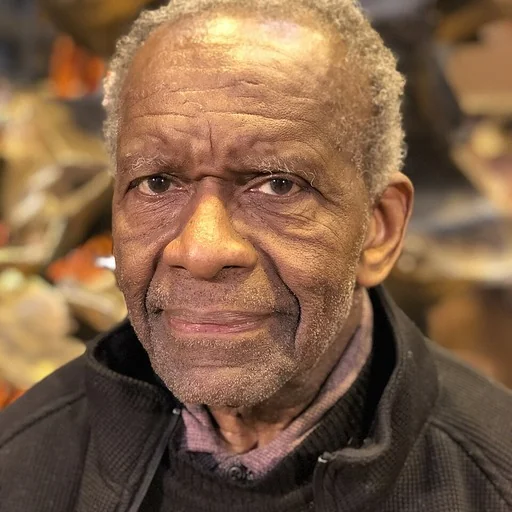
American, 1935–2023
Richard Hunt was an American artist. 6 works are cataloged here, principally at Museum of Modern Art. Richard Hunt was born in South Side.
Overview
Richard Howard Hunt (September 12, 1935 – December 16, 2023) was an American artist and sculptor. In the second half of the 20th century, he became "the foremost African-American abstract sculptor and artist of public sculpture." A Chicago native, Hunt studied at the School of the Art Institute of Chicago in the 1950s. While there he received multiple prizes for his work. In 1971, he was the first African-American sculptor to have a retrospective at Museum of Modern Art. Hunt has created over 160 public sculpture commissions, more than any other sculptor in prominent locations in 24 states across the United States. With a career spanning seven decades, Hunt held over 170 solo exhibitions and is represented in more than 125 public museums across the world. His notable abstract, modern and contemporary sculpture and works on paper have appeared in museum and gallery exhibitions since the 1950s. Richard Hunt used “industrial materials and modern methods to sculpt organic forms and historical archetypes, such as freedom, flight, and progress” throughout his career. He was one of the first artists to serve on the governing body for National Endowment for the Arts and later served on the board of the Smithsonian American Art Museum. In 2022, Barack Obama stated that "Richard Hunt is one of the greatest artists Chicago has ever produced."
Early life
Richard Hunt was born in 1935 on Chicago's South Side and raised in the Woodlawn and Englewood neighborhoods. Hunt and his younger sister, Marian, grew up with their parents, Cleophus Howard Hunt, a barber, and Etoria Inez Henderson Hunt, a librarian and beautician. The Hunts were descendants of enslaved people brought from West Africa through the Port of Savannah, and often visited extended family in Georgia. Although he moved to Galesburg, Illinois at eleven years old, he spent the majority of his time in the city of Chicago. From an early age he was interested in the arts. Accompanying his mother, a beautician and librarian, he attended performances by local opera companies that sang classical repertoires of Mozart, Rossini, Verdi, and Handel. As a young boy, Hunt began to show enthusiasm and talent for drawing, painting, and sculpting, interests that he increasingly developed. Inspired to pursue his career in the arts, he stated "My mom was supportive and dad was tolerant." Hunt also acquired business sense and awareness of social issues from working in his father's barbershop.
As a teenager, Hunt began his work in sculpture, working with clay, carving wood, and modeling Sculpt-Metal. While his work started in a makeshift studio in his 1940s bedroom, he eventually built a basement studio in his father's barbershop and later a basement studio in the family's Englewood home.
Education
Beginning in the eighth grade at age 13, Hunt took classes at the Art Institute of Chicago's Junior School of the Arts. He graduated early from Englewood High School in January 1953 and entered the School of the Art Institute of Chicago later that year, and graduated in 1957. He also took classes at the University of Illinois and the University of Chicago. While studying at the School of the Art Institute of Chicago, Hunt focused his sculptural work on creating soldered wire figures, then on welding sculptures, as well as producing drawings, paintings, and lithographs. The School of the Art Institute of Chicago did not have classes or materials suitable for learning welding, so he purchased his own welding equipment in 1955, and with little instruction, taught himself to weld in the basement studio of his father’s barbershop. Interested in Modernism, Abstract Expressionism, and Surrealism, he experimented with the assemblage of broken machine parts, car bumpers, and metals from the junkyard reshaping them into organic forms. Hunt went on to work with iron, steel, copper, and aluminum producing a series of "hybrid figures", references to human, animal, and plant forms. Hunt explored the interplay of organic and industrial subject matter in his artwork. His earliest works, which often represented classical themes, are more figurative than his later works. Hunt began exhibiting his sculptures nationwide while still a student at the School of the Art Institute of Chicago. In 1957 as a senior, his piece Arachne (1956) was purchased by the Museum of Modern Art in New York. He received a bachelor's of arts in education (BAE) from the School of the Art Institute of Chicago that same year.
Notable degrees
In addition to his studies, Hunt received eighteen honorary degrees from universities all over the country. Some of which include the School of the Art Institute of Chicago (Chicago, IL), Northwestern University (Evanston, IL), Tufts University (Medford, MA), and the University of Notre Dame (Notre Dame, IN).
European travel
Upon graduating, Hunt was awarded the James Nelson Raymond Foreign Travel Fellowship. He sailed to England on the SS United States and then to Paris, where he leased a car, a Citroën 2CV, to travel to Spain, Italy, and eventually back to Paris. He spent most of his time in Florence, where he learned to cast his first sculptures in bronze, at the renowned Marinelli foundry. His time abroad solidified his belief that metal was the definitive medium of the twentieth century.
Military service
Hunt served in the United States Army from 1958 to 1960. He took basic training at Fort Leonard Wood. Hunt served as an illustrator for Brooke Army Medical Center.
Desegregation activism
On March 7, 1960, Mary Andrews, president of the local youth council of the NAACP, wrote letters to store managers in downtown San Antonio, Texas, who operated white-only lunch counters. Encouraged by the growing sit-in movement, she requested equal services be provided to all, regardless of race. Hunt in U.S. Army uniform went to lunch at Woolworth's on March 16, 1960. Seated at the counter, his order was taken, and he was served without incident. Hunt, the only known African American to eat at San Antonio's Woolworth's lunch counter that day, fulfilled Mary Andrews's vision of integration. This action, along with a handful of other African Americans at other lunch counters across the city, made San Antonio the first peaceful and voluntary lunch counter integration in the south.
Teaching
After completing his military service, Hunt was invited to teach a class in metal design by the School of the Art Institute of Chicago during the 1960-1961 academic year. He also taught sculpture, drawing, and metalworking at the University of Illinois branch at Navy pier for two years. In 1962, Hunt was awarded the John Simon Guggenheim Memorial Fellowship for Creative Sculpture, which enabled him to stop teaching and become a full-time sculptor.
Influences
Hunt began to experiment with materials and sculpting techniques, influenced heavily by progressive twentieth-century artists. At the age of 17, Hunt was inspired to focus on sculpture after visiting the exhibition, Sculpture of the Twentieth Century, which was held at the Art Institute of Chicago in 1953. The Sculpture of the Twentieth Century included works of Pablo Picasso, Julio González, David Smith, Constantin Brancusi, Reg Butler, Lynn Chadwick, Alberto Giacometti, Umberto Boccioni, and Jean Arp. At the exhibition, Hunt for the first time saw various artworks of welded metal. Hunt was also inspired and paid respect to French sculptor Raymond Duchamp-Villon whose 1914 bronze "Horse" was instructional. Seeing these artists' works led Hunt to teach himself how to solder wire to create small figures. He would later go on to create both figurative and abstract shapes by learning to weld metal in 1955. Hunt also focused on linear-spatial arrangement of his materials where he followed Julio González's footsteps into three-dimensional structures.
Career
From 1955 through the 1970s, Hunt used scrap yards as his quarries and transformed salvaged metal into abstract, welded sculptures. Early works such as Hero’s Head (1956), Arachne (1956), Steel Bloom, Number 10 (1956), and Hero Construction (1958) set the foundation for Hunt’s exploration of various sculptural forms; and his merging of anthropomorphic, biomorphic, and metamorphic elements into single works of art. These early sculptures were followed by a series of welded metal compositions with a calligraphic style that experimented with linear space. Following the influence of Julio González, Hunt’s “drawing in space” sculptures pushed the limits of metals’ tensile strength to create delicate and expansive linear forms. In the early 1960s, Hunt began to explore enclosed forms with a focus on incorporating rounded, organic shapes and axial geometry. Hunt’s frequent experimentation garnered critically positive response from the art community, such that Hunt was exhibited at several of the Artists of Chicago and Vicinity Shows and the American Show, where the Museum of Modern Art purchased Arachne (1956) for its collection. He was the youngest artist to exhibit at the 1962 Seattle World's Fair, a major international survey exhibition of modern art. Hunt received his first sculpture commission from the State of Illinois Public Art Program in 1967. In 1969, he finished the commission, resulting in a public artwork named Play. This was the start of Hunt’s use of Cor-Ten steel as a material, which was inspired by Picasso’s use of the same material in his large work (The Picasso) in Daley Plaza, Chicago. Hunt’s Play stands in the John J. Madden Health Center in Maywood, Illinois. In 1971, Hunt acquired a deactivated electrical substation near northern Chicago and repurposed it into a metal welding sculpture studio. The station came equipped with a bridge crane, which was convenient for moving large sculpture pieces, and a spacious 40-foot (12 m) ceiling. While handling the metal, Hunt worked with two assistants. Hunt described metalworks as "free play of forms evolving, developing and contrasting with one another." Seeking a more direct connection with nature, Hunt bought a farmhouse on 26 acres in McHenry County, Illinois, in 1974, while continuing to maintain his Lill Avenue studio in Chicago. He also purchased a satellite studio in Benton Harbor, Michigan in 1995 as part of an initiative to revitalize the community. This Richard Hunt Studio Center was gifted to the Krasl Art Center in August 2023. In 1981, Hunt was chosen to serve as one of eight jurors—both the youngest and the sole African American—for the Vietnam Veterans Memorial design competition. On March 30, 1,421 designs were submitted and displayed for the jury in an airport hangar at Andrews Air Force Base. Ultimately, the jury, including Hunt, selected a design by Maya Lin. Hunt was the first African American visual artist to serve on the National Council on the Arts, the governing body of the National Endowment for the Arts. He was appointed by President Lyndon Johnson in 1968. He also served on boards of the Smithsonian Institution. From 1980 to 1988, Hunt served as Commissioner of the Smithsonian Institution's National Museum of American Art. From 1994 to 1997, Hunt served on the Smithsonian Institution's National Board of Directors. In 2023, Hunt established the Richard Hunt Legacy Foundation as a nonprofit arts organization. The foundation is operated by a board of trust
Early period (1953–1975)
In 1955, Hunt attended the funeral of Emmett Till at the Roberts Temple Church in Chicago. The open-casket funeral showed Till's face, mutilated and disfigured from having been lynched. This experience had a profound impact on Hunt. Till had grown up in Woodlawn only a few blocks from the home where Hunt was born. Hunt, like Till, traveled South to visit family. Hero's Head, a solemn representation of the disfigured head of Till, was one of the first welded sculptures that Hunt created. He witnessed Till's funeral and taught himself how to weld the very same summer. On January 6, 2003, Hunt also attended Mamie Till's funeral out of reverence for what she did for her child and for the Civil Rights Movement as a whole. The hollow, almost skull-like form of Hero’s Head evokes strong feelings of horror and sorrow. Curator and historian of African American art, LeRonn P. Brooks writes that "Hero's Head is both an exposition of racism's deadly ends and a critique of the American racial order. It also brings anachronistic and mythological themes often associated with modern abstraction back into the world in the service of civil rights." Hunt salvaged everyday materials, including a car muffler and two lampshades, and transformed these odds and ends into a sculpture he called Arachne, which is a reference to Ovid’s epic poem, Metamorphoses. The figure in Hunt's metallic sculpture resembles a Kafkaesque hybrid of a human and insect. Dorothy Miller, who was a groundbreaking curator at the Museum of Modern Art in New York (MoMA), saw Arachne in a 1957 exhibition at the Art Institute of Chicago, and helped to get it acquired and exhibited at MoMA just a few months later. Hunt’s Arachne inspired the poem "Richard Hunt's 'Arachne'" by Robert Earl Hayden. In February 1957, Richard Hunt participated in the Chicago Artists No-Jury Exhibition at Navy Pier on Lake Michigan. His sculpture, Steel Bloom, Number 10 was included in the show and received the Pauline Palmer Prize. Steel Bloom, Number 10 is part of Hunt’s “Steel Bloom” series, which he created in 1956, shortly after he taught himself how to weld. The welded steel sculpture evokes natural and organic forms. Plant Form, which is in the collection of the Smithsonian American Art Museum, is an important early example of how Hunt developed a signature style for transforming industrial forms into organic compositions that allude to biomorphic entities. The sculpture is indicative of a mode Hunt called "hybrid figures," described as "a kind of bridge between what we experience in nature and what we experience from the urban, industrial, technology-driven society we live in." Hunt created Hero Construction one year after graduating from the School of the Art Institute of Chicago. He built the sculpture from found objects, including several mufflers, collected from the street and in metal scrap yards, and welded them together to create a humanoid form with a pose that alludes to a figure of a heroic status. Since 2017, Hero Construction (1958) has stood as the centerpiece of The Art Institute of Chicago. Hunt displayed Organic Construction with Branching Forms at the Seattle World’s Fair exhibition, Art Since 1950 (April 21 to October 21, 1962). He was the youngest artist to exhibit work in that show. Hunt was awarded the Walter M. Campana Prize from the Art Institute of Chicago for Antique Study after Nike at the 65th American Exhibition. The work is part of Hunt’s “Antique Study” series that explored t
Middle period (1976–2000)
In 1977, Hunt finished a maquette for a monumental plaza sculpture outside the Social Security Administration building in Richmond, California. Study for Richmond Cycle consists of two distinct parts, a larger biomorphic form and a smaller one. The theme of the sculpture references the cycle of life and the duality between the weight of experience and the lightness and promise of youth. Richard Wright’s 1940 novel, Native Son, provided inspiration for Hunt’s sculpture Bigger Bridge which references that novel’s protagonist, Bigger Thomas. Composed of welded chromed steel furniture legs and automobile bumpers, the work takes the shape of a bridge-like arc of steel. This sculpture is now in the collection of the Savannah College of Art and Design Museum of Art. Slowly Toward the North’s abstract form alludes to two distinct forms, the train and push plow. The shape of a steam engine can be discerned via the driving wheels and front-end cowcatcher components. The forms of the steam engine are juxtaposed with stylized handles, plowshare, and wheels of a push plow cultivator. The work is part of Hunt’s “Plow Series,” which he explains, “grew out of my family’s history and childhood experiences on family farms.” These two major symbolic elements within the large bronze sculpture commemorates the Great Migration. Per Hunt’s instruction, the train elements face north, representing the journey of Black Americans leaving the south for the northern states; while the plow is oriented to the agrarian south, which indicates their laborious work in the fields. Slowly Toward the North is on view at Crystal Bridges Museum of American Art’s North Forest. Hunt ties together the organic form in Hybrid Movement. A complex and twisting welded Cor-Ten steel balances on three points. Here, Hunt “captures the implied vitality of animalistic locomotion and the progression of sound through a musical composition.” Walter O. Evans commissioned Hunt to create Model for a Middle Passage Monument to commemorate the Atlantic slave trade. The “middle passage” was the segment of the Atlantic slave trade that brought newly enslaved Africans to the Americas. The bronze tabletop sculptural model alludes to a large ship-like structure that would serve as a public work commemorating the slave passage from Africa, and is inspired by the 1962 poem “Middle Passage” by Robert Hayden. Toward a New City is emblematic of Hunt’s belief that artists can create new realities that are more free and just. The circular stainless steel base spirals upwards into two reaching forms as a gesture of aspiration. “My art is about art–embracing a vision of the future that is unlike past futures.” In 1995, Hunt completed Steelaway as a tribute to his mother, Etoria Inez Henderson Hunt. The title comes from the African-American spiritual “Steal Away to Jesus,” which refers to the intimate parent-child bond. Hunt’s Flintlock Fantasy or The Promise of Force is a massive 7-foot-tall and 700-pound abstract sculpture with an ominous, foreboding form that calls to mind weapons of war and mass destruction. The impetus behind the work’s creation was the start of the Persian War on January 16, 1991. Growing Forward’s upward-reaching bronze extensions suggest the hybridization of biological growth and civil rights and social progress. In a review of Growing Forward on display at the 1997 Studio Museum in Harlem exhibition of the same name, Sculpture magazine indicated the sculpture “cantilevers off a cliff
Late period (2001–2023)
Hunt pays homage to his African ancestry and personal trips to Egypt in his sculpture, Nile Journey, which is in the collection of the Brauer Museum of Art, Valparaiso University, Valparaiso, Indiana. Nile Journey undulates with currents of bronze in a swirling and wayward fashion in reference to an ancient journey on the Nile, and “gives the impression of a subtly moving tree of gold, befitting the tomb of any pharaoh." Exhibited at the Art Institute of Chicago in 2021-22, Rampant Heraldry was fashioned after decorative water pitchers from the Middle Ages called aquamaniles, demonstrating the wide array of subject matter and influences covered by Hunt’s work. Out and Further Out represents Hunt’s artistic aspiration to push the limits of gravity and material, extending the bronze tendril-like forms horizontally reaching out from a solid columnar base. Hunt described his inspiration for this piece: “I liked the idea of creating this extension rather than having to grow up from the base more vertically. And as a piece that was more improvisational when I started, I was going to have it go out, and I decided I will go further out. I had to do that and gave it that title.” Planar and Tubular represents Hunt’s concept of organic and industrial hybridization in a monumental form, with its hard angular edges on a stacked double trapezoid base transforming into curvilinear, upward-reaching forms created from industrial ducts. Upon installation of the sculpture on the terrace of the Art Institute of Chicago in 2020 for an exhibition, Hunt “mounted a ladder in theatrical fashion and began sanding and polishing the work in rhythmic, circular motions for a live audience in what could have been billed as a sculptural ‘performance.’” In 2014, Hunt began to create a monumental bronze sculpture, inspired by the forms of scholar’s rocks (gongshi) and the Martin Luther King Jr. memorial in Washington, DC. The piece took six years to complete. It was constructed from large scraps of crumpled bronze material that he received from Revere Copper & Brass. The three-part title is derived from the formal and figurative elements of the sculpture. Hunt’s travels to China, where he was fascinated by gardens containing gongshi, or scholar’s rocks, influenced the piece’s organic shape. Stone of Hope is the title of the Martin Luther King Jr. sculpture carved in granite by sculptor Lei Yixin. A “love of bronze” is a reference to the actual bronze material used in this particular work of art. Hunt explained that “the Love of Bronze is something that came to mind because on one of those crumpled pieces of metal that I got, the person at Revere had written, ‘Love you, 655.’” Hunt’s Arching and Ascending combines the biblical reference from an earlier and similar welded bronze sculpture, Arching (1985)--God’s command to create an arch that stretches across the waters, called Heaven–with his awareness of his own mortality. Hunt completed Arching and Ascending in his final years of his life as he reflected on his art, career, and personal transcendence.
Public art and monuments
Hunt completed more public sculptures than any other sculptor in the country. He also created monuments for some of the United States' greatest heroes, including Martin Luther King Jr., Mary McLeod Bethune, John Jones, Jesse Owens, Ida B. Wells-Barnett, and Hobart Taylor Jr. Hunt received his first sculpture commission in 1967 known as Play, which was commissioned by the State of Illinois Public Art Program for the John J. Madden Health Center in Maywood, Illinois. Hunt created Play using Cor-Ten steel. This was the first time he used that specific material to create a sculpture. The making of Play led to Hunt receiving many other public commissions, an undertaking that he considered to be his second career. Play was originally titled The Chase, and is based on the myth of Diana and Actaeon from Ovid’s Metamorphoses. Hunt also noted that imagery from 1963, of police dogs chasing civil rights activists in Birmingham, Alabama motivated him to create the sculpture. Hunt completed Play in 1969. In 1969, Hunt completed a sculpture to honor the abolitionist John Jones, who was the first African American elected to public office in the state of Illinois. The sculpture’s form combines geometric abstraction and representational figuration. Hunt explained that he “used the form like a block growing out of his foot to show the weight he had to bear as a Negro as he climbed. And the other block growing out of his shoulder to show how his burden held him down at the same time he was trying to climb.” John Jones was initially installed on the campus of the University of Illinois at Chicago Circle. It is currently in the collection of the DuSable Black History Museum and Education Center in Chicago. Harlem Hybrid is in contrast with the mode of minimalist sculpture that prevailed at the time of its creation. The sculpture’s organic shape and form suggests what Hunt describes as the “synthesis of organic and industrial subject matter.” Jacob’s Ladder is a monumental two-piece welded bronze and brass sculpture, installed in the foyer of the Carter G. Woodson Regional Library on Chicago’s South Side. The title of the sculpture references an African American spiritual. The large work is suspended from the library’s ceiling, and is presented in two parts. The base resembles an altar, while the piece at the top features a rolling and ascending ladder. Hunt said that “This piece leaves wings and angels more to the imagination. It relates to the structure of the building. At the bottom, to involve the whole space in the composition, is a form that is circular, in part, and that reaches up toward the ladder. It suggests a sort of altar that Jacob built after having his dream.” In 1977, on the occasion of the ninth anniversary of Martin Luther King Jr.’s assassination, Hunt was commissioned by the Mallory Knights Charitable Organization to make a sculpture memorializing his life. I Have Been to the Mountain is situated outdoors at the Dr. Martin Luther King Jr. Reflection Park in downtown Memphis, Tennessee. The large steel forms of the piece symbolize a mountain range, and a metaphor for King’s activism and message about reaching the archetypal promised land, where Black people will live in peace and have equal rights. Hunt’s large bronze sculpture, A Bridge Across and Beyond was completed in 1978. It is located at the Blackburn Center on the Howard University campus in Washington, D.C. The sculpture is surrounded by fountains within a large reflecting pool. T
Collections represented

Museum