Artwork
Oberst Joachim Theodor Lundbye, kunstnerens fader
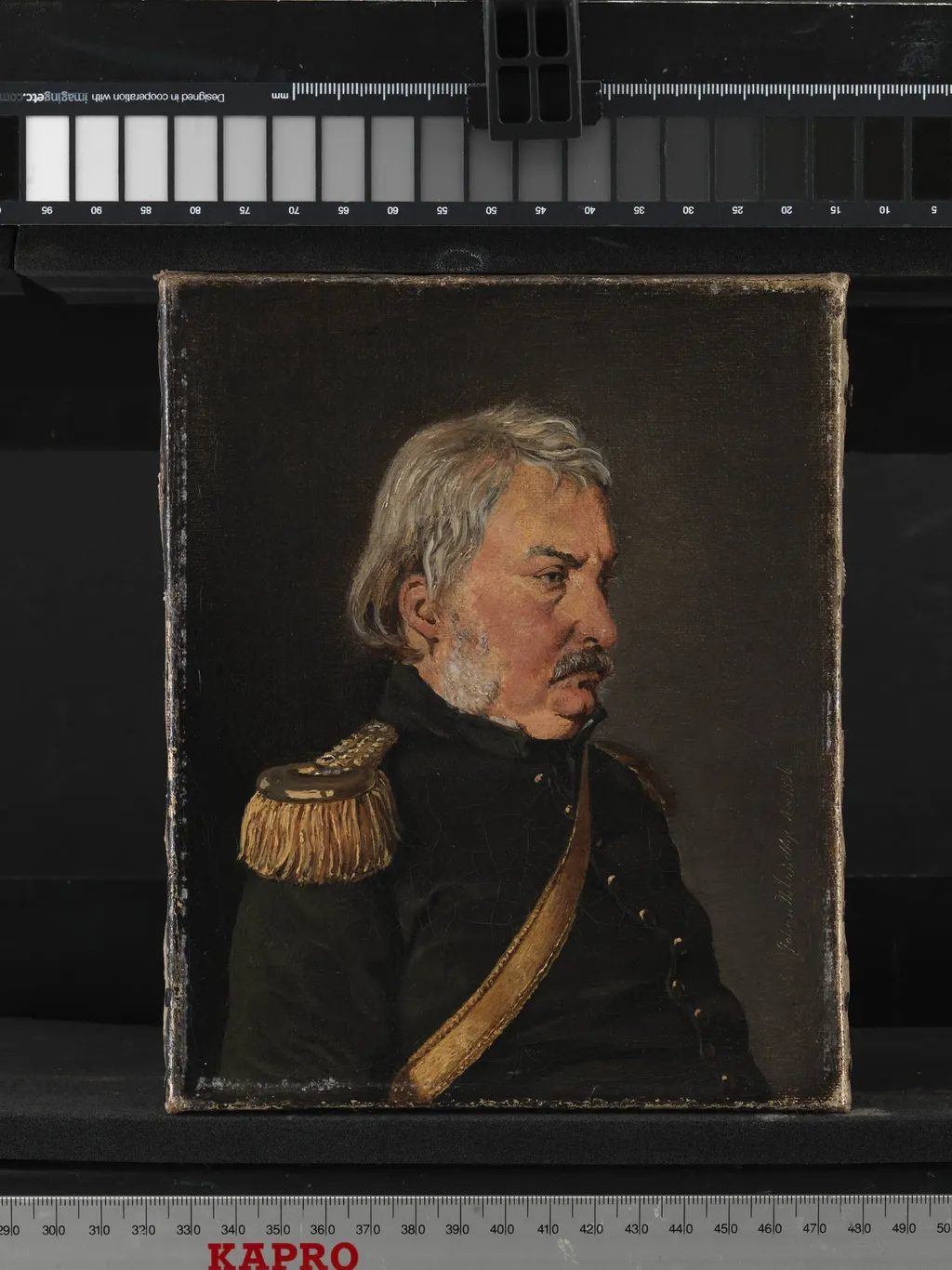
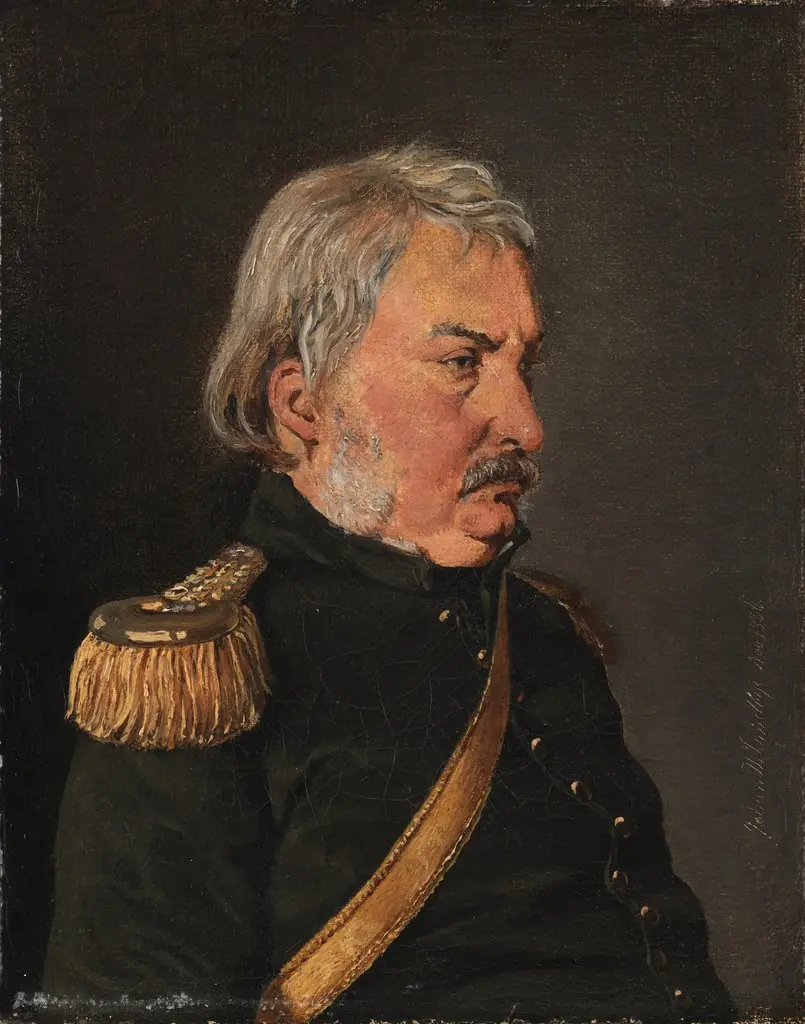
Oberst Joachim Theodor Lundbye, kunstnerens fader is a photography by the Romanticist artist Unknown. It dates from 1836 and is held in the collection of the Statens Museum for Kunst. Painted in 1836, this portrait depicts Oberst Joachim Theodor Lundbye, father of the Danish artist Christen Lundbye.
About this work
Overview
Its composition centers entirely on the sitter, with minimal background detail, emphasizing his military bearing and solemn presence.
Painted in 1836, this portrait depicts Oberst Joachim Theodor Lundbye, father of the Danish artist Christen Lundbye. Executed in oil on canvas, the work is part of the Museum of Ethnography’s collection. Its composition centers entirely on the sitter, with minimal background detail, emphasizing his military bearing and solemn presence. The surface shows signs of age, particularly along the frame’s edges, suggesting decades of handling and exposure.
Subject & Meaning
The subject, a Danish military officer, is rendered with restrained dignity. His dark uniform, adorned with fur trim and epaulettes, signals rank and service, while his gray hair and mustache convey age and experience. The absence of symbolic objects or landscape reinforces a focus on personal character rather than achievement. His direct, unsmiling gaze suggests introspection, aligning with 19th-century ideals of stoic leadership and familial authority.
Technique & Style
The artist employs subtle chiaroscuro to model the face and uniform, using soft transitions between light and shadow to define form without theatricality. Brushwork is precise in rendering textures—fur, wool, and skin—while the dark, neutral background isolates the figure. The palette is muted, dominated by browns, grays, and blacks, enhancing the portrait’s somber tone and timeless quality.
History & Provenance
The painting was created during the artist’s early career, likely as a private commission. It remained within the Lundbye family before entering the Museum of Ethnography’s holdings. Its preservation reflects its personal significance to the family, though its institutional placement suggests later recognition as a document of Danish social and military life in the early 1800s.
Context
In 1830s Denmark, portraiture of military officers often served to affirm social status and national identity. This work aligns with a broader trend of domestic, intimate portraiture that prioritized individual presence over grandeur. The artist’s choice to depict his own father reflects a personal engagement with the genre, distinct from official state commissions of the era.
Legacy
Though not widely exhibited, the portrait endures as a quiet testament to familial ties within Denmark’s artistic community. It offers insight into the domestic sphere of a painter who would later contribute to the Danish Golden Age. Its modest scale and restrained execution contrast with the more public works of contemporaries, preserving a private moment of respect and memory.
Artist & collection

 Domestic Scene
 Giacomo and Cardinal Marco, investing Andrea, Abbot of San Zeno, with his Benefice
 The Nymph of Fontainebleau
 Portrait of a Woman
 Madonna and Child with Saints in the Enclosed Garden
 Venus and Minerva
 Family Group of Four on Sofa
 Wall painting from Room H of the Villa of P. Fannius Synistor at Boscoreale
 Male portrait
 Portrait of Geronimo Savoini (1766–1836)
 Portrait of Karol Sierakowski, artillery general
 Portrait of Prince Józef Poniatowski
 Rittmeister Heinrich Bauer
 Portrait of Louis XVIII
 Portrait of Louis XVIII
 Adolf Ludvig von Schwerin
 Portrait of Stanisław Kostka Potocki
 Julius Geber (1816-1876), wholesale dealer, banker, married to Hilda Philipson
 Portrait of a Russian military official
 Oberst Joachim Theodor Lundbye, kunstnerens fader