Artwork
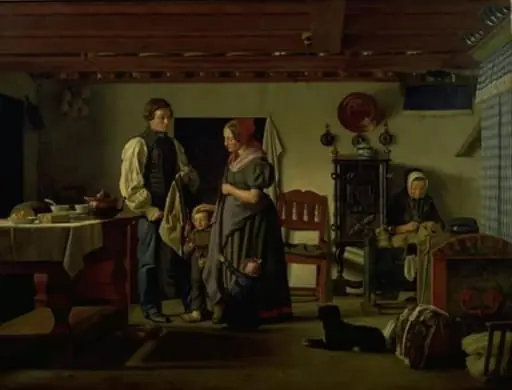
Familieliv i et lille fiskerleje nord for Helsingør
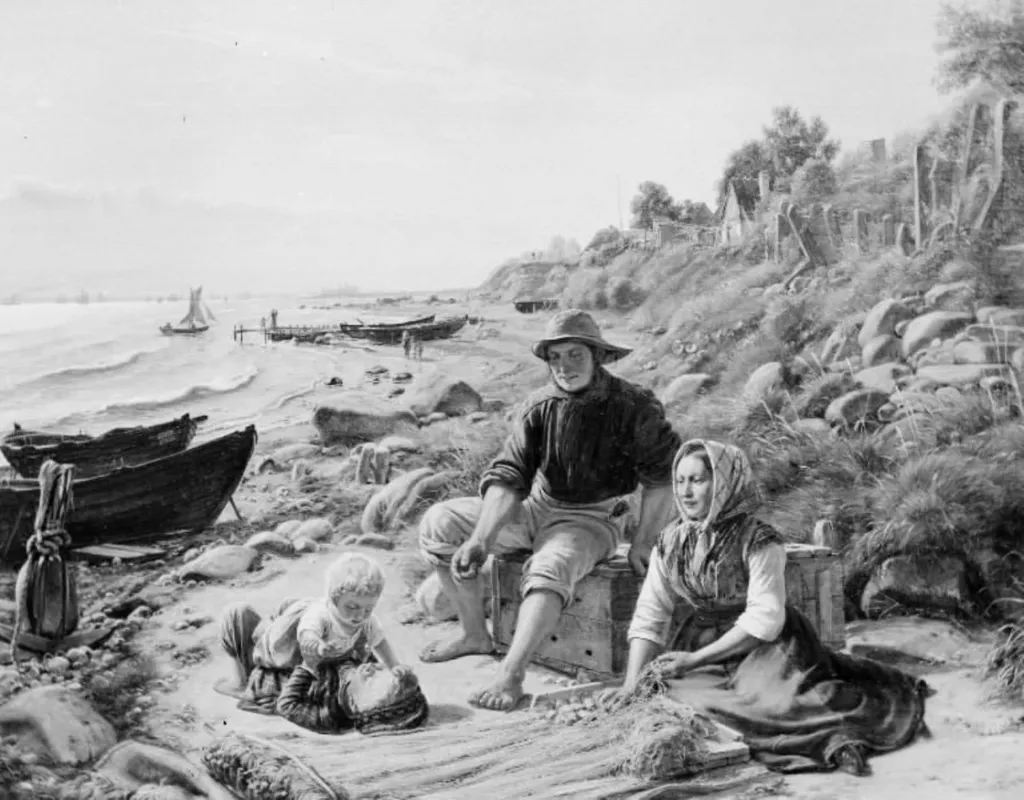
Familieliv i et lille fiskerleje nord for Helsingør is a photography by the Impressionist artist Unknown. It dates from 1855 and is held in the collection of the Statens Museum for Kunst. This black-and-white photograph, dated 1855, captures a moment of daily life in a small fishing settlement north of Helsingør.
About this work
Overview
The image is part of the Museum of Ethnography’s collection, where it serves as a record of coastal livelihoods in mid-19th-century Denmark.
This black-and-white photograph, dated 1855, captures a moment of daily life in a small fishing settlement north of Helsingør. Taken with early photographic technology, it presents a quiet scene of a family engaged in routine activities along a rocky shoreline. The image is part of the Museum of Ethnography’s collection, where it serves as a record of coastal livelihoods in mid-19th-century Denmark.
Subject & Meaning
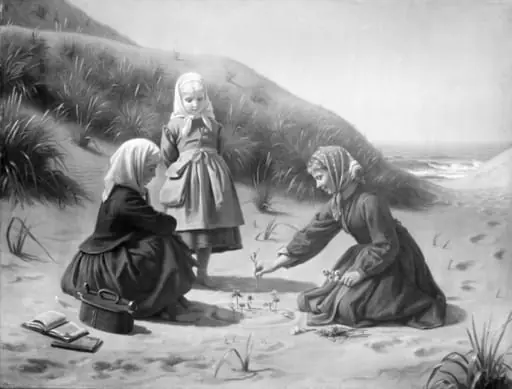
The image depicts a father seated on a rock, observing the sea, while his wife and child sort fishing gear or catch in a woven basket. Their postures and attire suggest a life shaped by the rhythms of the sea. The presence of nearby boats, both grounded and afloat, implies a community dependent on fishing. The scene conveys no drama or ceremony—only the unremarkable, persistent labor of coastal existence.
Technique & Style
Rendered in monochrome, the photograph uses natural light to define texture and form. The composition is unposed, with figures placed organically against the landscape. The shallow depth of field and grainy detail reflect the limitations of early photographic processes. The framing emphasizes the relationship between the family and their environment, with the sea and rocky shore forming a quiet, unadorned backdrop.
History & Provenance
Created in 1855, the photograph entered the collection of the Museum of Ethnography, likely as part of a broader effort to document rural and maritime communities in Denmark during the 19th century. Its preservation suggests early recognition of its value as a documentary record. No known artist is credited, and its original purpose—whether personal, scientific, or journalistic—remains undocumented.
Context
In the mid-1800s, coastal villages north of Helsingør were centers of small-scale fishing, often isolated and economically modest. Photography was still a novel medium, used sparingly to record daily life. This image aligns with emerging ethnographic interests in capturing vanishing rural traditions, offering a rare visual glimpse into the domestic and occupational routines of working-class families before industrialization transformed the region.
Legacy
The photograph endures as a quiet testament to pre-industrial coastal life in Denmark. It contributes to historical understanding of how families sustained themselves through fishing and seasonal labor. Though not widely exhibited, it remains a reference point for scholars studying 19th-century vernacular photography and the material culture of Nordic fishing communities.
Artist & collection

 Domestic Scene
 Giacomo and Cardinal Marco, investing Andrea, Abbot of San Zeno, with his Benefice
 The Nymph of Fontainebleau
 Portrait of a Woman
 Madonna and Child with Saints in the Enclosed Garden
 Venus and Minerva
 Family Group of Four on Sofa
 Wall painting from Room H of the Villa of P. Fannius Synistor at Boscoreale