Artwork
The Gipsy Woman Telling the Soldiers their Fortunes
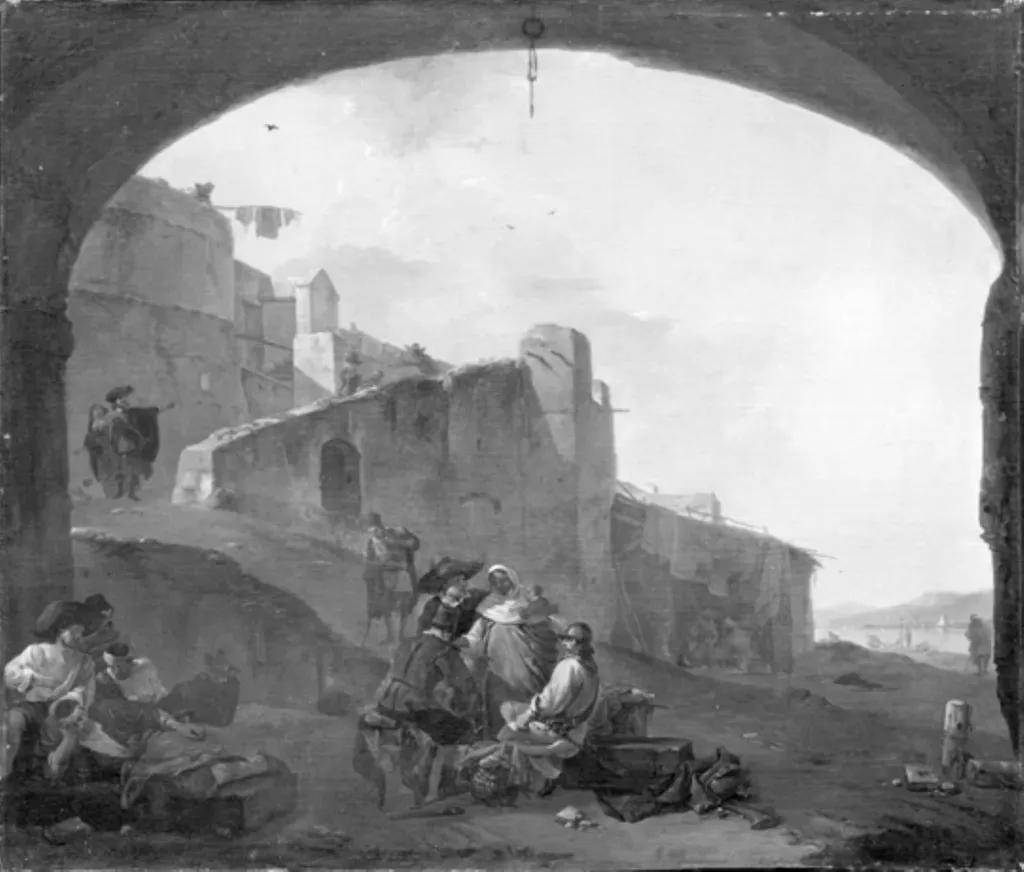
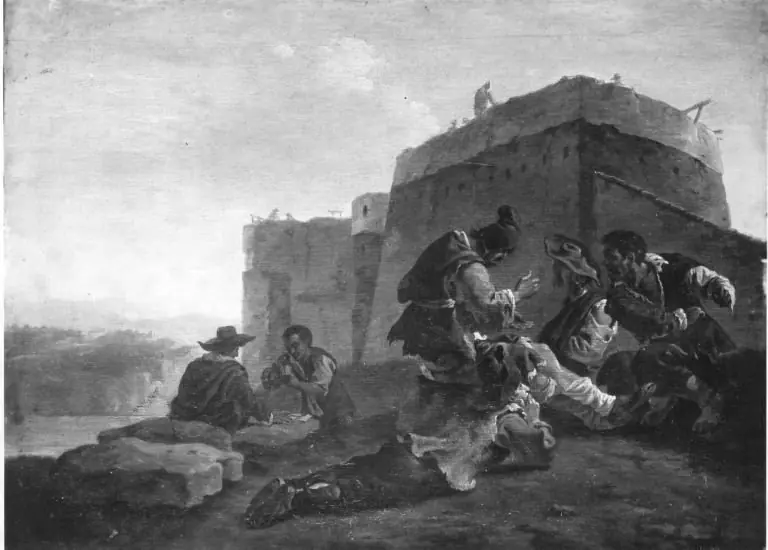
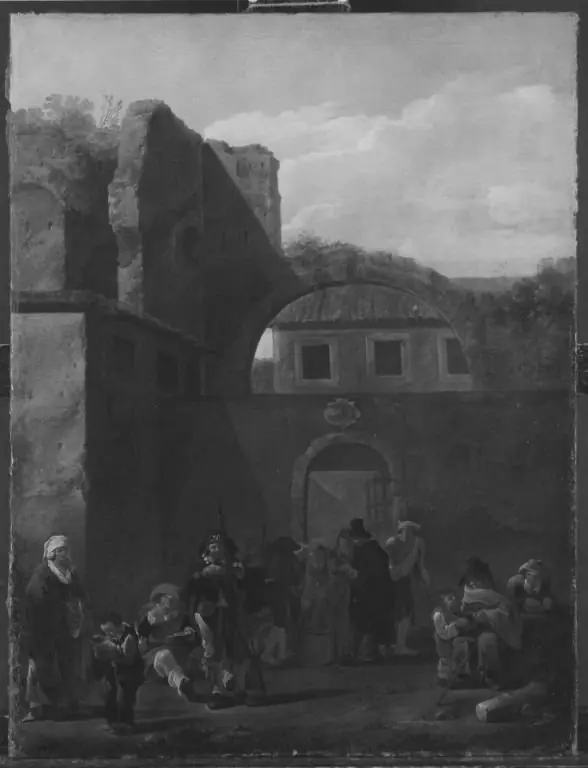
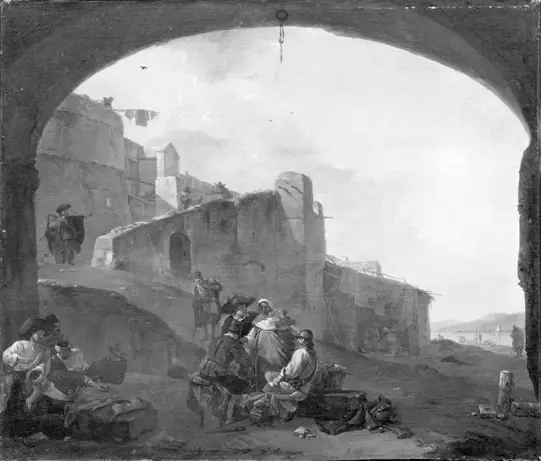
The Gipsy Woman Telling the Soldiers their Fortunes is a photography by Unknown. It dates from 1650 and is held in the collection of the Statens Museum for Kunst. Created around 1650, this image depicts a Romani woman offering readings to a group of soldiers near a decaying stone fortress.
About this work
Overview
Created around 1650, this image depicts a Romani woman offering readings to a group of soldiers near a decaying stone fortress.
Created around 1650, this image depicts a Romani woman offering readings to a group of soldiers near a decaying stone fortress. The scene is rendered in monochrome, emphasizing contrasts of light and shadow. The composition centers on the interaction between the woman and three soldiers, with others observing from a distance. The setting suggests a moment of transient connection amid the ruins of military architecture.
Subject & Meaning
The Romani woman, positioned as the focal point, engages with soldiers through palm reading or divination, likely using a small object resembling a crystal ball. Her role as a fortune-teller introduces themes of fate, uncertainty, and the human desire for guidance. The soldiers, in varied postures, reflect differing levels of engagement—some attentive, others detached—hinting at the varied responses to mysticism in a military context.
Technique & Style
The image employs strong chiaroscuro to model forms and direct attention toward the central figures. Subtle gradations of gray define textures—fabric, stone, skin—while the background remains muted, isolating the group. The lack of color heightens the sense of timelessness and austerity. Compositionally, the soldiers are arranged in a loose semicircle, drawing the viewer’s eye toward the woman’s hands and the object she holds.
History & Provenance
The work is held in the collection of the Museum of Ethnography, though its origin as a drawing, print, or photograph remains unspecified. It lacks a documented artist attribution, and its creation date is estimated based on costume and architectural details. Its preservation suggests it was valued as a record of social interaction rather than as fine art in its time.
Context
In mid-17th-century Europe, Romani people were often itinerant and viewed with suspicion, yet frequently employed as entertainers or fortune-tellers. Soldiers, frequently stationed in remote areas, sought solace in such practices. The crumbling fortress in the background may reflect the decay of military authority or the impermanence of power, reinforcing the scene’s themes of transience and vulnerability.
Legacy
This image contributes to a broader visual record of Romani presence in early modern Europe, countering stereotypes with a moment of quiet intimacy. It remains a rare depiction of cross-cultural exchange in a military setting, valued today for its anthropological insight rather than artistic fame. Its preservation underscores interest in everyday rituals overlooked by mainstream art history.
Artist & collection

 Domestic Scene
 Giacomo and Cardinal Marco, investing Andrea, Abbot of San Zeno, with his Benefice
 The Nymph of Fontainebleau
 Portrait of a Woman
 Madonna and Child with Saints in the Enclosed Garden
 Venus and Minerva
 Family Group of Four on Sofa
 Wall painting from Room H of the Villa of P. Fannius Synistor at Boscoreale