Artwork
Dead Wildfowl and a Game Dog
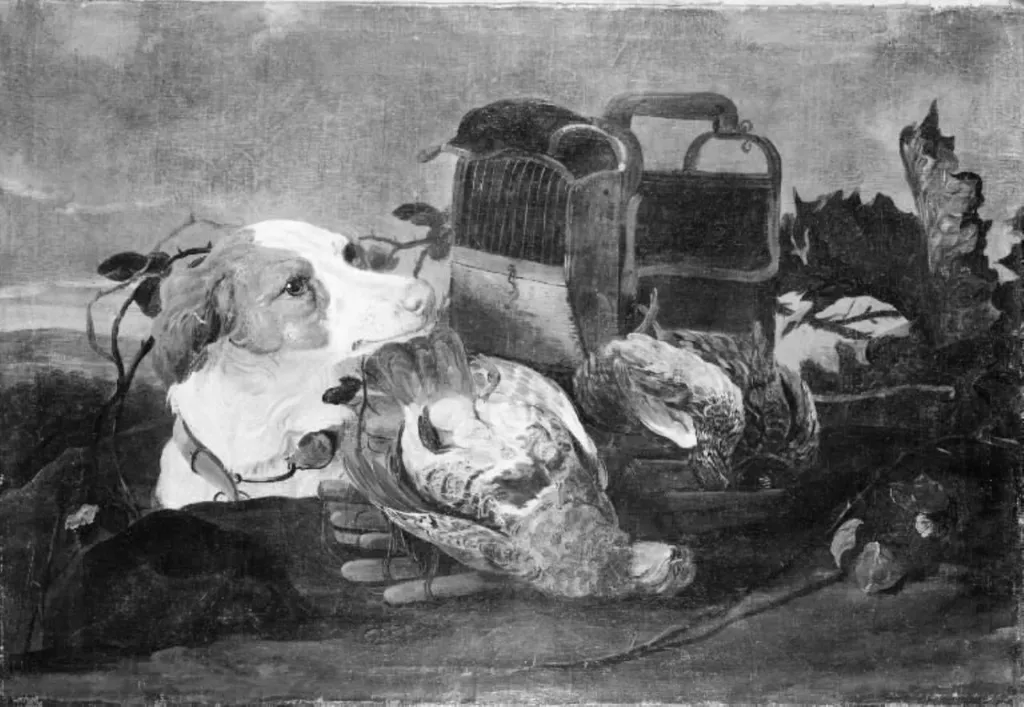
Dead Wildfowl and a Game Dog is a photography by Unknown. It dates from 1650 and is held in the collection of the Statens Museum for Kunst. Created around 1650, this black-and-white painting depicts a game dog resting beside a wooden birdcage and a fallen wildfowl.
About this work
Overview
Created around 1650, this black-and-white painting depicts a game dog resting beside a wooden birdcage and a fallen wildfowl. The work is held in the Museum of Ethnography and reflects a quiet, observational approach to still life. The composition centers on the dog’s gaze and the stillness of the dead bird, suggesting themes of capture and loss without overt narrative.
Subject & Meaning
The scene presents a dog, likely bred for hunting, gazing toward an empty birdcage while a single wildfowl lies motionless nearby. The absence of human figures and the dog’s alert posture imply a moment suspended after a hunt. The stillness evokes contemplation rather than triumph, hinting at the quiet consequences of human intervention in nature.
Technique & Style
Rendered in monochrome, the painting employs chiaroscuro to model form and depth. Soft gradations of gray define the dog’s fur, the cage’s wooden slats, and the bird’s feathers. The dark, unmodeled background isolates the subjects, enhancing their presence. Brushwork is restrained, favoring subtle tonal shifts over detail, reinforcing the scene’s somber tone.
History & Provenance
The painting’s creator remains unidentified, though stylistic elements suggest a Northern European origin in the mid-17th century. It entered the Museum of Ethnography’s collection through an early 20th-century acquisition, likely from a private European collection. Its attribution to a specific artist or school has not been conclusively established.
Context
In 17th-century Europe, depictions of game and hunting dogs were common in still life, often symbolizing wealth or leisure. This work diverges by omitting abundance or display; instead, it focuses on aftermath and solitude. Its muted palette and lack of ornamentation align with regional traditions that valued quiet realism over theatricality.
Legacy
Though not widely exhibited, the painting contributes to studies of early modern animal representation and the evolution of still life beyond ornamental display. Its restrained emotion and focus on quiet aftermath offer a counterpoint to more celebratory hunting scenes, influencing later interpretations of domesticated nature in art.
Artist & collection

 Domestic Scene
 Giacomo and Cardinal Marco, investing Andrea, Abbot of San Zeno, with his Benefice
 The Nymph of Fontainebleau
 Portrait of a Woman
 Madonna and Child with Saints in the Enclosed Garden
 Venus and Minerva
 Family Group of Four on Sofa
 Wall painting from Room H of the Villa of P. Fannius Synistor at Boscoreale
 Totes Geflügel
 Früchtestück in einer Landschaft
 Still life with birds and fish
 Stillleben mit totem Rebhuhn
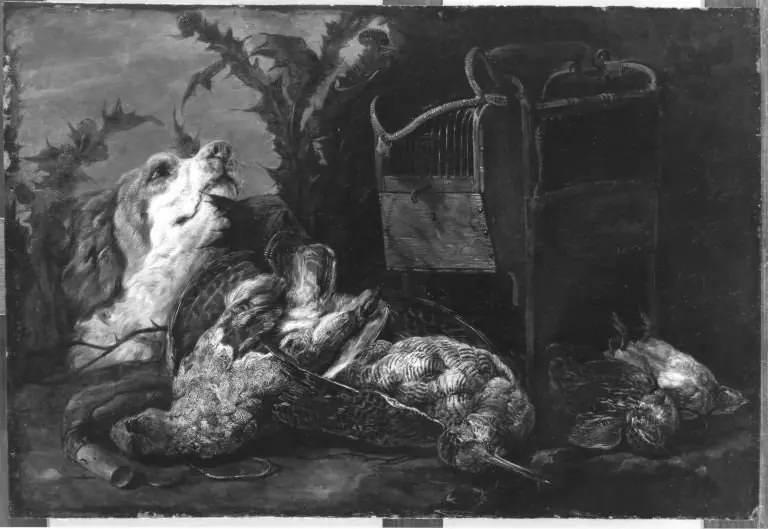 Jagdstillleben mit Hündin
 Still Life with Small Game, Basket of Fruit, Goldfinches and a Squirrel
 Stillleben (?)
 A Cook and a Kitchen Maid with the Provisions of the Kitchen
 Stilleben
 Stillleben mit Jagdbeute und Obst