Artwork
Et prospekt af de europæiske factorier i Canton
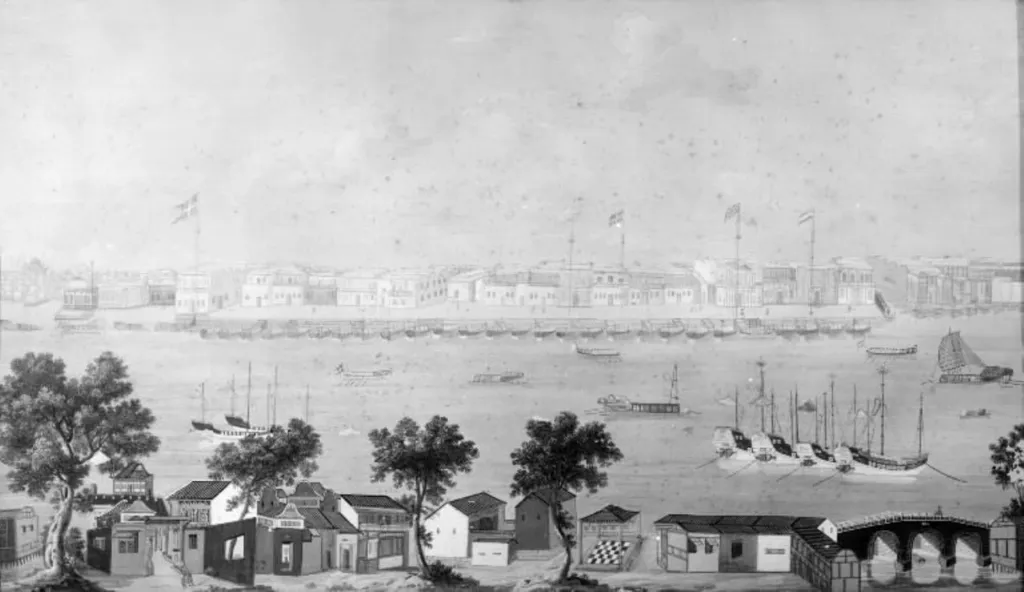
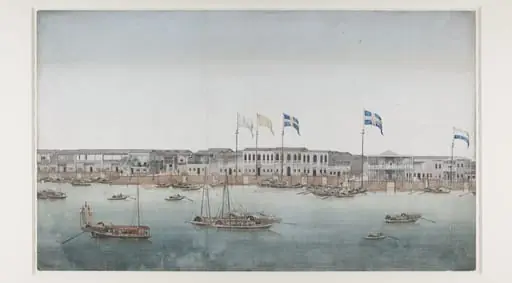
Et prospekt af de europæiske factorier i Canton is an unspecified painting by Unknown. It dates from 1750 and is held in the collection of the Statens Museum for Kunst. This mid-18th-century view depicts the European trading posts along the Pearl River in Canton, now Guangzhou.
About this work
Overview
This mid-18th-century view depicts the European trading posts along the Pearl River in Canton, now Guangzhou.
This mid-18th-century view depicts the European trading posts along the Pearl River in Canton, now Guangzhou. Painted around 1750, it captures the physical layout of foreign factories—small, functional buildings where merchants from Britain, the Netherlands, France, and other nations conducted commerce under strict Qing regulations. The scene is rendered with quiet precision, emphasizing order and restraint rather than spectacle.
Subject & Meaning
The painting documents the limited foreign presence permitted in Canton during China’s Canton System. The row of low buildings represents the factories of European trading companies, isolated from the city proper. The calm river and distant ships suggest the flow of goods and the controlled nature of trade. The absence of Chinese figures underscores the separation between foreign traders and local society.
Technique & Style
Executed in a restrained, topographical style, the work favors clarity over dramatic effect. Buildings are rendered with simple geometric forms, their walls subtly differentiated by texture and color. The river reflects light evenly, enhancing the sense of stillness. Trees and distant structures are rendered with minimal detail, reinforcing the painting’s function as a factual record rather than an expressive composition.
History & Provenance
Created around 1750, the painting likely originated from a European merchant or artist stationed in Canton. It entered the collection of the Museum of Ethnography, where it remains as part of a broader archive of material documenting global trade networks. Its survival reflects early European interest in documenting foreign commercial environments, even under restrictive conditions.
Context
In the mid-18th century, foreign trade with China was confined to Canton under the Qing dynasty’s Canton System. European traders lived and worked in these factory compounds, subject to Chinese laws and seasonal restrictions. This painting reflects the physical reality of that system: a compact, regulated enclave on the river’s edge, designed for efficiency and separation rather than integration.
Legacy
As a rare visual record of the European factories in Canton, the painting offers insight into the material culture of early global trade. It serves as a historical document for scholars studying cross-cultural commerce, architectural adaptation, and the limits of foreign influence in imperial China. Its quiet realism distinguishes it from later, more romanticized depictions of the region.
Artist & collection

 Domestic Scene
 Giacomo and Cardinal Marco, investing Andrea, Abbot of San Zeno, with his Benefice
 The Nymph of Fontainebleau
 Portrait of a Woman
 Madonna and Child with Saints in the Enclosed Garden
 Venus and Minerva
 Family Group of Four on Sofa
 Wall painting from Room H of the Villa of P. Fannius Synistor at Boscoreale
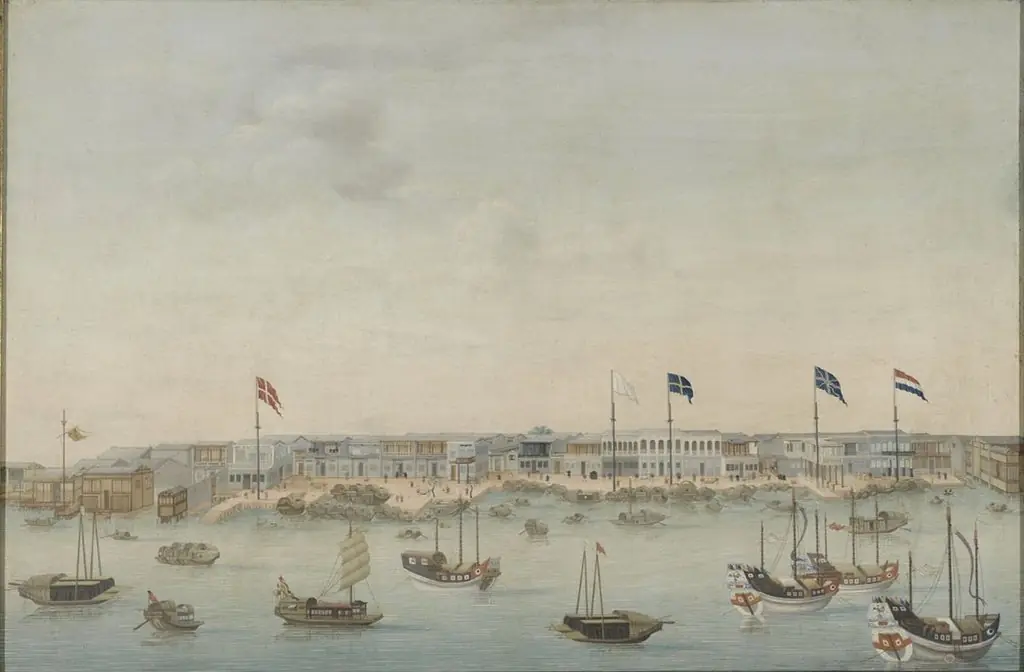 Drie gezichten op de Parelrivier: Kanton, Macao, Whampoa
 Crowninshield's Wharf
 Former Dolmabahçe Palace and Mosque
 Plimouth Sound
 New York City and Harbor from Weehawken
 Ryde, Isle of Wight
 Kasim Pasa, the former Ottoman Naval Arsenal, from the Golden Horn
 View of the Town and Port of Bayonne (La villa y puerto de Bayona)
 a view of the Canton waterfront
 View of the Whampoa Anchorage