Artwork
View of Campo Vaccino in Rome
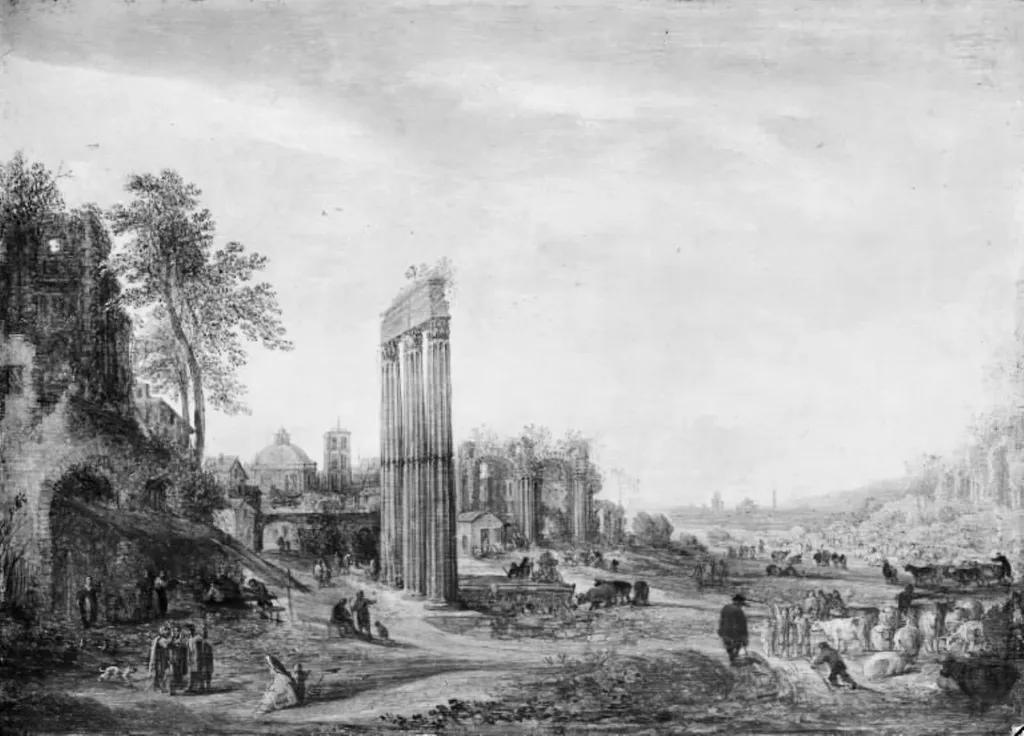
View of Campo Vaccino in Rome is a photography by Unknown. It dates from 1650 and is held in the collection of the Statens Museum for Kunst.
About this work
Overview
View of Campo Vaccino in Rome is a mid‑17th‑century cityscape rendered in monochrome.
View of Campo Vaccino in Rome is a mid‑17th‑century cityscape rendered in monochrome. Executed around 1650 and attributed to the artist catalogued as 938_person, the work depicts a bustling open area of ancient Rome, centered on a slender, flat‑topped tower. The composition balances human activity, grazing animals, and natural elements, all set against a backdrop of trees, modest structures, and a river along the lower edge.
Subject & Meaning
The scene captures the Campo Vaccino, the former Roman cattle market, illustrating daily life amid historic ruins. Figures stroll, sit on the grass, and livestock graze, suggesting a harmonious coexistence of urban and pastoral functions. The prominent tower, likely a surviving Roman monument, serves as a focal point that anchors the viewer’s attention and underscores the continuity of the city's architectural heritage.
Technique & Style
Rendered in black and white, the image relies on tonal contrast to model forms and convey depth. The artist employs chiaroscuro, using light and shadow to delineate the tower’s simple geometry against the surrounding foliage and architecture. Linear perspective guides the eye toward the river at the bottom, while the varied textures of stone, grass, and water are suggested through careful gradations of tone.
History & Provenance
Created circa 1650, the work entered the collection of the Museum of Ethnography, where it remains on display. Its attribution to the anonymous 938_person reflects cataloguing practices that assign numeric identifiers to works lacking a documented creator, a common approach for lesser‑known pieces from the period.
Context
During the mid‑1600s, European artists often revisited classical sites, merging antiquarian interest with contemporary observation. This depiction of the Campo Vaccino aligns with that trend, presenting an idealized yet lively vision of Rome’s ancient spaces as they functioned within a 17th‑century urban landscape.
Artist & collection

 Domestic Scene
 Giacomo and Cardinal Marco, investing Andrea, Abbot of San Zeno, with his Benefice
 The Nymph of Fontainebleau
 Portrait of a Woman
 Madonna and Child with Saints in the Enclosed Garden
 Venus and Minerva
 Family Group of Four on Sofa
 Wall painting from Room H of the Villa of P. Fannius Synistor at Boscoreale
 Architectural Study with Columns and a Fountain
 Fantasielandschaft
 Architectural Study with Columns and a Fountain
 Decorative Painting with Imaginary Architecture
 Italian Landscape
 Italian Landscape
 Landscape with Classical Ruins
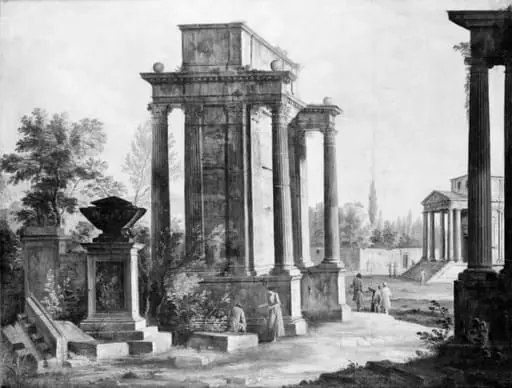 Imaginary Architectural Monuments
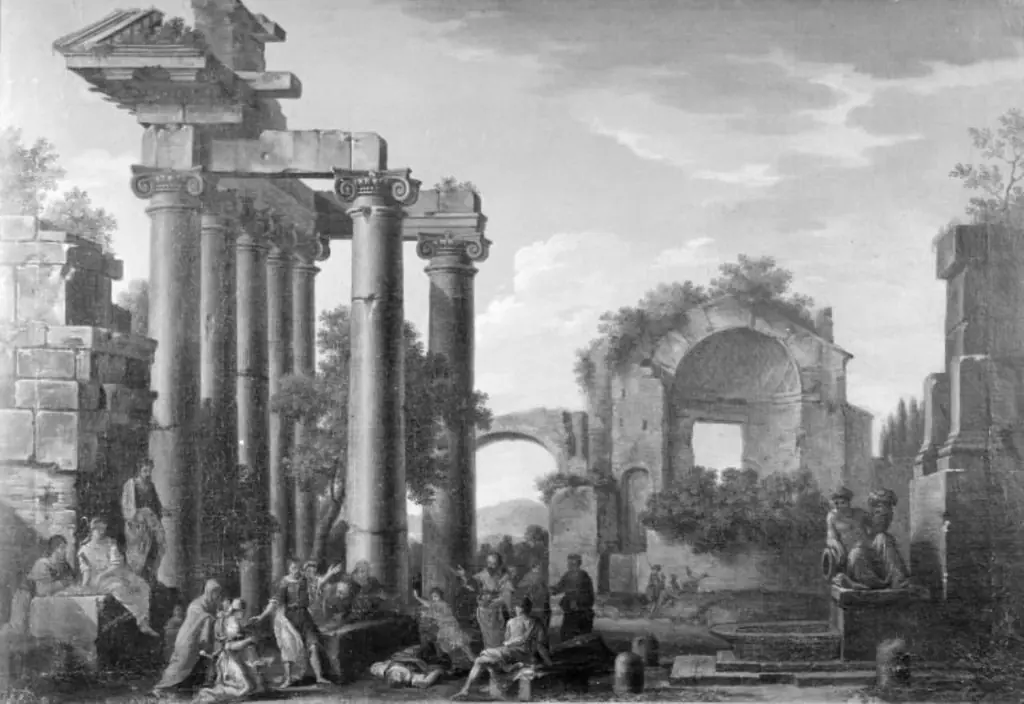 Ruiner af et græsk-romersk tempel med mange figurer