Artwork
Bentworth
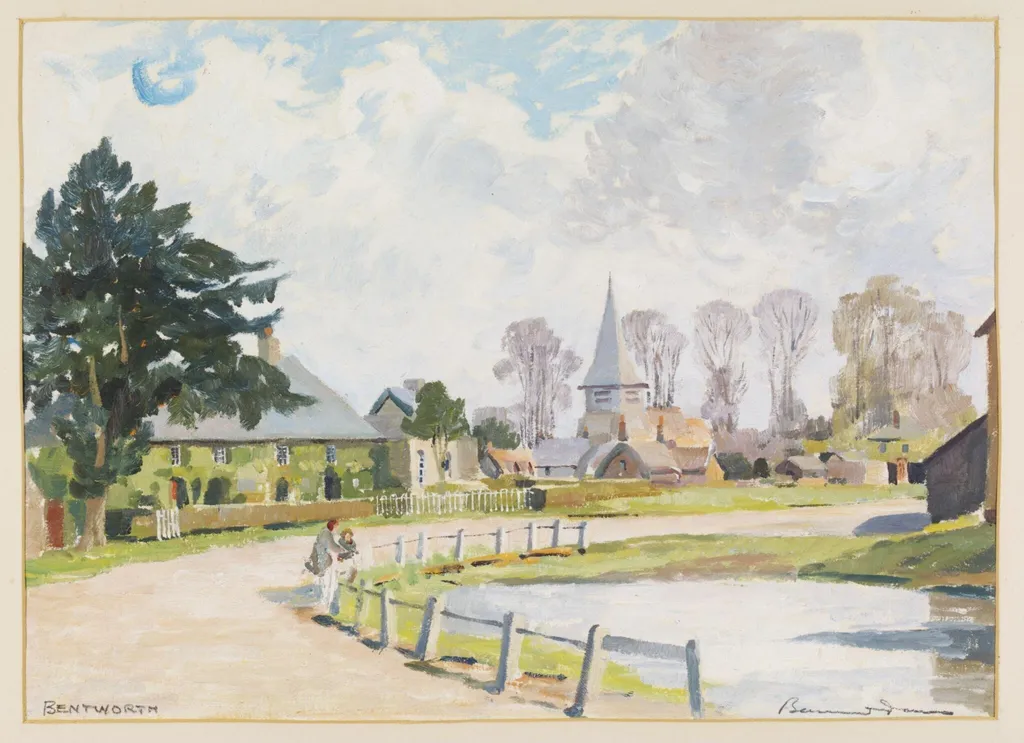
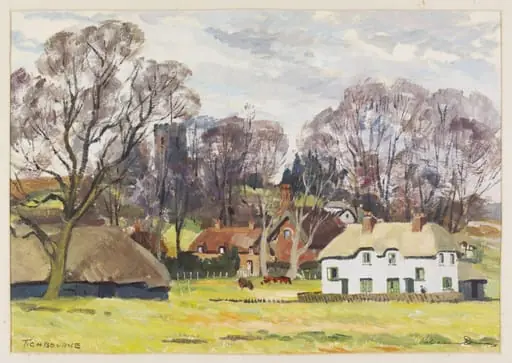
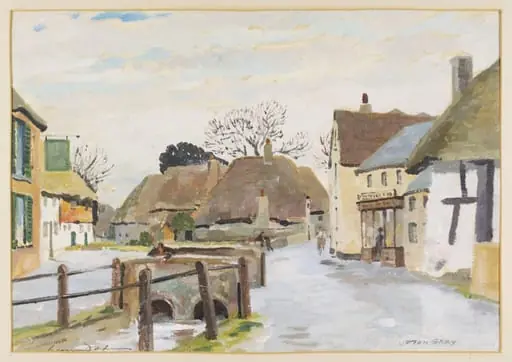
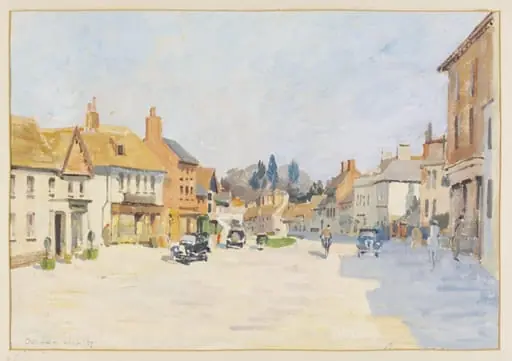
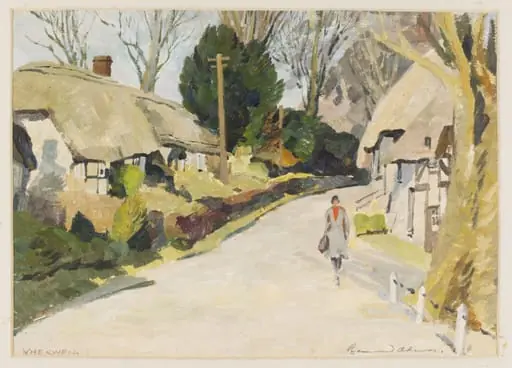
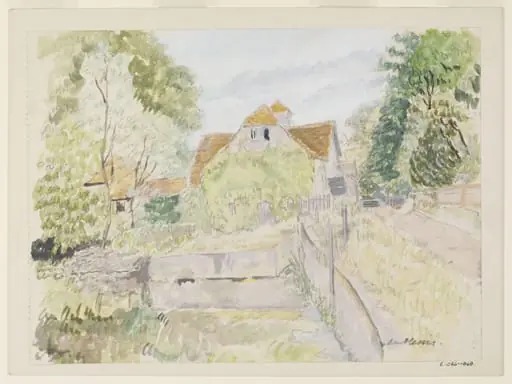
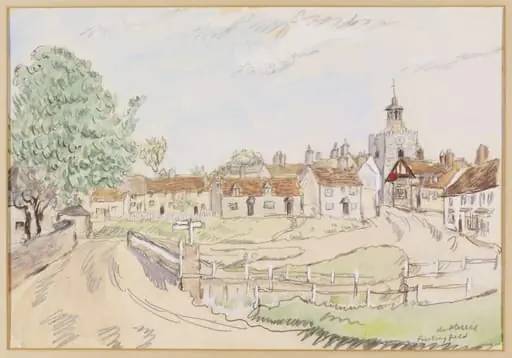
Bentworth is a paint painting by Adams. It dates from 1940 and is held in the collection of the Victoria and Albert Museum.
About this work
Overview
The painting captures a modest scene with a church spire, scattered dwellings, and a path leading to a pond, all rendered in delicate washes.
Edward Adams’s 1940 watercolour *Bentworth* is a quiet depiction of a Hampshire village, created as part of the *Recording Britain* project. This initiative sought to visually archive rural landscapes at risk during wartime. The painting captures a modest scene with a church spire, scattered dwellings, and a path leading to a pond, all rendered in delicate washes. Its purpose was not grandeur but preservation—recording everyday English scenery before it could be altered or lost.
Subject & Meaning
The scene centers on a tranquil village moment: a figure walks a dog along a dirt path beside a wooden fence, with a pond reflecting the overcast sky. Behind, a church spire rises among modest homes, and a large evergreen anchors the left side. These elements—commonplace, unadorned—suggest continuity in rural life. The painting’s quietude reflects the project’s aim to honor ordinary places, framing them as worthy of documentation amid national upheaval.
Technique & Style
Adams employed loose, fluid watercolour brushwork, allowing pigment to bleed softly across the paper. Muted tones of gray-green, pale blue, and earthy brown dominate, evoking a subdued, overcast day. The sketchlike quality suggests immediacy, as if observed in passing. There is no sharp detail or dramatic contrast; instead, the effect is atmospheric, emphasizing light and mood over precision. This approach aligns with the project’s preference for evocative simplicity over polished finish.
History & Provenance
Commissioned in 1940 under the *Recording Britain* initiative, the painting was funded by the Pilgrim Trust and overseen by the Ministry of Labour and National Service. Sir Kenneth Clark, then director of the National Gallery, spearheaded the effort to document vulnerable landscapes. Adams’s work entered the collection of the Victoria and Albert Museum, where it remains as part of a larger archive of over 1,500 works created by artists across Britain during the war years.
Context
During the early 1940s, Britain faced threats to its rural heritage from bombing, agricultural change, and urban sprawl. The *Recording Britain* project responded to these pressures by mobilizing artists to record scenes deemed at risk. Adams’s painting is one of many that captured village life not as idealized nostalgia, but as a tangible, fading reality. It reflects a national effort to preserve cultural memory through art during a time of uncertainty.
Legacy
The *Recording Britain* collection, including Adams’s work, endures as a vital visual archive of mid-20th-century English rural life. Rather than celebrating grandeur, these works document the quiet persistence of everyday places. Today, they serve as historical records and touchstones for understanding how communities perceived their landscapes during wartime. The painting remains accessible at the Victoria and Albert Museum, where it continues to inform discussions on heritage and memory.
Artist & collection
Artist
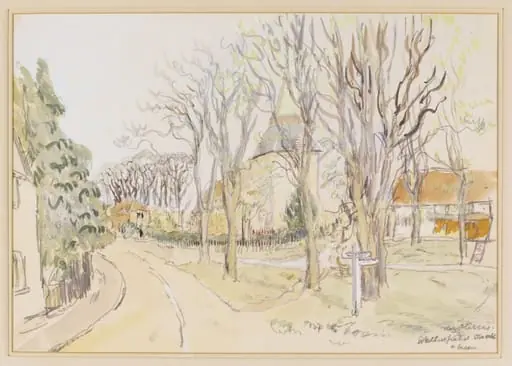
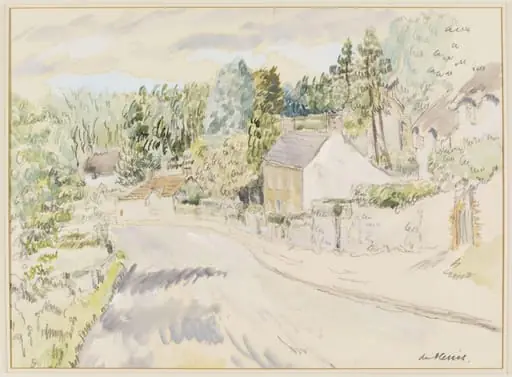
This bundle gathers quiet English countryside scenes from an artist whose name isn’t widely recorded.