Artwork
The Judgment of Paris
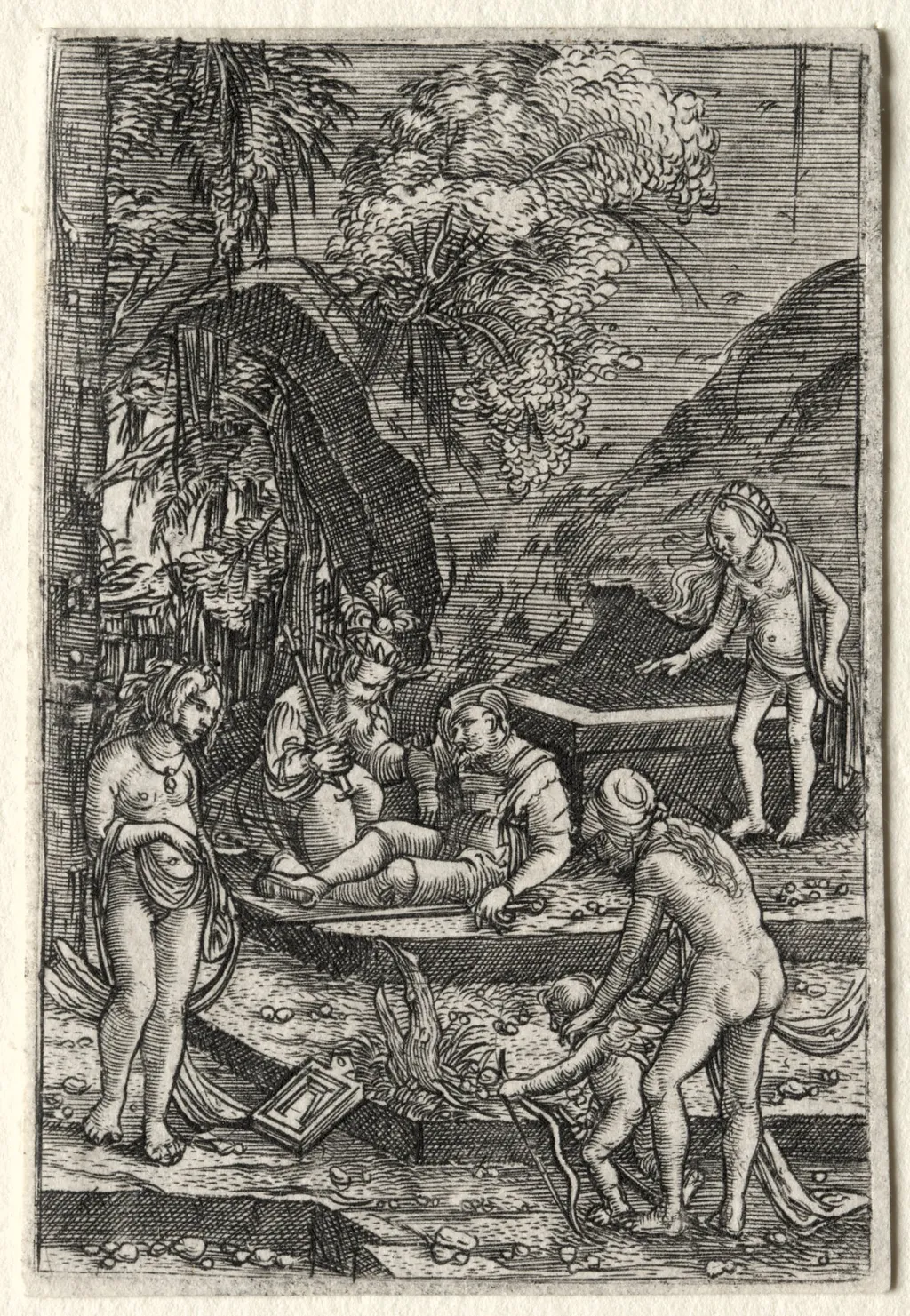
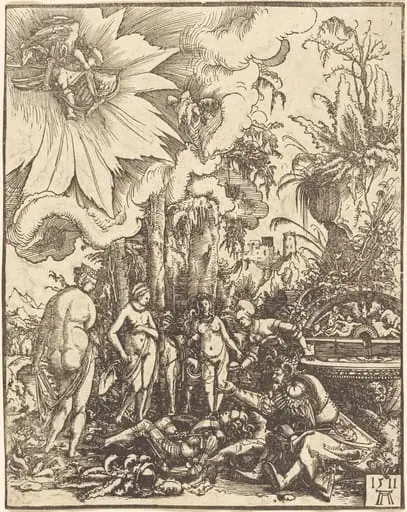
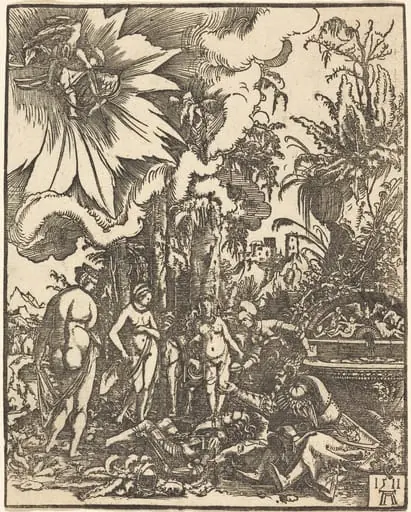
The Judgment of Paris is a print by the Renaissance artist Albrecht Altdorfer. It dates from 1511 and is held in the collection of the Cleveland Museum of Art.
About this work
Overview
Created in 1511 by Albrecht Altdorfer, this black-and-white print depicts a moment from Greek myth set within a dense, atmospheric forest.
Created in 1511 by Albrecht Altdorfer, this black-and-white print depicts a moment from Greek myth set within a dense, atmospheric forest. Altdorfer, active in Regensburg, was known for blending narrative subjects with intricate natural settings. Though executed in monochrome, the work demonstrates his mastery of line and shadow to suggest volume and depth, characteristic of his printmaking practice during the early Renaissance.
Subject & Meaning
The scene illustrates the myth of Paris, a Trojan prince asked to judge which of three goddesses—Hera, Athena, and Aphrodite—is most beautiful. Each offers a gift: power, wisdom, or love. In this version, the figures are arranged around a table with fruit and cloth, suggesting the gifts' symbolic presence. The infant held by one figure may allude to future consequences, subtly hinting at the myth’s tragic outcome without overt drama.
Technique & Style
Altdorfer employed fine, controlled engraving lines to define forms and textures, using contrast between light and shadow to model figures and foliage. The composition emphasizes verticality, with towering trees framing the central group. Unlike contemporaries who prioritized idealized anatomy, he gave equal weight to the natural environment, rendering bark, leaves, and undergrowth with meticulous attention, reflecting his unique integration of landscape and narrative.
History & Provenance
The print originates from Altdorfer’s active period in Regensburg, where he worked as an artist, architect, and civic official. While the exact early ownership is undocumented, it aligns with the circulation of small-scale engravings among educated patrons in southern Germany. Its survival in black-and-white suggests it was produced as a standalone print, not a preparatory study, indicating its intended audience valued both myth and aesthetic detail.
Context
In early 16th-century Germany, artists began shifting from purely religious themes to classical subjects, often framed by natural settings. Altdorfer’s work reflects this trend, influenced by Italian Renaissance humanism but filtered through a Northern European sensibility. His landscapes, though not yet autonomous, carry emotional weight and spatial complexity, distinguishing him from contemporaries and anticipating later developments in landscape art.
Legacy
Altdorfer’s integration of myth with immersive nature influenced later Northern artists who sought to elevate landscape beyond mere backdrop. While not widely copied, his approach to atmospheric depth and narrative restraint contributed to the evolution of printmaking in Central Europe. His work remains a quiet example of how Renaissance ideals were adapted locally, prioritizing mood and environment over classical symmetry.
Artist & collection
Artist
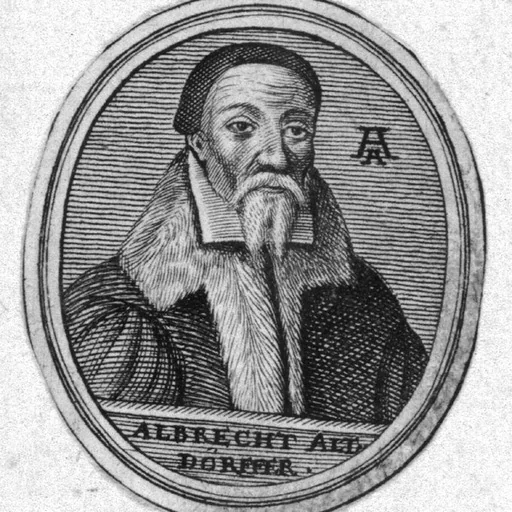
Albrecht Altdorfer (c. 1480 – 12 February 1538) was a German painter, engraver and architect of the Renaissance working in Regensburg. Along with Lucas Cranach the Elder and Wolf Huber he is regarded to be the main…