Artwork
The Judgment of Paris
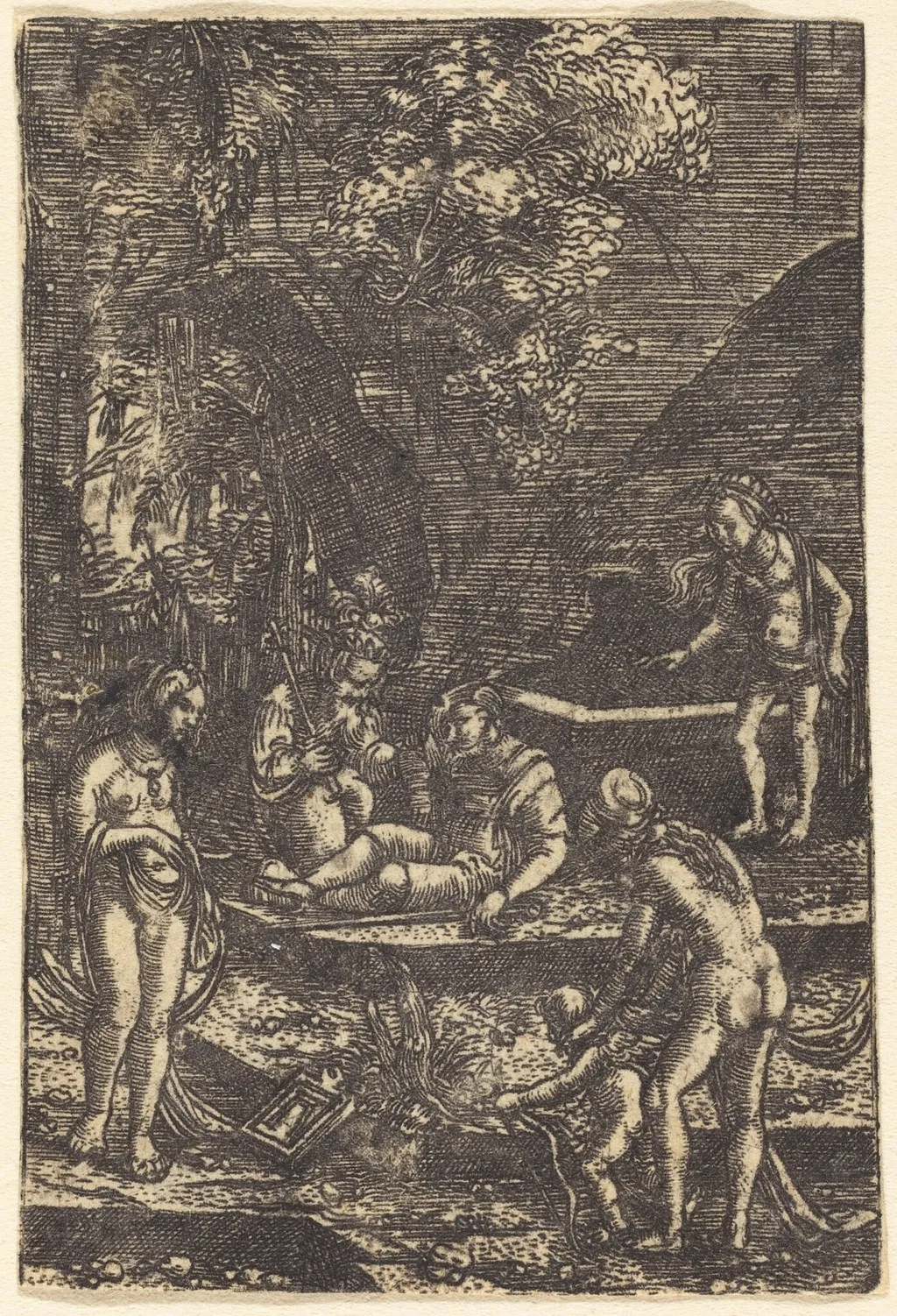
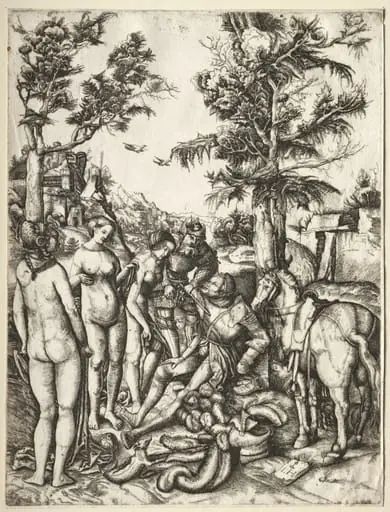
The Judgment of Paris is an ink print by the Renaissance artist Albrecht Altdorfer. It dates from 1516 and is held in the collection of the National Gallery of Art.
About this work
Overview
Created around 1516, this engraving on laid paper by Albrecht Altdorfer depicts the mythological scene of Paris judging the beauty of three goddesses.
Created around 1516, this engraving on laid paper by Albrecht Altdorfer depicts the mythological scene of Paris judging the beauty of three goddesses. As a German artist linked to the Danube School, Altdorfer used the medium of engraving to explore narrative and natural setting with unusual intimacy. The work belongs to a tradition of small-scale prints produced by the Nuremberg Little Masters, valued for their precision and detail.
Subject & Meaning
The scene illustrates the myth in which Paris, a Trojan prince, is asked to choose the most beautiful among Hera, Athena, and Aphrodite. Each figure is rendered with subtle differentiation: one holds a mirror, another stands apart, and a child observes quietly. The composition centers Paris in repose, suggesting his role as passive arbiter. The narrative draws from classical myth but is rendered with a quiet, humanized tone rather than grandeur.
Technique & Style
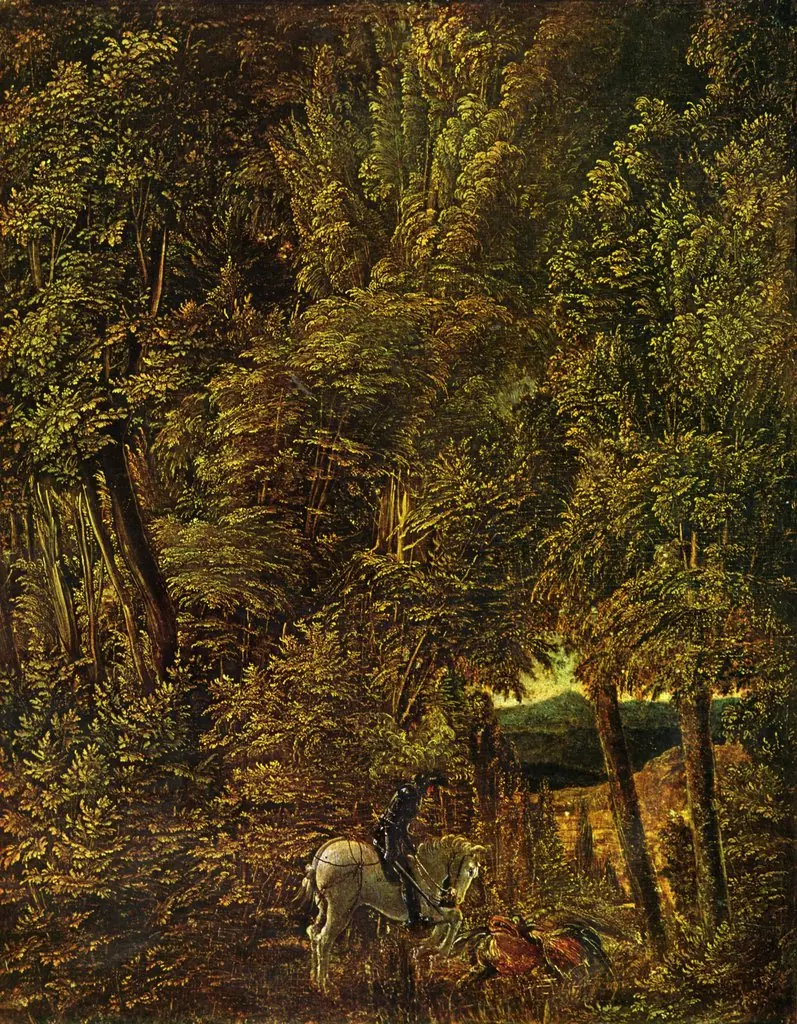
Altdorfer employed fine, controlled lines to model forms and texture, characteristic of engraving’s capacity for detail. The figures are delicately rendered against a dense, winding woodland background, where foliage and tree trunks are meticulously incised. His treatment of nature is not merely ornamental; the landscape envelops the figures, creating a sense of immersive, almost intimate wilderness that anticipates later landscape traditions.
History & Provenance
The print was produced in the early 16th century, likely in Nuremberg, a center for printmaking. Altdorfer’s engravings circulated among collectors and artists across Germany and beyond. While specific early ownership records are sparse, the work’s survival in multiple institutional collections suggests it was valued early for its technical finesse and imaginative composition within the printmaking community.
Context
This engraving emerged during a period when Northern Renaissance artists increasingly blended classical themes with local naturalism. Altdorfer’s focus on wooded settings distinguished him from Italian contemporaries, who emphasized architectural space. His work reflects a broader Northern interest in nature as a meaningful backdrop to human action, separate from purely religious or allegorical imperatives.
Legacy
Altdorfer’s integration of landscape as an active element in narrative scenes influenced later generations of printmakers and painters. Though not widely copied, his approach to combining myth with dense, atmospheric environments contributed to the evolution of landscape as a subject in its own right. His engravings remain key examples of how Northern Renaissance artists reimagined classical stories through intimate, naturalistic lenses.
Artist & collection
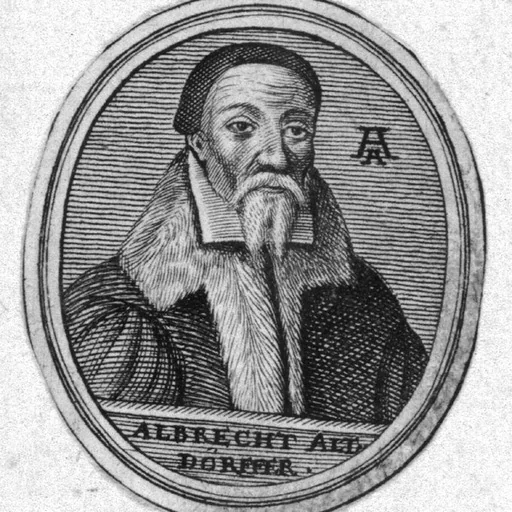
Artist
Albrecht Altdorfer (c. 1480 – 12 February 1538) was a German painter, engraver and architect of the Renaissance working in Regensburg. Along with Lucas Cranach the Elder and Wolf Huber he is regarded to be the main…