Artwork
The Judgment of Paris
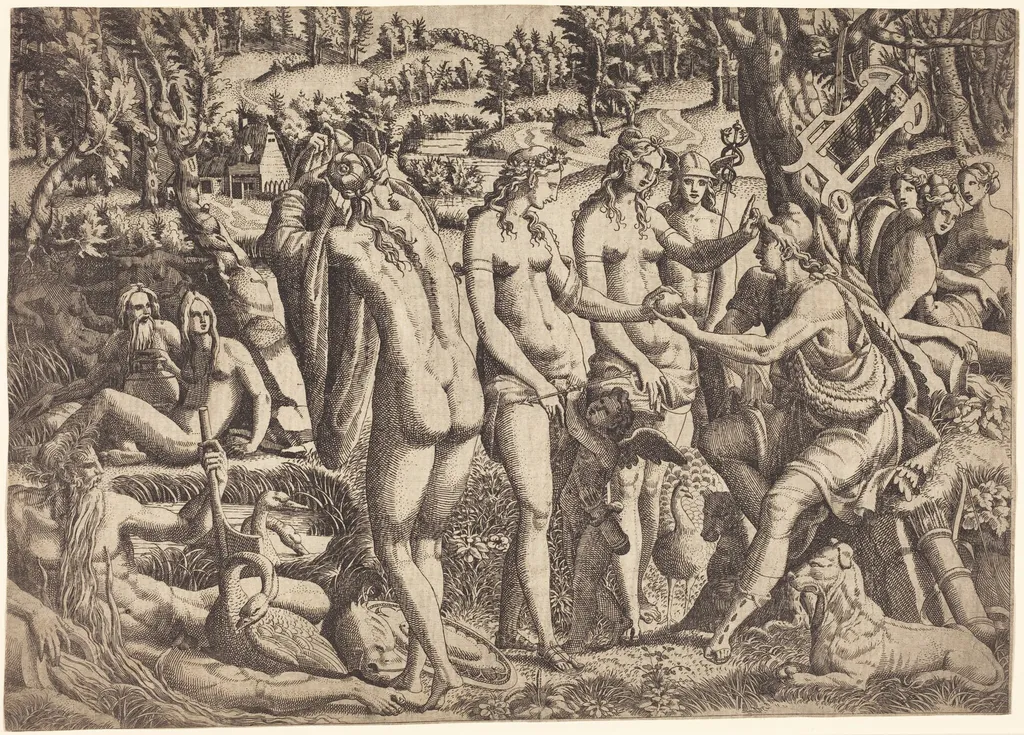
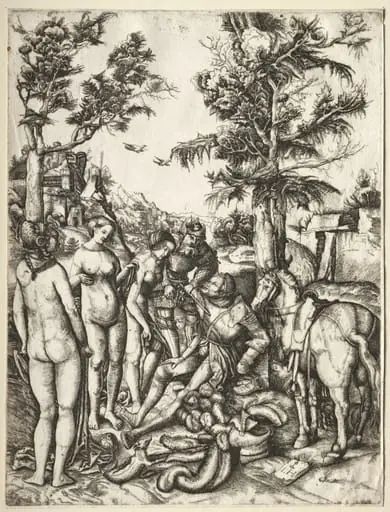
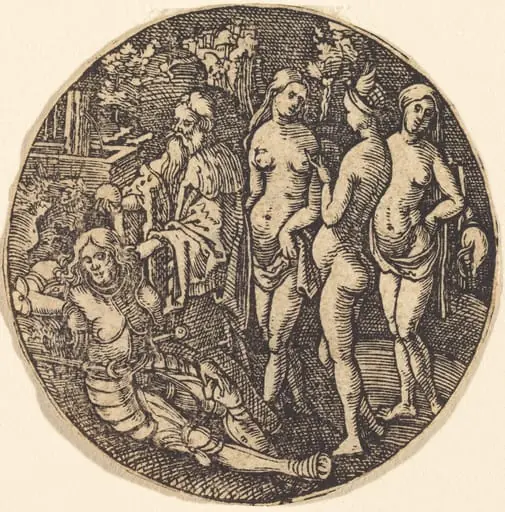
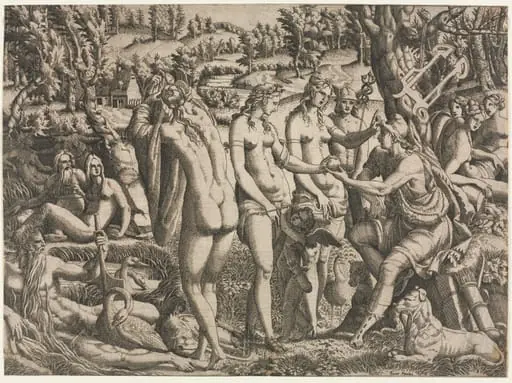
The Judgment of Paris is an ink print by the Renaissance artist Jean Mignon. It is held in the collection of the National Gallery of Art.
About this work
Overview
Jean Mignon’s 1563 engraving presents the mythic episode in which Paris must decide which of three goddesses merits the golden apple. The print arranges a nude central figure, a seated woman on a rock, a standing male figure, and another seated woman within a landscape of trees and distant structures, creating a compact yet narrative scene.
Subject & Meaning
The work visualizes the pivotal moment of the Judgment of Paris, a story from Greek mythology that explores themes of beauty, choice, and the origins of the Trojan War. By placing the central nude figure at the focal point, the composition emphasizes the tension of the decision and the allure of each goddess.
Technique & Style
Executed in engraving on laid paper, Mignon employs fine cross‑hatching to model forms, imparting texture and a sense of three‑dimensionality. The line work delineates musculature and drapery, while the careful gradations of tone enhance depth. The composition reflects the elegant, elongated figures typical of the Fontainebleau aesthetic.
History & Provenance
Mignon, a French printmaker active from the late 1530s through the mid‑1550s, produced this image during his involvement with the First School of Fontainebleau. The design derives from drawings by Italian artist Luca Penni, who worked at the royal palace in the 1530s‑1540s, illustrating the collaborative exchange between French and Italian artists of the period.
Context
The engraving exemplifies the cross‑cultural artistic dialogue that defined the Fontainebleau court, where Italian Mannerist influences merged with French decorative tastes. By translating a classical narrative into a reproducible print, Mignon helped disseminate the court’s visual language beyond the palace walls, reaching a broader audience of collectors and connoisseurs.
Artist & collection

Artist
Jean Mignon was a French artist in painting and printmaking in the 16th century, active from 1537 to the mid-1550s.