Artwork
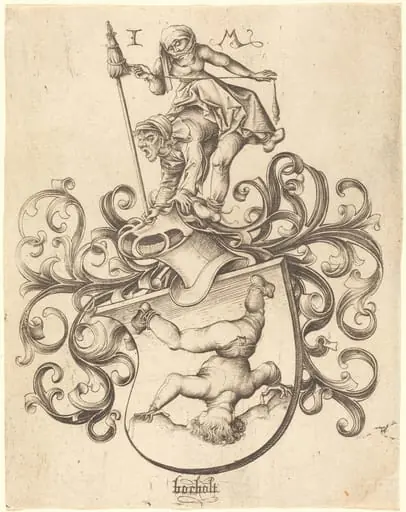
The Coat of Arms with a Lion and Cock
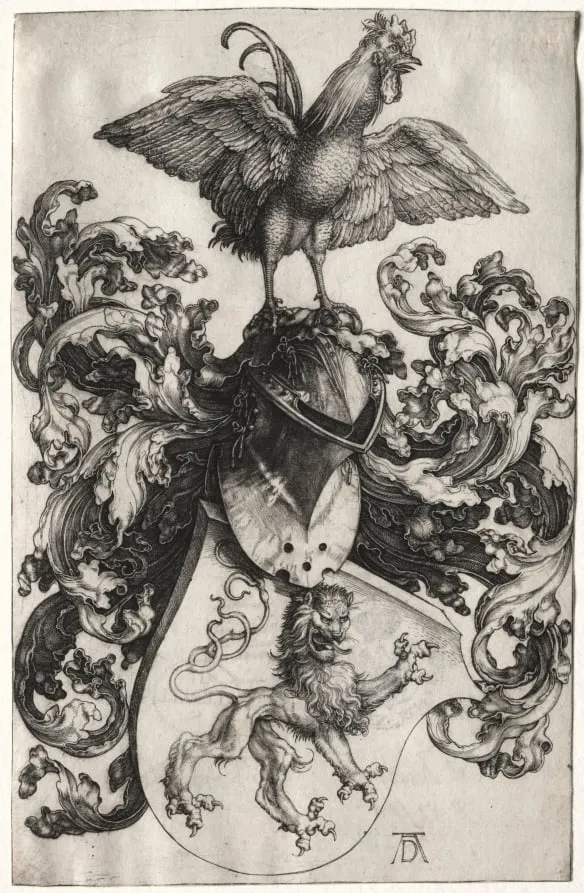
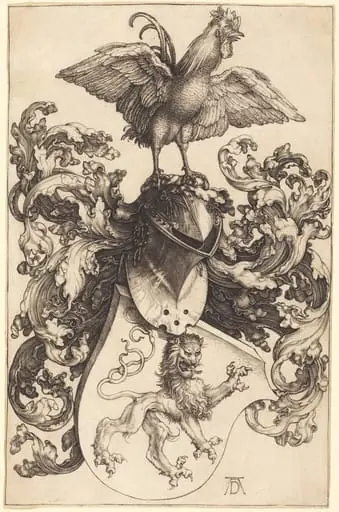
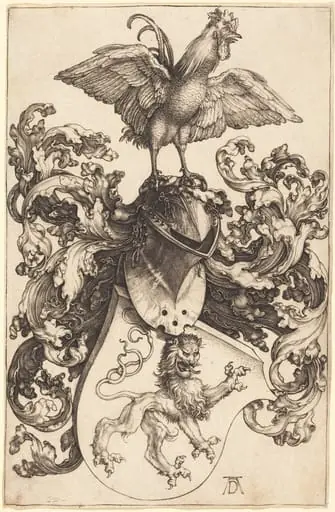
The Coat of Arms with a Lion and Cock is a print by the Renaissance artist Albrecht Dürer. It dates from 1503 and is held in the collection of the Cleveland Museum of Art.
About this work
Overview
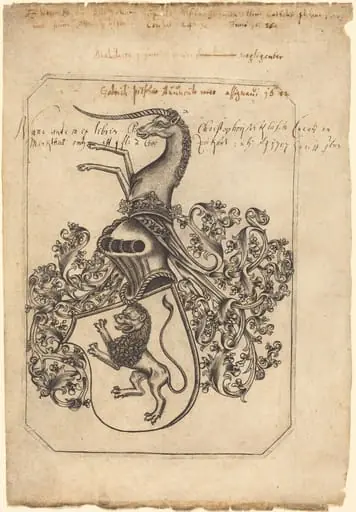
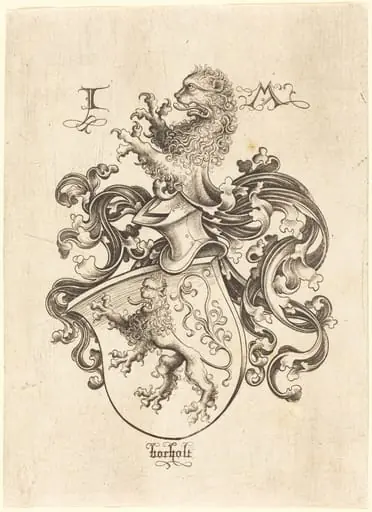
Created around 1503, this engraving by Albrecht Dürer presents a heraldic composition centered on a shield bearing a rampant lion and a perched cock.
Created around 1503, this engraving by Albrecht Dürer presents a heraldic composition centered on a shield bearing a rampant lion and a perched cock. Executed in fine black lines on a pale ground, the work exemplifies Dürer’s precision in engraving and his interest in symbolic imagery. Though not a commissioned piece, it reflects his broader engagement with heraldic forms during his early career, when his technical mastery was gaining widespread attention across Europe.
Subject & Meaning
The lion, a traditional symbol of strength and nobility, stands upright within the shield, while the cock, often associated with vigilance and resurrection, perches atop. Their facing orientation suggests mutual guardianship of the emblem. The surrounding scrollwork and enigmatic banner may reference familial or civic identity, though no specific patron is documented. The imagery aligns with Northern Renaissance conventions, where animals conveyed moral or social virtues within heraldic frameworks.
Technique & Style
Dürer employed fine-line engraving to render intricate textures in the lion’s fur and the cock’s feathers, demonstrating his command of linear detail. The composition is tightly structured, with decorative arabesques framing the central emblem without overwhelming it. The absence of color and reliance on tonal contrast emphasize the engraving’s clarity and precision, hallmarks of Dürer’s approach to printmaking during this period.
History & Provenance
The print was produced during Dürer’s formative years, shortly after his return from Italy and before his official appointment by Emperor Maximilian I. It likely circulated among patrons and fellow artists as a demonstration of technical skill rather than as a commissioned coat of arms. No definitive record of its original ownership exists, but surviving impressions suggest it was widely reproduced and collected in early 16th-century Europe.
Context
In early 1500s Germany, heraldic imagery was increasingly used beyond aristocratic circles, appearing in prints as expressions of identity or aspiration. Dürer’s engagement with such motifs coincided with the rise of humanist culture and the spread of printed media. His work bridged traditional iconography with new artistic standards, contributing to the intellectualization of visual symbols in Northern Renaissance art.
Legacy
This engraving remains a testament to Dürer’s ability to elevate decorative forms through technical rigor. While not among his most famous works, it influenced later printmakers in their treatment of heraldic subjects and reinforced the potential of engraving as a medium for complex symbolism. Its preservation in major collections underscores its role in documenting the evolution of Renaissance graphic art.
Artist & collection
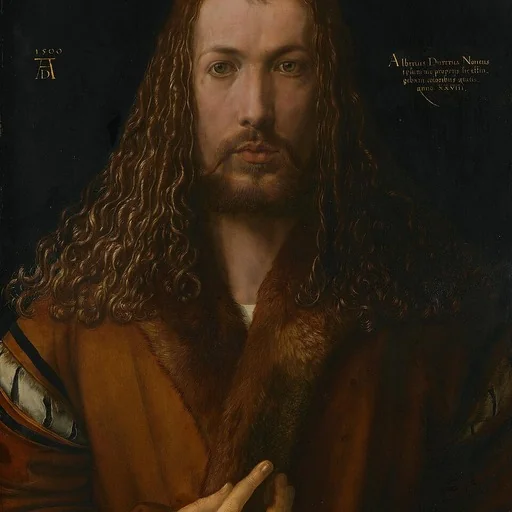
Artist
Albrecht Dürer spent his life in Nuremberg, a busy German city where artists traded prints like currency.

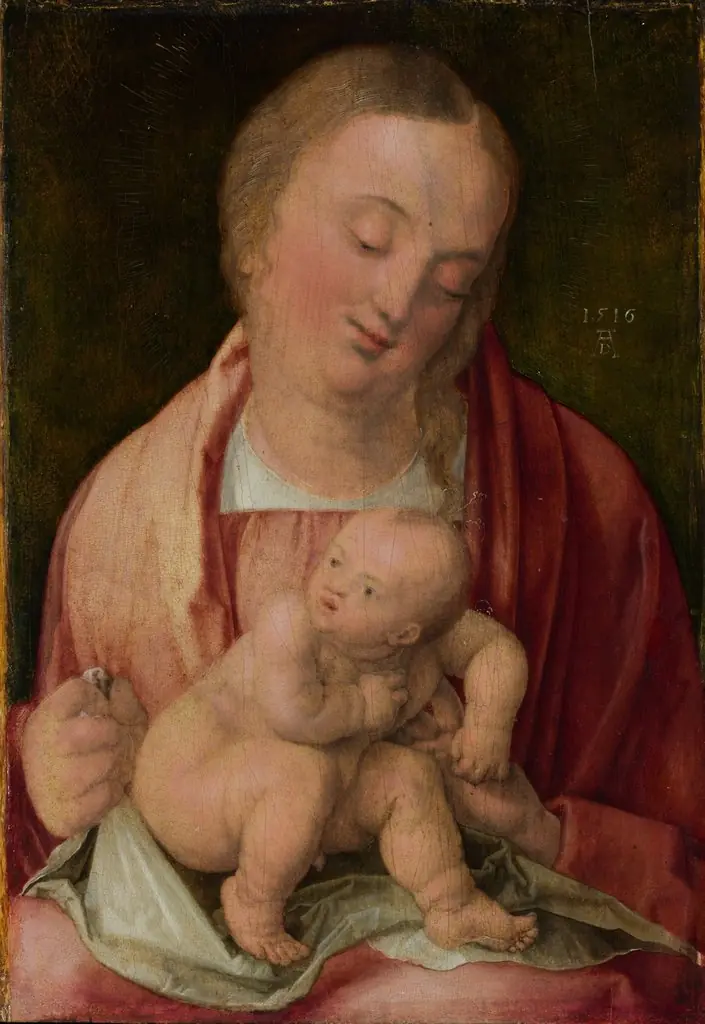
![Madonna and Child [obverse], by Albrecht Dürer](https://artifactworldgallery.com/img/albrecht-durer--madonna-and-child-obverse--d7b8ebf05d22ebe5-w320.webp)
![Lot and His Daughters [reverse], by Albrecht Dürer](https://artifactworldgallery.com/img/albrecht-durer--lot-and-his-daughters-reverse--b4ebf9b282faa17a-w320.webp)
![Crested Coat of Arms [reverse], by Antwerp 16th Century](https://artifactworldgallery.com/img/antwerp-16th-century--crested-coat-of-arms-reverse--635f462b0f763a94-w320.webp)