Artwork
The Ravisher
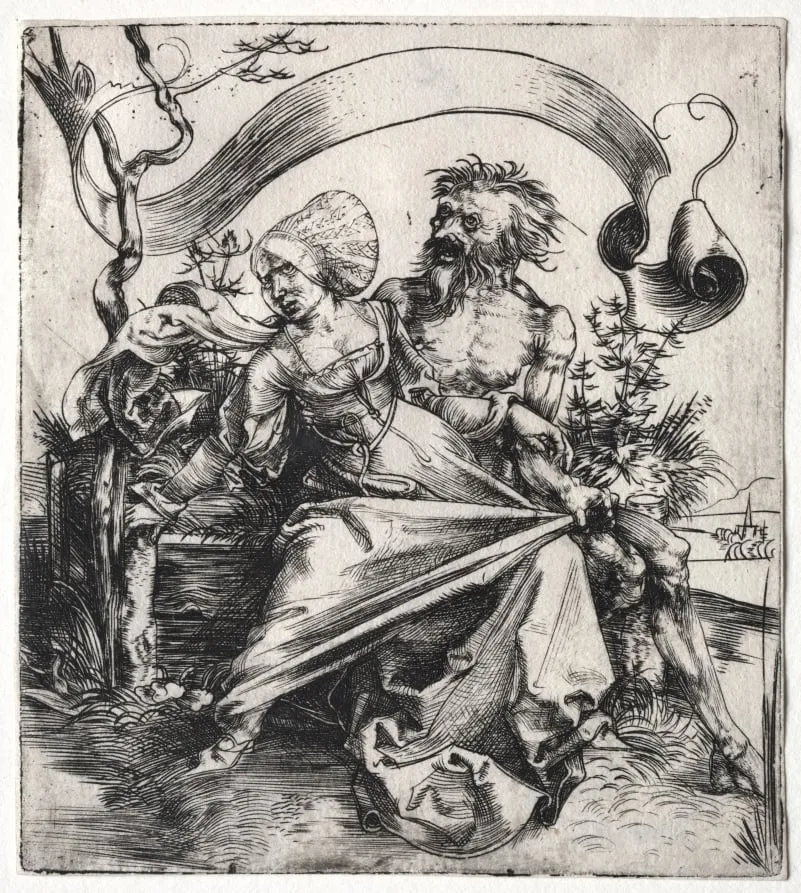
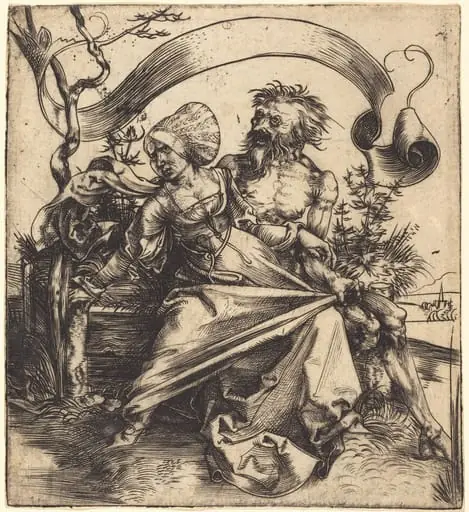
The Ravisher is a print by the Renaissance artist Albrecht Dürer. It dates from 1495 and is held in the collection of the Cleveland Museum of Art.
About this work
The empty scroll above them might have had a message, but Dürer left it blank—the picture says enough.
You see a woman in a long dress fighting off a bony, wild-eyed man who looks like a corpse. He grips her arm while she twists away, her face twisted in fear.
This is Death grabbing someone who thought he was her lover. Artists in Dürer’s time often showed Death this way to warn people about sin and how short life is. The empty scroll above them might have had a message, but Dürer left it blank—the picture says enough.
Look up other works from germany, late 15th century to see more scenes like this.
Overview
This woodcut by Albrecht Dürer depicts a tense, intimate confrontation between a woman and a skeletal figure representing Death. The woman, dressed in a long garment, recoils in terror as Death clutches her arm with unyielding force. Her expression suggests a moment of horrifying realization—that the figure she mistook for a lover is, in fact, the harbinger of her end. The scene is devoid of narrative text, relying entirely on visual tension to convey its message.
Subject & Meaning
The image draws on a medieval moral tradition in which Death appears as a menacing, corpse-like figure to remind viewers of mortality and divine judgment. The woman’s mistaken identification of Death as a suitor implies moral transgression—perhaps vanity, lust, or worldly distraction. Her futile struggle underscores the inevitability of death’s claim, reinforcing the idea that earthly desires lead to spiritual reckoning.
Technique & Style
Dürer employs fine, incised lines to render both the woman’s flowing dress and Death’s gaunt, textured form with striking contrast. The dense cross-hatching in the background deepens the sense of claustrophobia, while the figures’ exaggerated poses heighten emotional intensity. The absence of landscape or setting focuses attention entirely on the psychological drama, characteristic of Dürer’s early printmaking style.
History & Provenance
Created around 1495, this print belongs to Dürer’s early period of independent graphic work, produced before his first trip to Italy. It circulated widely among northern European audiences, likely as a devotional or cautionary image. No known contemporary inscriptions accompany the print, and the blank scroll above the figures remains unexplained—suggesting Dürer intended the imagery to speak for itself.
Context
In late 15th-century Germany, depictions of Death as a skeletal seducer or grim reaper were common in religious art, particularly in the context of the memento mori tradition. Such images served as visual sermons, urging repentance amid widespread fears of plague, sin, and divine retribution. Dürer’s work aligns with this cultural moment, reflecting the anxieties of a society deeply engaged with themes of mortality and moral accountability.
Legacy
The print influenced later northern European artists who adopted similar motifs of Death as an intimate, terrifying intruder. Its psychological immediacy and technical precision set a standard for narrative woodcuts. Though not widely reproduced in later centuries, it remains a key example of how early printmaking could convey complex moral themes with minimal means, shaping the visual language of death in Renaissance art.
Artist & collection
Artist
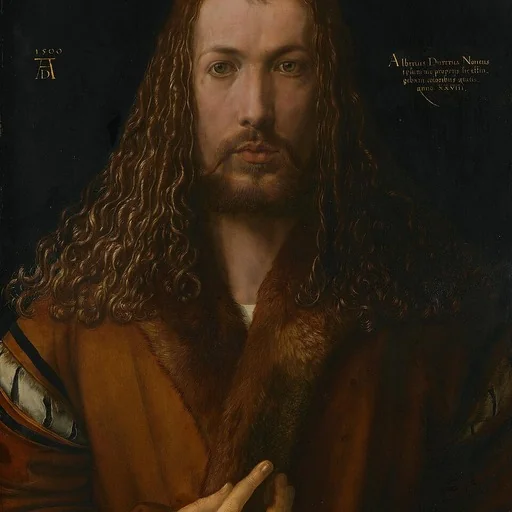
Albrecht Dürer spent his life in Nuremberg, a busy German city where artists traded prints like currency.

![Madonna and Child [obverse], by Albrecht Dürer](https://artifactworldgallery.com/img/albrecht-durer--madonna-and-child-obverse--d7b8ebf05d22ebe5-w320.webp)
![Lot and His Daughters [reverse], by Albrecht Dürer](https://artifactworldgallery.com/img/albrecht-durer--lot-and-his-daughters-reverse--b4ebf9b282faa17a-w320.webp)