Artwork
Wet Little Italy
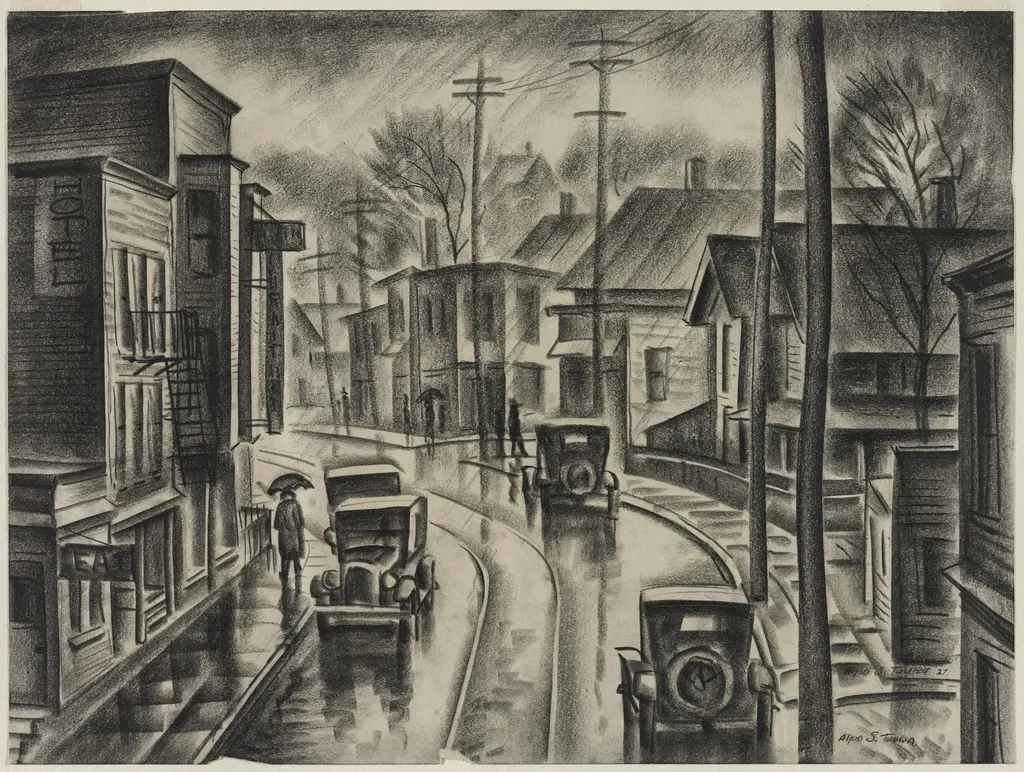
Wet Little Italy is a drawing by Alpo S. Tuura. It dates from 1927 and is held in the collection of the Cleveland Museum of Art.
About this work
Overview
Wet Little Italy, drawn by Alpo S. Tuura in 1927, is a graphite work capturing a narrow urban alley in a rain-soaked neighborhood. Executed with precise linework and dense shading, the drawing conveys a sense of enclosure and dampness. It resides in the collection of The Cleveland Museum of Art, where it is recognized for its atmospheric intensity and quiet urban observation.
Subject & Meaning
The scene depicts a modest, densely packed street lined with aging buildings, their forms leaning inward to compress the space. Figures under umbrellas and two parked automobiles suggest daily life continuing despite the weather. The scale of human and mechanical elements is deliberately minimized, emphasizing the overwhelming presence of architecture and weather over individual activity.
Technique & Style
Tuura employed sharp, controlled lines and deep chiaroscuro to model the wet surfaces and heavy structures. The contrast between darkened building facades and the muted gray of rain-slicked pavement creates a tactile sense of moisture and weight. Minimal detail in figures and vehicles enhances the mood of isolation, while the absence of bright light reinforces the overcast, oppressive atmosphere.
History & Provenance
Created in 1927, the drawing entered The Cleveland Museum of Art’s collection shortly after its completion. Tuura, a Finnish-American artist active in the early 20th century, produced a modest body of work focused on urban environments. This piece remains one of the few documented drawings from his period of American residency, offering insight into his observational approach.
Context
In the late 1920s, American artists increasingly turned to everyday urban scenes as subjects, moving away from idealized imagery. Wet Little Italy reflects this trend, capturing the quiet realism of immigrant neighborhoods in industrial cities. The drawing’s mood aligns with broader regionalist and social realist currents, though it avoids overt political commentary.
Legacy
Though not widely exhibited, Wet Little Italy endures as a refined example of early 20th-century American draftsmanship. Its restrained palette and emotional gravity distinguish it from more dramatic depictions of city life. The work contributes to a quieter, more introspective strand of urban art that values atmosphere over narrative.
Own this work as a print
Artist & collection