Artwork
Edö
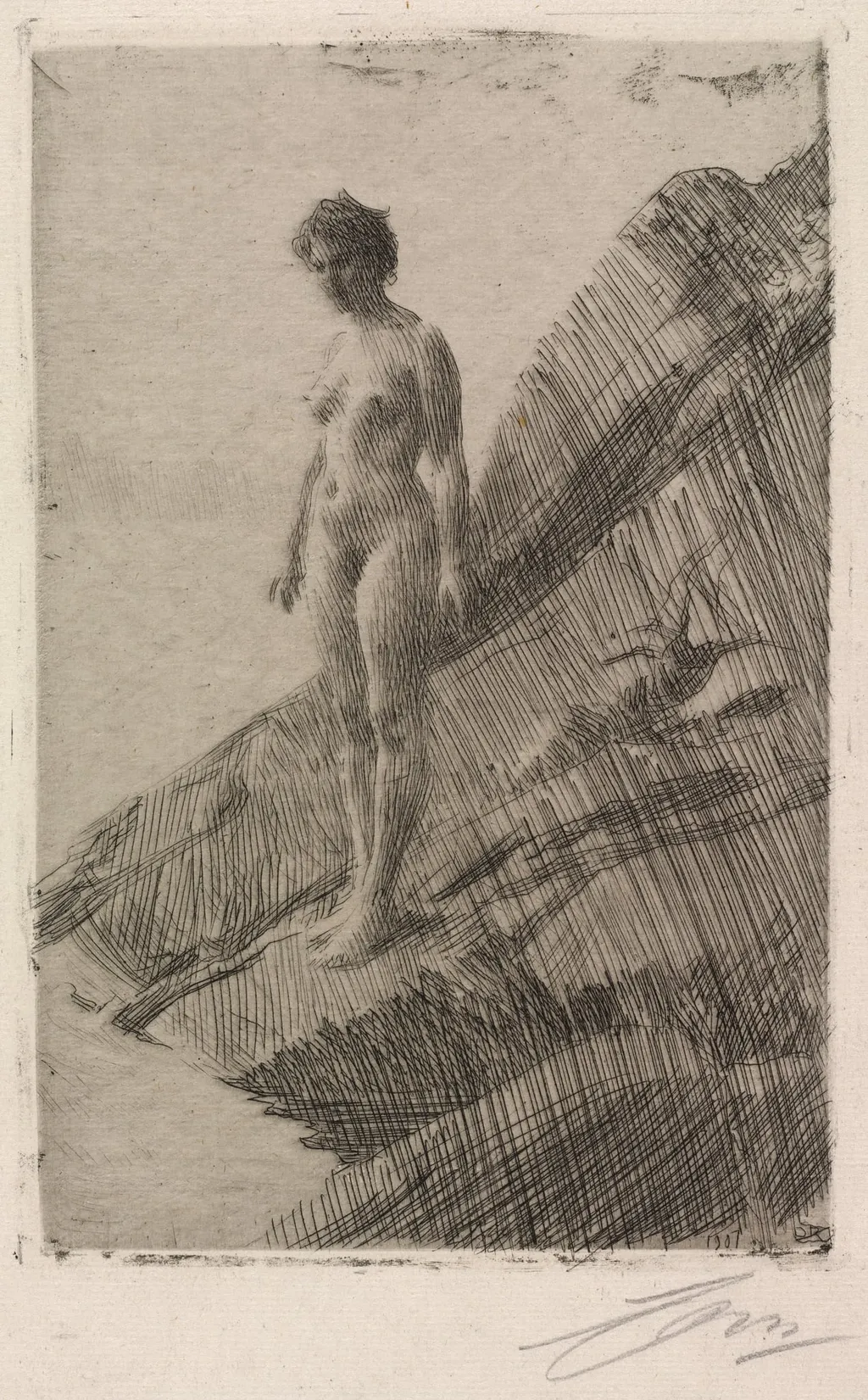
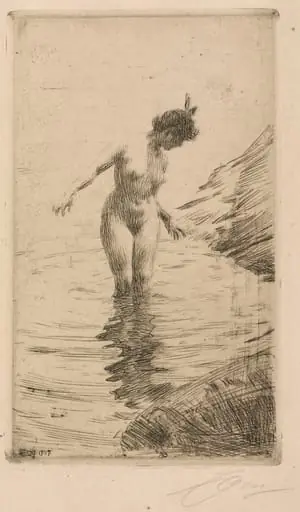
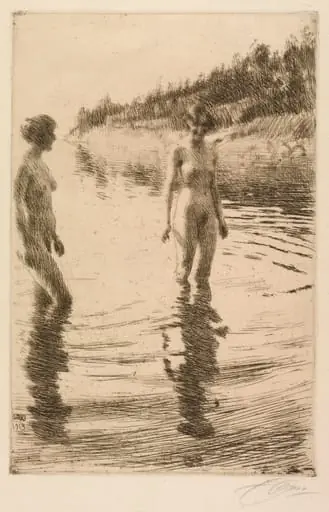
Edö is a print by Anders Zorn. It dates from 1907 and is held in the collection of the Cleveland Museum of Art.
About this work
Overview
Executed with minimal lines, the work captures a solitary figure walking away from the viewer, rendered in a spontaneous, almost improvisational manner.
Edö is a 1907 drypoint print by Swedish artist Anders Zorn, currently in the collection of The Cleveland Museum of Art. Executed with minimal lines, the work captures a solitary figure walking away from the viewer, rendered in a spontaneous, almost improvisational manner. The print reflects Zorn’s interest in capturing fleeting moments through direct, unpolished mark-making, emphasizing movement over detail.
Subject & Meaning
The figure, seen from behind, is anonymous and unadorned, suggesting a universal presence rather than a specific individual. Their bare back and relaxed posture convey a sense of quiet solitude, while the lack of facial features invites contemplation rather than narrative. The absence of context or setting shifts focus to the act of walking itself, evoking themes of transience and introspection.
Technique & Style
Zorn employed drypoint etching, using a sharp needle to scratch directly into a metal plate, creating rich, velvety lines. The figure is defined by clean, flowing contours, while the background erupts in dense, overlapping strokes that suggest foliage or terrain without defining it. This contrast between controlled form and chaotic texture exemplifies Zorn’s ability to balance precision with expressive abandon.
History & Provenance
Created in 1907, Edö was produced during Zorn’s mature period, when he increasingly turned to intimate, experimental prints. The work entered The Cleveland Museum of Art’s collection through established acquisition channels, likely as part of a broader interest in European graphic arts. Its preservation reflects early 20th-century institutional recognition of printmaking as a serious artistic medium.
Context
In the early 1900s, Zorn was part of a generation of artists redefining printmaking beyond reproduction, treating it as a medium for personal expression. Edö aligns with broader European trends favoring immediacy and emotional resonance over academic finish. Its sketch-like quality resonates with contemporaneous developments in French and Scandinavian art, where spontaneity was valued as a form of truth.
Legacy
Edö exemplifies Zorn’s influence on modern printmaking through its emphasis on gesture and economy of line. While not widely reproduced, it remains a key example of how drypoint could convey psychological depth without detail. The work continues to inform discussions on the relationship between sketch and finished art, particularly in studies of Nordic modernism.
Own this work as a print
Artist & collection

Artist
Anders Leonard Zorn was born in February 1860 in Mora, Dalarna, the illegitimate son of a Bavarian brewer and a Swedish farmer's daughter; his mother died shortly after his birth, and his grandparents raised him.

![Nude [recto], by Childe Hassam](https://artifactworldgallery.com/img/childe-hassam--nude-recto--569fc48bc9ef425f-w320.webp)