Artwork
Eve
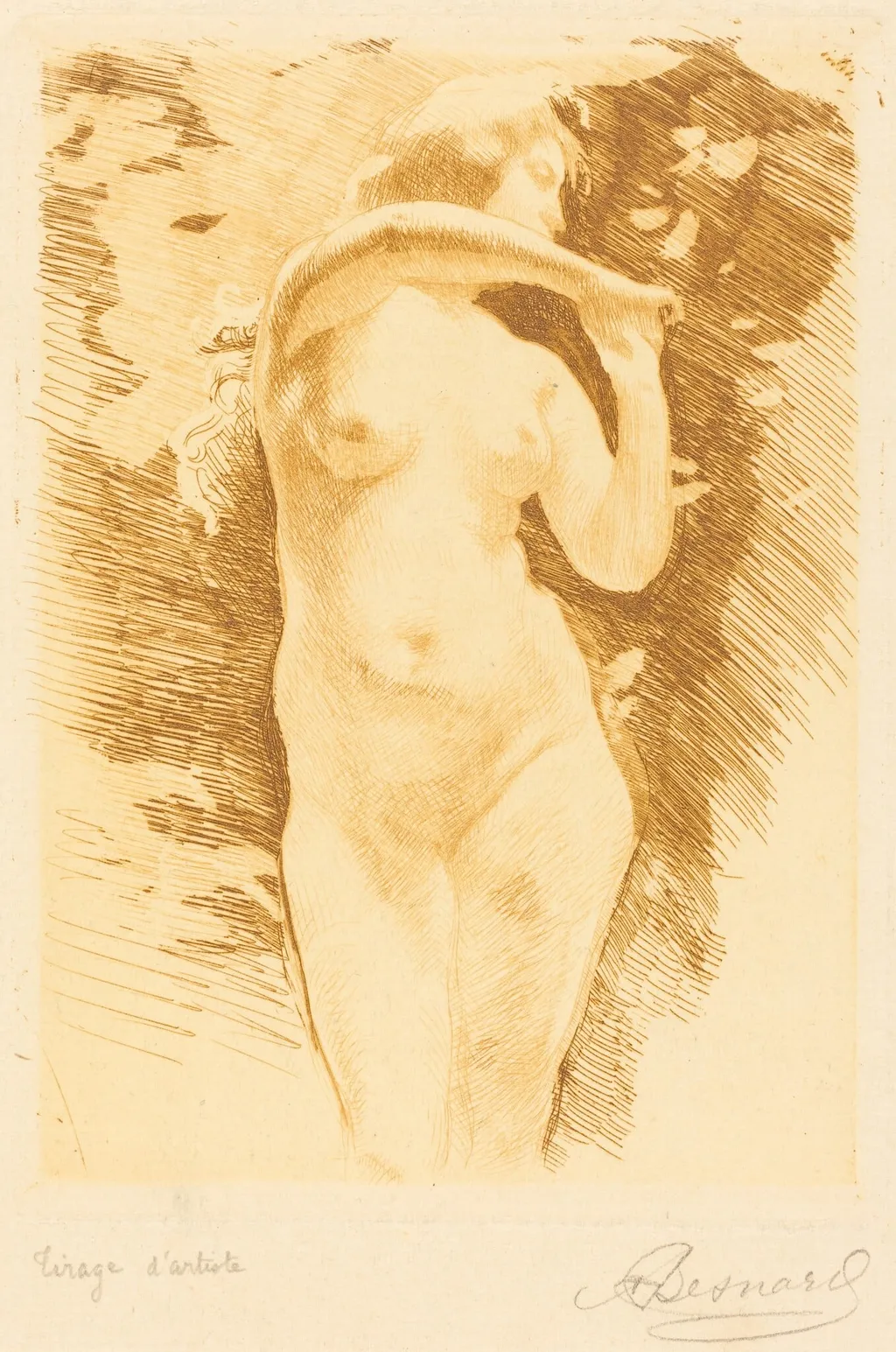
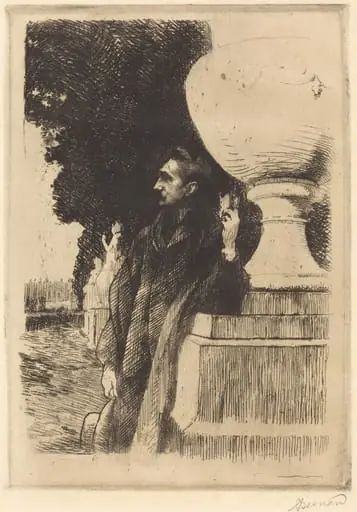
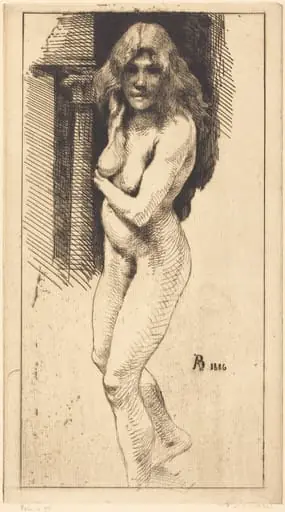
Eve is an ink print by the Impressionist artist Paul-Albert Besnard. It dates from 1896 and is held in the collection of the National Gallery of Art.
About this work
Overview
Albert Besnard’s 1896 print titled “Eve” is an etching executed on laid paper with a yellow‑brown ink. The work presents a solitary nude figure seen from behind, her hair loosely gathered and arms resting at her sides. The background consists of undulating, unmodelled lines that function as a tonal texture rather than a detailed setting.
Subject & Meaning
The composition focuses on the back of a woman, evoking the biblical Eve in a moment of quiet contemplation. By omitting facial features and surrounding narrative elements, Besnard emphasizes the universal qualities of the human form and invites reflection on themes of innocence, vulnerability, and the transition from concealment to exposure.
Technique & Style
Created through traditional intaglio etching, the artist applied a warm yellow‑brown ink to a copper plate, then transferred the image onto a sheet of laid paper with a pronounced texture. The loose, sketch‑like quality of the lines, especially in the background, suggests a rapid, gestural approach, while the careful rendering of the figure’s contours demonstrates Besnard’s control of line and tone.
History & Provenance
The print bears Besnard’s signature and is marked as an artist’s proof, indicating it was part of a limited trial run rather than a commercial edition. As an early work in Besnard’s career, it reflects his experimentation with printmaking techniques before he turned more fully to painting and illustration in the subsequent decades.
Artist & collection
Artist
Paul-Albert Besnard (1849–1934) was a French artist, born in 7th arrondissement of Paris.