Artwork
Mosaique: The Imperial Court of Napoleon III
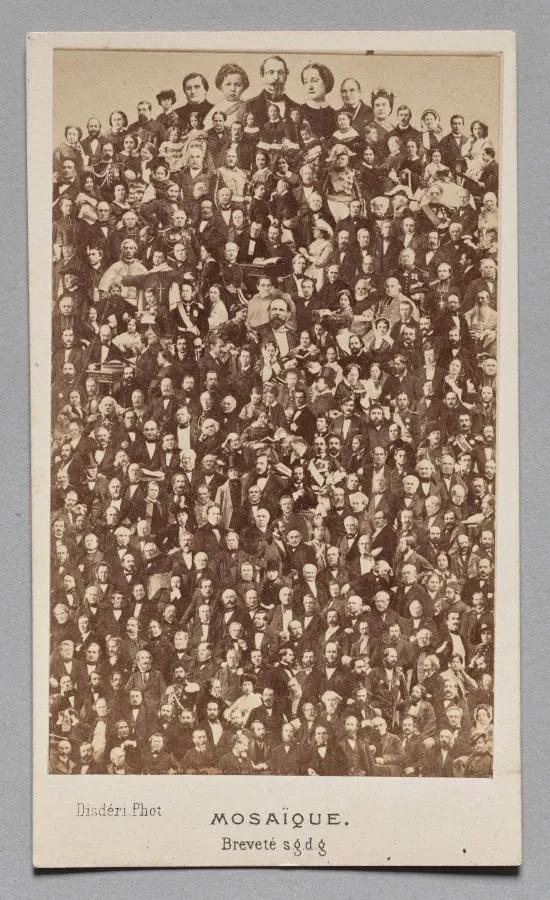
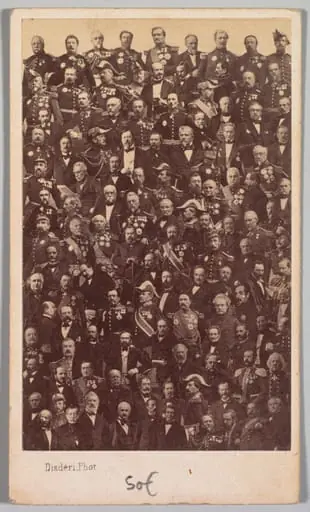
Mosaique: The Imperial Court of Napoleon III is a photography by the Impressionist artist André Adolphe-Eugène Disdéri. It dates from 1866 and is held in the collection of the Cleveland Museum of Art. This photograph presents a composite portrait of the imperial court of Napoleon III, assembled from hundreds of individual likenesses.
About this work
Overview
The resulting card, measuring 6 by 9 centimeters, functions as a visual directory of prominent figures associated with the Second French Empire.
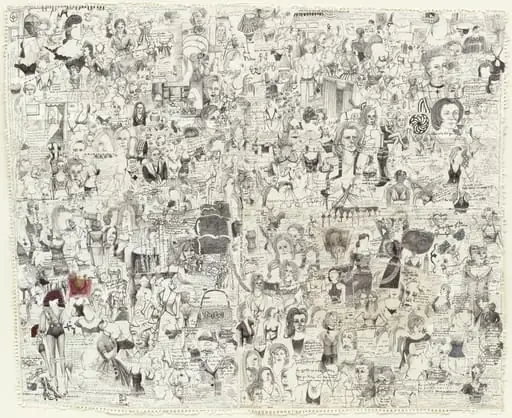
This photograph presents a composite portrait of the imperial court of Napoleon III, assembled from hundreds of individual likenesses. Originally captured separately, each figure was excised from its background, arranged hierarchically on a single surface, and rephotographed to create a unified image. The resulting card, measuring 6 by 9 centimeters, functions as a visual directory of prominent figures associated with the Second French Empire.
Subject & Meaning
The composition organizes its subjects in a pyramidal structure, with Napoleon III, Empress Eugénie, and their son positioned at the apex. Below them appear statesmen, military leaders, artists, writers, and other court affiliates, each reduced to a miniature portrait. The arrangement reflects both social hierarchy and the collective identity of the imperial elite, offering viewers a condensed representation of power and cultural influence.
Technique & Style
The image was constructed through a labor-intensive process of photographic collage. Individual portraits, originally taken by André-Adolphe-Eugène Disdéri, were cut from their original prints and affixed to a backing sheet. This composite was then photographed anew, producing a seamless yet densely populated scene. The method anticipates later practices of photomontage, though here the emphasis remains on clarity and legibility rather than abstraction.
History & Provenance
Disdéri’s studio produced these mosaic cards as commercial collectibles, capitalizing on public fascination with celebrity and imperial authority. The format allowed purchasers to possess a compact visual record of an entire social milieu. While the original collage sheets no longer survive, surviving examples of the printed cards attest to their popularity as ephemera in mid-19th-century France.
Context
The image emerged during a period when photography was expanding beyond individual portraiture into new forms of mass communication. Disdéri’s carte-de-visite portraits had already established a market for affordable, reproducible likenesses. This mosaic format extended that concept, transforming discrete images into a collective portrait that mirrored the era’s interest in classification, whether of species, social types, or institutional hierarchies.
Legacy
Though conceived as a commercial novelty, the work exemplifies early experiments in photographic assemblage. Its layered production process foreshadows techniques later adopted by avant-garde artists and propagandists alike. The mosaic card also reflects the 19th century’s preoccupation with visual taxonomy, a concern that would persist in both artistic and scientific imaging practices.
Artist & collection