Artwork
Untitled (French Military Heroes and Political Leaders)
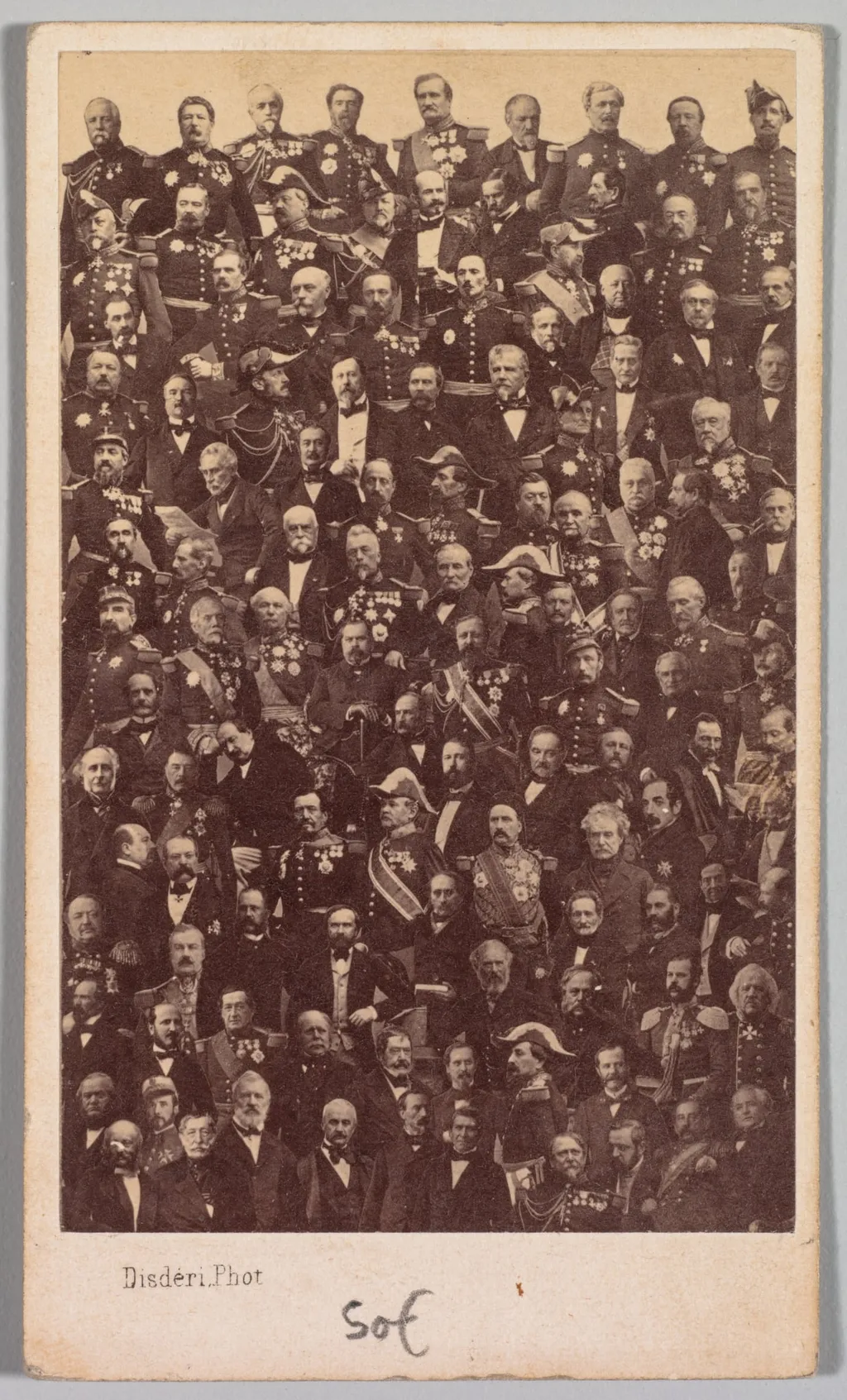
Untitled (French Military Heroes and Political Leaders) is a photography by the Impressionist artist André Adolphe-Eugène Disdéri. It dates from 1864 and is held in the collection of the Cleveland Museum of Art.
About this work
Check out this artist next: André Adolphe-Eugène Disdéri (French, 1819–1889).
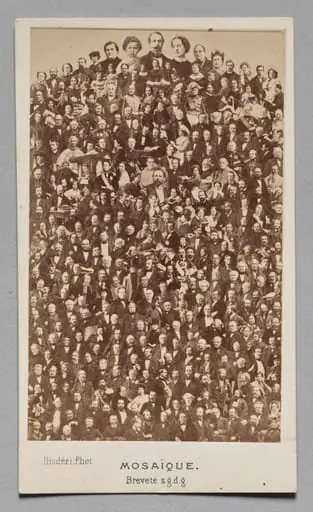
This is a grid of small photos pasted together. Each shows a man in uniform or fancy clothes. They’re arranged in neat rows on a single sheet.
Disdéri invented a trick here. He cut photos of leaders, pasted them, then re-photographed the collage. It looks like one big picture. These cards sold fast. People liked flipping through France’s top brass like trading cards.
Check out this artist next: André Adolphe-Eugène Disdéri (French, 1819–1889).
Overview
This photograph is a composite image created by André Adolphe-Eugène Disdéri, presenting a grid of individual portraits of French military and political figures. The composition was assembled by cutting out previously taken portraits and arranging them into a unified layout, then re-photographing the entire collage to produce a single printed card. The format, known as a carte de visite montage, was a commercial innovation that capitalized on public fascination with portraiture and national identity.
Subject & Meaning
The image gathers prominent French leaders—military officers and state figures—into a single visual field, suggesting unity and authority. By presenting them as a collective, the work reinforces institutional prestige and national pride during a period of political consolidation. The selection of subjects reflects the era’s emphasis on hierarchy and service, transforming individual recognition into a curated symbol of state power.
Technique & Style
Disdéri employed a multi-step photographic process: individual portraits were cut from their original mounts, arranged into a precise grid on a backing board, and then captured as a single image through the camera. This technique allowed for mass reproduction of a complex composition, blending the precision of studio portraiture with the novelty of collage. The result mimicked a unified scene while preserving the distinct identity of each subject.
History & Provenance
Produced in the 1860s, this type of photographic montage emerged alongside the popularity of carte de visite cards in France. Disdéri, who patented the standard size for these cards, leveraged the format’s affordability and collectibility. Such composites were widely distributed as souvenirs and status objects, reflecting both technological advancement and the public’s appetite for visual documentation of public figures.
Context
In mid-19th century France, photography was becoming accessible to the middle class, and portraiture served as both personal memento and civic ritual. The proliferation of cartes de visite coincided with the Second Empire’s emphasis on spectacle and national image. Disdéri’s montages tapped into this cultural moment, offering a tangible way for citizens to engage with the state’s leadership through domestic collections.
Legacy
Disdéri’s composite technique influenced later photographic practices in journalism, propaganda, and popular media by demonstrating how multiple images could be synthesized into a single authoritative composition. While the format faded with changing tastes, it established a precedent for the visual aggregation of identity and power—a method echoed in modern digital collages and media montages.
Artist & collection