Artwork
Five Figure Studies (verso)
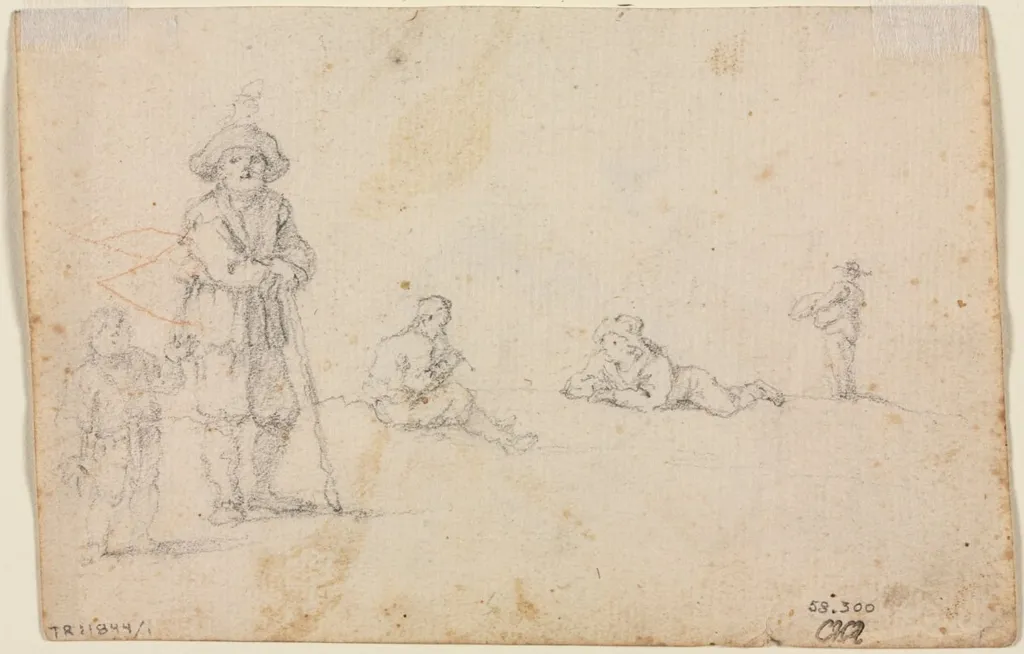
Five Figure Studies (verso) is a drawing by the Baroque artist Unknown. It dates from 1604 and is held in the collection of the Cleveland Museum of Art.
About this work
Overview
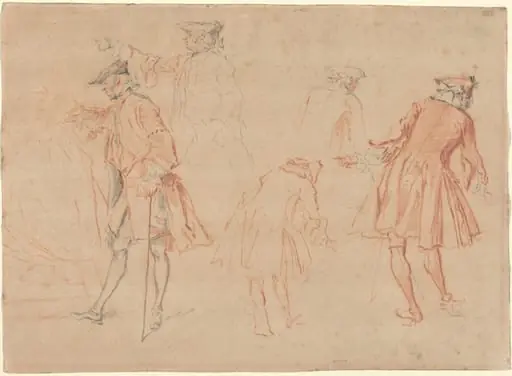
The five figures are rendered in loose, rapid lines, suggesting an artist practicing gesture and posture rather than creating a polished composition.
This drawing, titled Five Figure Studies (verso), is an unsigned sketch on the reverse side of a reused sheet, likely from the 1600s. The five figures are rendered in loose, rapid lines, suggesting an artist practicing gesture and posture rather than creating a polished composition. Its function appears pedagogical—possibly used in a studio setting to study human form. The absence of a signature and the utilitarian reuse of the support indicate it was never intended as a finished work.
Subject & Meaning
The five figures depict male forms in varied, naturalistic poses: arms bent, heads tilted, bodies slightly twisted. Their simplicity suggests an emphasis on movement and anatomical observation rather than narrative or symbolism. These are not idealized figures but studies of real, unposed bodies, reflecting a focus on the physicality of human motion. The lack of context or environment reinforces their role as exercises in seeing and recording form.
Technique & Style
The lines are fluid and unrefined, with minimal shading and no fine detailing. The artist used a dry medium, likely chalk or charcoal, applied with quick, confident strokes. The absence of sfumato or blended tones indicates a preference for structural clarity over atmospheric effect. The sketchiness reveals an emphasis on capturing gesture over finish, characteristic of preparatory work in early modern drawing academies.
History & Provenance
The sheet was originally used as a support for another work, later repurposed for these figure studies. Its origins are undocumented, but the style and material align with Dutch or French studio practices of the 17th century. No collector or artist signature survives, and its path from creation to museum collection remains unclear. Its survival is likely due to its value as a teaching tool rather than its artistic merit at the time.
Context
In 17th-century art training, figure studies were essential for apprentices learning anatomy and composition. Artists often reused parchment or paper to conserve materials, making such sketches common yet rarely preserved. These studies reflect a pedagogical tradition where observation of the live model preceded formal composition. Similar sheets survive in collections across Europe, testifying to the widespread practice of drawing as foundational training.
Legacy
Though anonymous and unfinished, this drawing offers insight into the daily practice of early modern artists. It reveals how foundational skills were cultivated through repetition and direct observation. Today, it serves as a quiet testament to the unseen labor behind canonical works—reminding viewers that even the most polished art often begins with such unassuming, transient attempts.
Artist & collection

 Domestic Scene
 Giacomo and Cardinal Marco, investing Andrea, Abbot of San Zeno, with his Benefice
 The Nymph of Fontainebleau
 Portrait of a Woman
 Madonna and Child with Saints in the Enclosed Garden
 Venus and Minerva
 Family Group of Four on Sofa
 Wall painting from Room H of the Villa of P. Fannius Synistor at Boscoreale
 A Judge and Two Gentlemen Lawyers
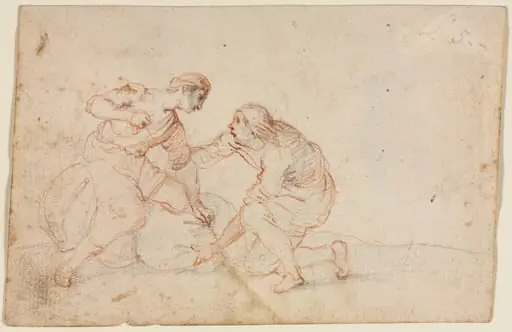
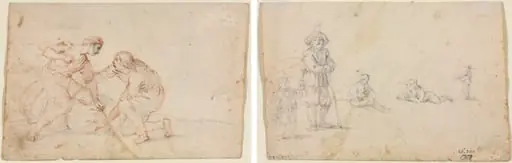 Two Men Tying a Bundle (recto) Five Figure Studies (verso)
 Detail of Martyrdom of Saint John the Evangelist, after Callot
 Sketches of a Gentleman
![Seated Guitarist [recto], by Jean Antoine Watteau](https://artifactworldgallery.com/img/jean-antoine-watteau--seated-guitarist-recto--1923603ffd027bd7-w320.webp) Seated Guitarist [recto]
Seated Guitarist [recto] Two drawings of Chinese men
 Two Studies of a Man
 Mercury and Argus (Ovid, Metamorphoses i.668–721)
 An Old Man with a Cape and a Rustic with a Backpack
 Ladies and Gentlemen in a Country Park
 Study for "The Rustic Dancers"
 Two Men Tying a Bundle (recto)