Artwork
Still Life with a Monkey and a Guitar (Art and Gluttony)
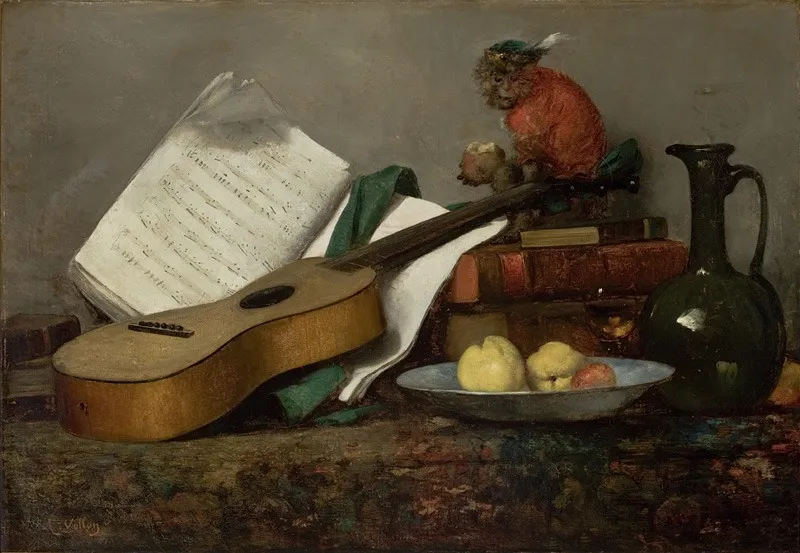
Still Life with a Monkey and a Guitar (Art and Gluttony) is an oil painting by the Realist artist Antoine Vollon. It dates from 1864 and is held in the collection of the São Paulo Museum of Art.
About this work
Overview
Antoine Vollon, a French artist known for his meticulous attention to ordinary objects, painted this still life in 1864.
Antoine Vollon, a French artist known for his meticulous attention to ordinary objects, painted this still life in 1864. Though he gained recognition among peers for his technical precision, his work rarely attracted public acclaim. This piece stands as a quiet example of his focus on domestic scenes, blending inanimate items with a living creature to suggest deeper narrative layers beyond mere representation.
Subject & Meaning
A monkey, dressed in a miniature red jacket and green hat, sits atop a pile of books beside a guitar, sheet music, fruit, and a jug. The animal’s attire and placement imply a satirical parallel between human behavior and animal mimicry. The guitar and music suggest artistic aspiration, while the fruit and jug hint at indulgence. Together, they form a subtle commentary on the folly of equating art with excess.
Technique & Style
Vollon employed thick, textured brushwork to render surfaces with tangible weight—the roughness of wood, the sheen of fruit skin, the nap of the monkey’s fabric. Colors remain subdued, anchored by earth tones and muted greens, allowing the monkey’s bright clothing to draw attention without overwhelming the composition. The arrangement appears casual, yet each element is carefully placed to guide the eye through a silent, introspective scene.
History & Provenance
Painted in 1864, the work entered the collection of the São Paulo Museum of Art in the 20th century, following a broader acquisition of European works by the museum’s founder. It was not widely exhibited during Vollon’s lifetime, and its symbolic content remained largely unremarked upon until later scholarly interest in 19th-century French realism brought renewed attention to his lesser-known pieces.
Context
In mid-19th-century France, realism rejected idealized subjects in favor of unembellished depictions of daily life. Vollon’s inclusion of a dressed monkey in a domestic setting aligns with contemporary fascination with anthropomorphism and moral allegory. While other artists focused on labor or urban scenes, Vollon turned to the quiet tensions of private spaces, where objects and animals could stand in for human frailties.
Legacy
Though Vollon’s reputation faded after his death, this painting endures as a quiet example of his ability to infuse still life with psychological nuance. Scholars now recognize it as an early instance of symbolic still life that anticipates later surrealist and satirical approaches. Its presence in São Paulo underscores its role as a transatlantic artifact of French realism, preserved beyond its original cultural context.
Artist & collection
Artist
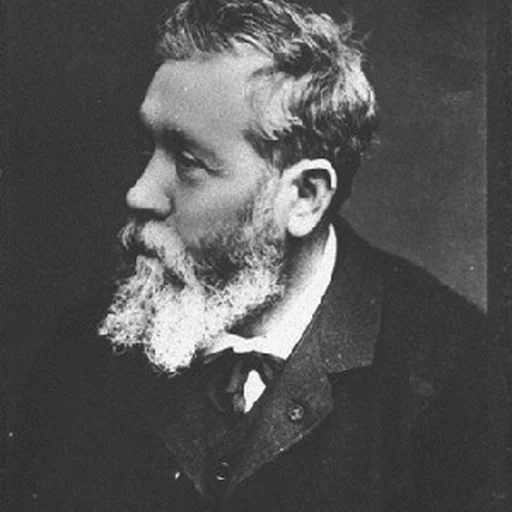
Antoine Vollon (23 April 1833 – 27 August 1900) was a French realist artist, best known as a painter of still lifes, landscapes, and figures.